Kế hoạch học tập của bạn · Tiếp tục · Ôn tập →
擅自 vs 私自 and 随便 (without permission)
Đã giới thiệuVị trí đã lưu của bạn vẫn nằm trong trình duyệt này. Việc tiếp tục sẽ không hoàn thành bài học hay trả lời các câu hỏi của nó.
Do not enter without permission
- A sign on a laboratory door reads: not; must (非…不可)非staff member工作人员please do not请勿without permission擅自enter进入。 — "Staff only: do not enter without permission."
- Goal: read and use without permission擅自 for actions done without permission, and choose between without permission擅自, privately; secretly私自 and as you like; casual随便.
without permission擅自 + verb
- without permission擅自 (shànzì) = "without permission, on one's own authority". It criticises the action: you should have asked first.
- he / him他not have / haven't没有to ask for leave请假,without permission擅自to depart离开(completed / change)了company公司。 — "He didn't ask for leave; he left the office without permission."
please do not请勿without permission擅自enter进入。
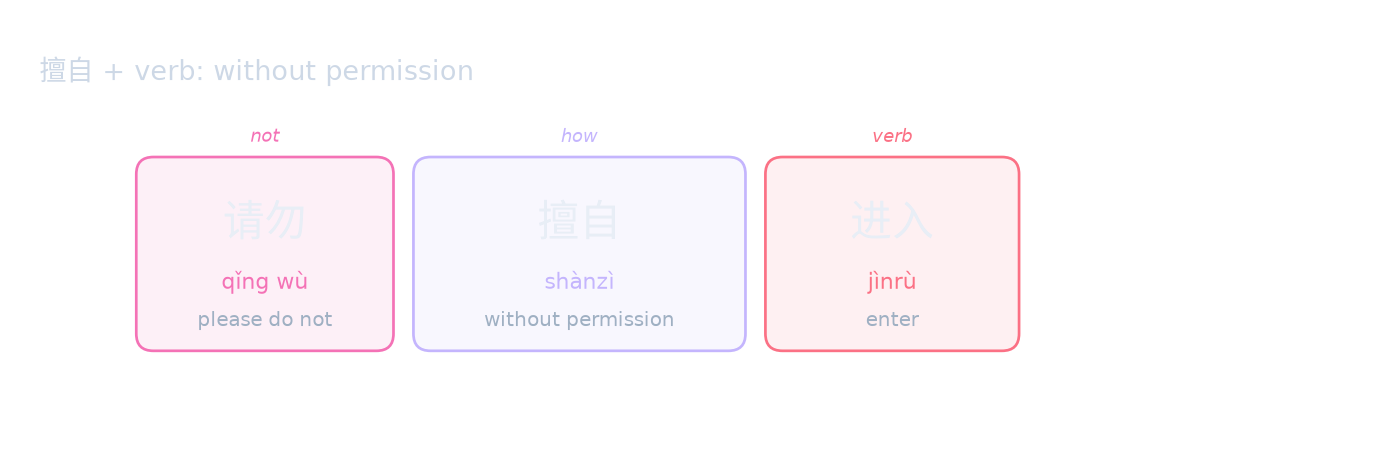
Complete (a sign): “Do not enter without permission.” 请勿____进入。
Độ khó 1/5 · 100 xu + phần thưởng nhỏ khi hoàn thành lần đầu tiên hôm nay
Without permission — 擅自.
Build: “He left the office without permission.”
Độ khó 3/5 · 200 xu + phần thưởng nhỏ khi hoàn thành lần đầu tiên hôm nay
擅自 + verb.
On signs and in rules
- without permission擅自 is common in notices and rules: must not不得without permission擅自change改变plans计划。 — "Plans must not be changed without permission." to prohibit禁止without permission擅自to pull up (stop one's…停车。 — "No unauthorised parking."
- please do not请勿 / must not不得 / to prohibit禁止 + without permission擅自 + verb is a typical pattern.
must not不得without permission擅自change改变plans计划。
Which is a typical rule?
Độ khó 1/5 · 100 xu + phần thưởng nhỏ khi hoàn thành lần đầu tiên hôm nay
擅自 + an action that needs permission.
without permission擅自 is about permission
- Use without permission擅自 when someone should have asked. For a relaxed "as you like", use as you like; casual随便: ✓ as you like; casual随便to sit / to take (a bus …)坐(suggestion)吧! — "Sit wherever you like!" ✗ without permission擅自to sit / to take (a bus …)坐(suggestion)吧.
- privately; secretly私自 = privately, behind others' backs: privately; secretly私自to take away拿走(completed / change)了company公司(modifier / structural particle)的information; materials资料 — "took company documents without telling anyone".
A host says to guests: “Sit wherever you like!” Which is right?
Độ khó 1/5 · 100 xu + phần thưởng nhỏ khi hoàn thành lần đầu tiên hôm nay
Friendly "as you like" — 随便.
without permission擅自, privately; secretly私自 and as you like; casual随便
- without permission擅自 = without the permission you needed (rules, work). privately; secretly私自 = secretly, for yourself, behind others' backs.
- as you like; casual随便 = as you like (friendly), or carelessly.
私自 suggests doing something secretly, behind others' backs.
Độ khó 1/5 · 100 xu + phần thưởng nhỏ khi hoàn thành lần đầu tiên hôm nay
私自拿走了资料.
Recap
- without permission擅自 + verb = without permission (criticism, rules): please do not请勿without permission擅自enter进入.
- Secretly, for yourself: privately; secretly私自. As you like: as you like; casual随便.
Read the full reference: HSK 6 grammar — Adverbs.
Write three rules for your school library or lab, using 请勿 / 不得 / 禁止 with 擅自.
Your answer need not copy the model.