Kế hoạch học tập của bạn · Tiếp tục · Ôn tập →
明明 (clearly …, yet …)
Đã giới thiệuVị trí đã lưu của bạn vẫn nằm trong trình duyệt này. Việc tiếp tục sẽ không hoàn thành bài học hay trả lời các câu hỏi của nó.
You clearly knew!
- Your friend knew about the change of exam room but didn't tell you.
- you你clearly明明knew知道,why为什么not不tell告诉me我? — "You clearly knew — why didn't you tell me?"
- Goal: point out an obvious fact that someone acts against with clearly明明, often with a complaint or surprise.
clearly明明 + obvious fact,(but; yet却 / still / also / even还) + the opposite
- clearly明明 (míngmíng) = "clearly, obviously". It states a fact that is plain to see; the next part shows someone acting as if it weren't true.
- he / him他clearly明明won't / can't不会,still / also / even还to speak说oneself自己can / will会。 — "He obviously can't do it, but he still says he can."
you你clearly明明knew知道,why为什么not不tell告诉me我?
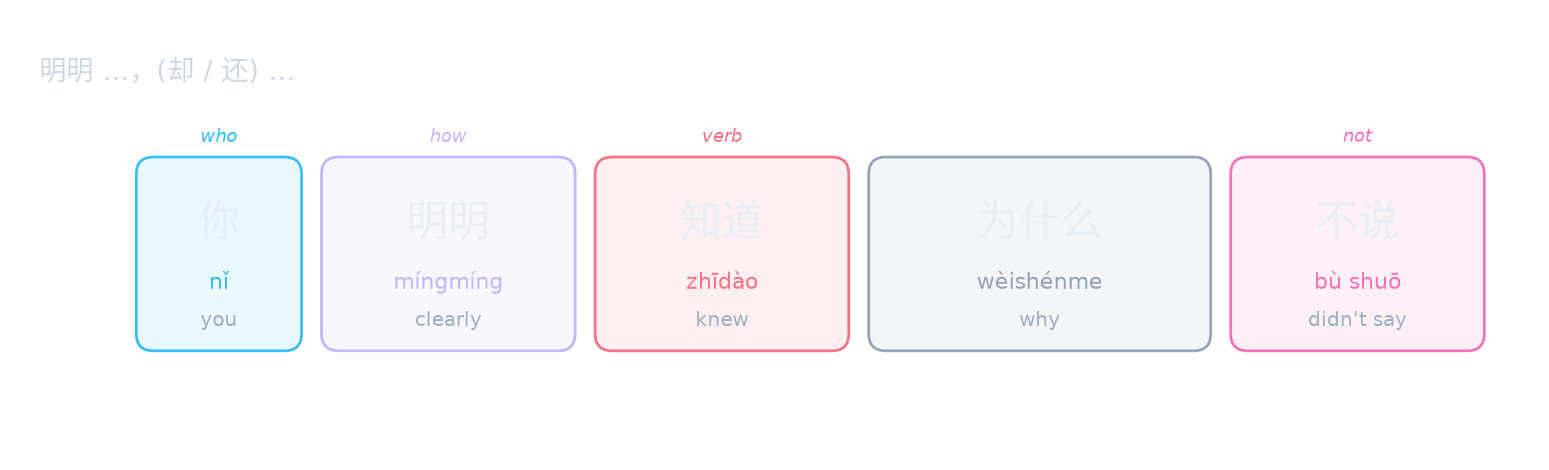
Complete: “You clearly knew — why didn't you tell me?” 你____知道,为什么不告诉我?
Độ khó 1/5 · 100 xu + phần thưởng nhỏ khi hoàn thành lần đầu tiên hôm nay
A plain fact, then a complaint — 明明.
Build: “He obviously can't do it, but he still says he can.”
Độ khó 3/5 · 200 xu + phần thưởng nhỏ khi hoàn thành lần đầu tiên hôm nay
明明 + fact, 还 + the opposite.
Surprise at your own mistake
- clearly明明 also shows surprise when something doesn't match what you remember: me我clearly明明(object)把keys钥匙put on放在the table桌上(completed / change)了,how come怎么not see / missing不见(completed / change)了? — "I definitely put the keys on the table — how come they're gone?"
- The tone is usually complaining, puzzled or annoyed.
I我definitely明明(object)把keys钥匙put on放在the table桌上了,how come怎么gone不见了?
我明明把钥匙放在桌上了,怎么不见了?How does the speaker feel?
Độ khó 1/5 · 100 xu + phần thưởng nhỏ khi hoàn thành lần đầu tiên hôm nay
明明 + 怎么 shows surprise that things don't match.
clearly明明 needs a contrast
- clearly明明 is used when what follows goes against the fact. Without that contrast it sounds odd: for a plain "obviously", say obviously显然 or degree / adjective linker很obvious明显: degree / adjective linker很obvious明显,he / him他degree / adjective linker很tired累。 — "Obviously, he's tired."
- clearly明明 usually goes after the subject. It can also come first for emphasis: clearly明明to be / is是you你to speak说(modifier / structural particle)的,how come怎么not不to admit承认? — "You clearly said it — why won't you admit it?"
A neutral report says the plan obviously failed. Which fits best?
Độ khó 1/5 · 100 xu + phần thưởng nhỏ khi hoàn thành lần đầu tiên hôm nay
A neutral conclusion — 显然. 明明 needs a contrast after it.
明明 usually goes after the subject, but it can also start the sentence for emphasis.
Độ khó 1/5 · 100 xu + phần thưởng nhỏ khi hoàn thành lần đầu tiên hôm nay
你明明知道 / 明明是你说的.
clearly明明, obviously显然 and clear; clearly分明
- obviously显然 = obviously (a neutral conclusion, often written). clear; clearly分明 = clearly (close to clearly明明, a bit more written).
- clearly明明 = it's plain that …, yet …: the feeling is in the contrast.
Recap
- (Subject +) clearly明明 + fact,(but; yet却 / still / also / even还 / why为什么) + the opposite = clearly …, yet ….
- A neutral "obviously" = obviously显然 / degree / adjective linker很obvious明显.
Read the full reference: HSK 6 grammar — Adverbs.
Write two short complaints with 明明: one about a friend, one about something you lost or forgot.
Your answer need not copy the model. A partner or teacher must hear the spoken response to comment on pronunciation.