Kế hoạch học tập của bạn · Tiếp tục · Ôn tập →
统统 (all, every single one)
Đã giới thiệuVị trí đã lưu của bạn vẫn nằm trong trình duyệt này. Việc tiếp tục sẽ không hoàn thành bài học hay trả lời các câu hỏi của nó.
Throw it all out
- You are helping your mum clear out a cupboard full of clothes nobody has worn for years.
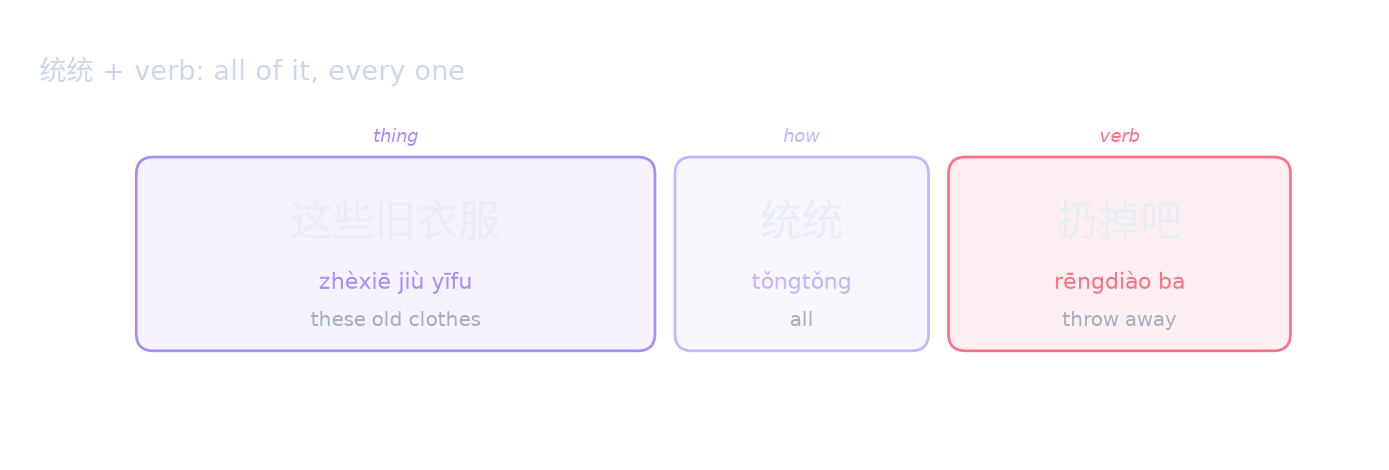
- these这些old旧clothes衣服all统统throw away扔掉(suggestion)吧! — "Throw all these old clothes away!"
- Goal: say "all of it, every single one" with all统统, an emphatic spoken word.
all统统 + verb
- all统统 (tǒngtǒng) = "all, every single one, entirely". Like all / both都, it goes before the verb and refers back to a group, but it is stronger and more spoken.
- he / him他(take)把school assignment作业all统统to do; to make做to finish完(completed / change)了。 — "He finished every bit of his homework."
these这些old旧clothes衣服all统统throw away扔掉吧!
Complete: “Throw all these old clothes away!” 这些旧衣服____扔掉吧!
Độ khó 1/5 · 100 xu + phần thưởng nhỏ khi hoàn thành lần đầu tiên hôm nay
All, every one (strong, spoken) — 统统.
统统 is stronger and more spoken than 都.
Độ khó 1/5 · 100 xu + phần thưởng nhỏ khi hoàn thành lần đầu tiên hôm nay
It stresses every single one.
Orders and strong statements
- all统统 often appears in orders and in (take)把 sentences: (take)把table桌子up / on / last; to get on, attend上(modifier / structural particle)的things东西all统统take away拿走! — "Take everything off the table!"
- And in strong statements: I / me我to speak说(的) + words; or "if"的话he / him他all统统to forget忘(completed / change)了。 — "He forgot every word I said."
(take)把on the table桌子上的things东西all统统take away拿走!
Build: “Take everything off the table!”
Độ khó 3/5 · 200 xu + phần thưởng nhỏ khi hoàn thành lần đầu tiên hôm nay
把 + things + 统统 + verb.
all统统 goes before the verb, not the noun
- all统统 is an adverb: ✗ all统统person人all / both都to come来(completed / change)了 ✓ 所有人all / both都to come来(completed / change)了 / ✓ visitor客人(plural)们all统统to come来(completed / change)了。 — "The guests all came, every one."
- In formal writing, use all; whole全部 or all / both都: material材料already已all; whole全部to submit (a report etc)提交。 — "All the materials have been submitted."
“Everyone came.” Which is right?
Độ khó 1/5 · 100 xu + phần thưởng nhỏ khi hoàn thành lần đầu tiên hôm nay
统统 can't go before a noun; use 所有.
all统统, all / both都 and all; whole全部
- all / both都 = all (neutral, everywhere). all统统 = all, every single one (strong, spoken).
- all; whole全部 = all, the whole (also before a noun: all; whole全部(modifier / structural particle)的money钱; formal or neutral).
Which fits a formal notice best? 材料已____提交。
Độ khó 1/5 · 100 xu + phần thưởng nhỏ khi hoàn thành lần đầu tiên hôm nay
In formal writing, 全部.
Recap
- (group) all统统 + verb = all of them, every one (strong, spoken; often orders and (take)把).
- Before a noun: all所有 / all; whole全部. Formal writing: all; whole全部 / all / both都.
Read the full reference: HSK 6 grammar — Adverbs.
You are tidying your room before the new term. Give two orders to yourself or a sibling with 统统.
Your answer need not copy the model. A partner or teacher must hear the spoken response to comment on pronunciation.