Kế hoạch học tập của bạn · Tiếp tục · Ôn tập →
显然 vs 明显 (obviously vs obvious)
Đã giới thiệuVị trí đã lưu của bạn vẫn nằm trong trình duyệt này. Việc tiếp tục sẽ không hoàn thành bài học hay trả lời các câu hỏi của nó.
He clearly didn't sleep
- Your colleague yawns through the whole morning meeting.
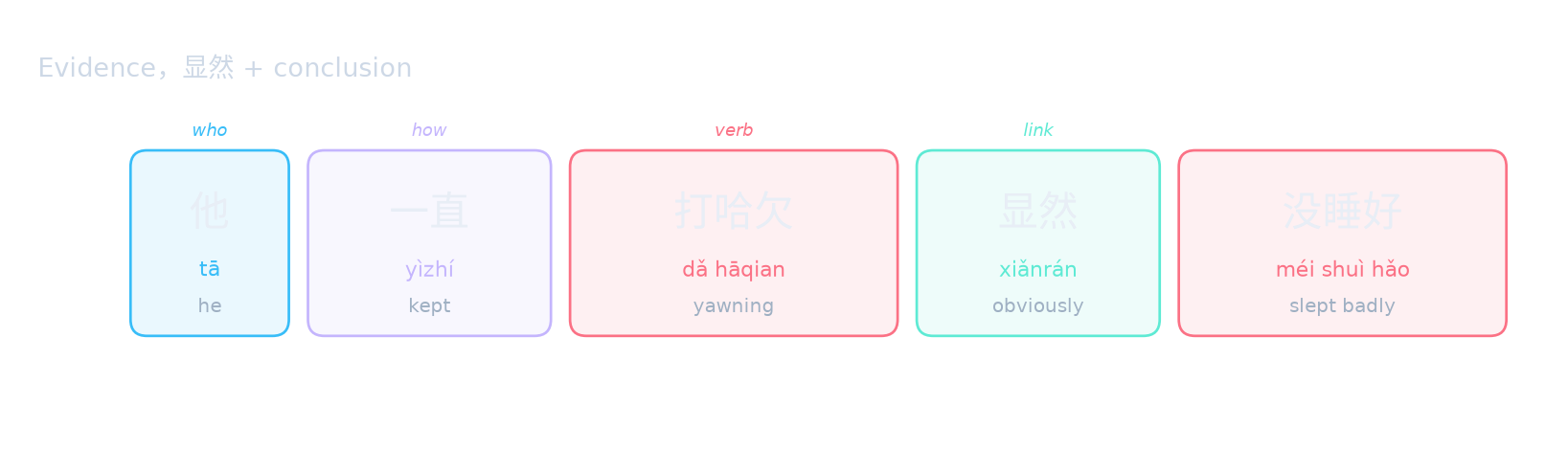
- he他kept一直yawning打哈欠,obviously显然yesterday evening昨晚没睡good好。 — "He keeps yawning; he obviously didn't sleep well last night."
- Goal: draw an obvious conclusion with the adverb obviously显然, and keep it apart from the adjective obvious; noticeable明显.
Evidence,obviously显然 + conclusion
- obviously显然 (xiǎnrán) = "obviously, clearly". It goes before the verb or at the start of the sentence, often after the evidence.
- obviously显然,this这个plan计划won't work行不通。 — "Clearly, this plan won't work."
he他kept一直yawning打哈欠,obviously显然didn't sleep well没睡好。
Complete: “He keeps yawning; he obviously didn't sleep well.” 他一直打哈欠,____没睡好。
Độ khó 1/5 · 100 xu + phần thưởng nhỏ khi hoàn thành lần đầu tiên hôm nay
Evidence first, then 显然 + the conclusion.
degree / adjective linker很obviously显然 and obviously显然is是
- degree / adjective linker很obviously显然,… opens a conclusion in speech and writing: degree / adjective linker很obviously显然,he他unexpectedly不想to answer回答this这个question问题。 — "Quite obviously, he doesn't want to answer this question."
- obviously显然is是 … = it's clearly …: this这obviously显然is是a一个misunderstanding误会。 — "This is clearly a misunderstanding."
this这clearly显然is是a一个misunderstanding误会。
Build: “This is clearly a misunderstanding.”
Độ khó 3/5 · 200 xu + phần thưởng nhỏ khi hoàn thành lần đầu tiên hôm nay
显然是 = is clearly.
很显然 can start a sentence that gives a conclusion.
Độ khó 1/5 · 100 xu + phần thưởng nhỏ khi hoàn thành lần đầu tiên hôm nay
很显然,… = quite obviously, ….
obviously显然 is not used before a noun
- Before a noun, use the adjective obvious; noticeable明显: ✓ obvious; noticeable明显(modifier / structural particle)的to change变化 — "an obvious change" ✗ obviously显然(modifier / structural particle)的to change变化.
- To say how much, use obvious; noticeable明显 + verb / adjective too: ✓ he他obvious; noticeable明显thin瘦(completed / change)了。 — "He has visibly lost weight." obviously显然 gives your conclusion; obvious; noticeable明显 describes what can be seen.
“an obvious change” — which is right?
Độ khó 1/5 · 100 xu + phần thưởng nhỏ khi hoàn thành lần đầu tiên hôm nay
Before a noun, use the adjective 明显.
obviously显然 or obvious; noticeable明显?
- obviously显然 = obviously (my conclusion from evidence): he他obviously显然not不happy; glad高兴.
- obvious; noticeable明显 = obvious, noticeable (a description): this这两张photograph照片to have / there is有obvious; noticeable明显(modifier / structural particle)的different不同 — "There is an obvious difference between these two photos." degree / adjective linker很obvious; noticeable明显 can start a sentence like degree / adjective linker很obviously显然.
“There is an obvious difference between the two photos.” 这两张照片有____的不同。
Độ khó 1/5 · 100 xu + phần thưởng nhỏ khi hoàn thành lần đầu tiên hôm nay
明显的不同 = an obvious difference (adjective before a noun).
Recap
- obviously显然 + verb / obviously显然,+ sentence = obviously (a conclusion). obviously显然is是 = is clearly.
- Before a noun, or to describe a visible change, use obvious; noticeable明显.
Read the full reference: HSK 6 grammar — Adverbs.
Your classmate got full marks after weeks of study. Write two sentences: one conclusion with 显然, and one description with 明显.
Your answer need not copy the model.