Kế hoạch học tập của bạn · Tiếp tục · Ôn tập →
不禁 / 不由得 (can't help — a reaction)
Đã giới thiệuVị trí đã lưu của bạn vẫn nằm trong trình duyệt này. Việc tiếp tục sẽ không hoàn thành bài học hay trả lời các câu hỏi của nó.
Tears she couldn't stop
- After four years abroad, your friend hears her mother's voice on the phone.
- hear听到mum; mother妈妈(modifier / structural particle)的voice声音,she她couldn't help不禁to cry哭(completed / change)了to get up起来。 — "Hearing her mother's voice, she couldn't help bursting into tears."
- Goal: describe a reaction someone could not hold back with couldn't help不禁 / couldn't help不由得.
Trigger,couldn't help不禁 + reaction
- couldn't help不禁 (bùjīn) = "can't help (doing), can't stop oneself". First comes what caused the feeling, then couldn't help不禁 + the reaction.
- Typical reactions: couldn't help不禁to laugh笑(completed / change)了, couldn't help不禁to cry哭(completed / change)了to get up起来, couldn't help不禁to recall想起…, couldn't help不禁to feel感到…: to see看到这张老照片,I我couldn't help不禁to recall想起(completed / change)了in one's childhood小时候。 — "Seeing this old photo, I couldn't help remembering my childhood."
hear听到the news消息,she她couldn't help不禁burst into tears哭了起来。
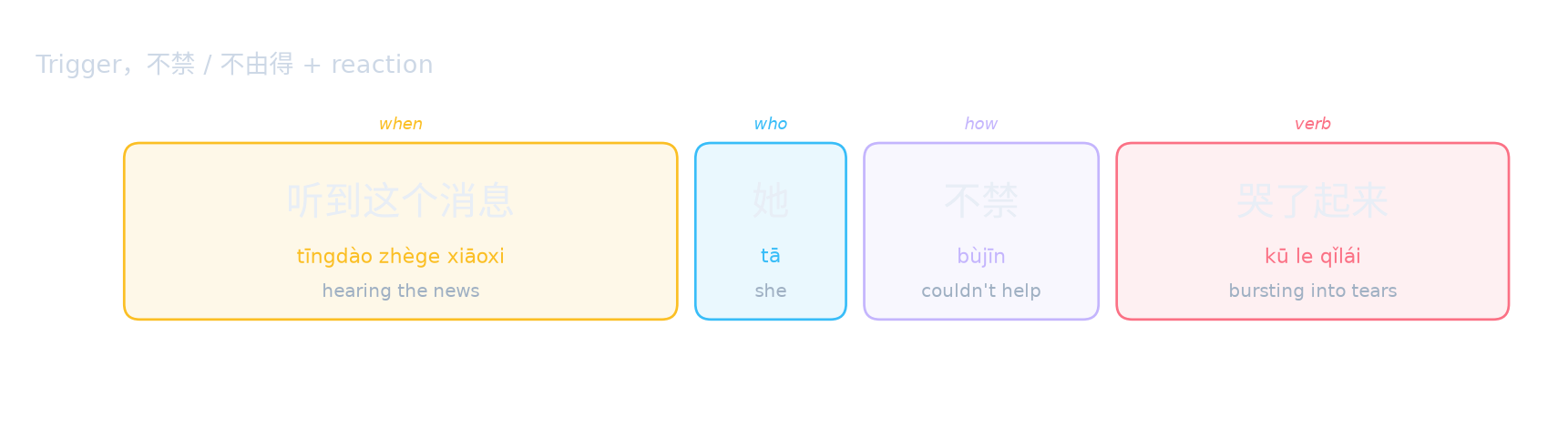
Complete: “Hearing the news, she couldn't help bursting into tears.” 听到这个消息,她____哭了起来。
Độ khó 1/5 · 100 xu + phần thưởng nhỏ khi hoàn thành lần đầu tiên hôm nay
Trigger first, then 不禁 + the reaction.
Build: “Seeing this old photo, I couldn't help remembering my childhood.”
Độ khó 3/5 · 200 xu + phần thưởng nhỏ khi hoàn thành lần đầu tiên hôm nay
Subject + 不禁 + reaction.
couldn't help不由得: one more use
- couldn't help不由得 (bùyóude) works the same way: to listen to听he / him他so much这么variant of 说说,I我couldn't help不由得to laugh笑(completed / change)了。 — "Hearing him say that, I couldn't help laughing."
- It can also mean "leaves you no choice but": he / him他variant of 说说(degree marker)得like that那么conscientious认真,couldn't help不由得you你not不letter信。 — "He said it so seriously that you couldn't help believing him."
I我couldn't help不由得laughed笑了。
不由得你不信 means "you can't help believing it".
Độ khó 1/5 · 100 xu + phần thưởng nhỏ khi hoàn thành lần đầu tiên hôm nay
不由得 can mean "leaves you no choice but".
A reaction, not a plan
- couldn't help不禁 / couldn't help不由得 describe a feeling that just happened, so they don't go with future plans or orders: ✗ tomorrow明天I我couldn't help不禁to go去to look at; to watch; to read看he / him他. ✗ you你couldn't help不禁to laugh笑.
- Put them after the subject and before the reaction: ✓ she她couldn't help不禁to laugh笑(completed / change)了。 ✗ couldn't help不禁she她to laugh笑(completed / change)了.
Which sentence is correct?
Độ khó 1/5 · 100 xu + phần thưởng nhỏ khi hoàn thành lần đầu tiên hôm nay
不禁 describes a reaction that just happened, after the subject.
couldn't help不禁 or can't hold back忍不住?
- can't hold back忍不住 = couldn't hold back, spoken, and it also works for the future: I我to be afraid怕I我can / will会can't hold back忍不住to laugh笑。 — "I'm afraid I won't be able to keep from laughing."
- couldn't help不禁 is more written and describes a reaction in the moment.
“I'm afraid I won't be able to keep from laughing (at the meeting tomorrow).” Which is more natural in speech?
Độ khó 1/5 · 100 xu + phần thưởng nhỏ khi hoàn thành lần đầu tiên hôm nay
For the future, use 忍不住. 不禁 describes the moment it happened.
Recap
- Trigger,subject + couldn't help不禁 / couldn't help不由得 + reaction = couldn't help ….
- Written style; for the future or in speech, use can't hold back忍不住.
Read the full reference: HSK 6 grammar — Adverbs.
Write two sentences for a story: something your character saw or heard, and the reaction they couldn't hold back. Use 不禁 once and 不由得 once.
Your answer need not copy the model.