Your learning plan · Continue · Review →
似乎 (it seems / as if)
Đã giới thiệuVị trí đã lưu của bạn vẫn giữ nguyên trong trình duyệt này. Tiếp tục sẽ không hoàn thành bài học hay trả lời câu hỏi của nó.
Something seems off
- Your usually cheerful colleague is quiet in the meeting and avoids eye contact.
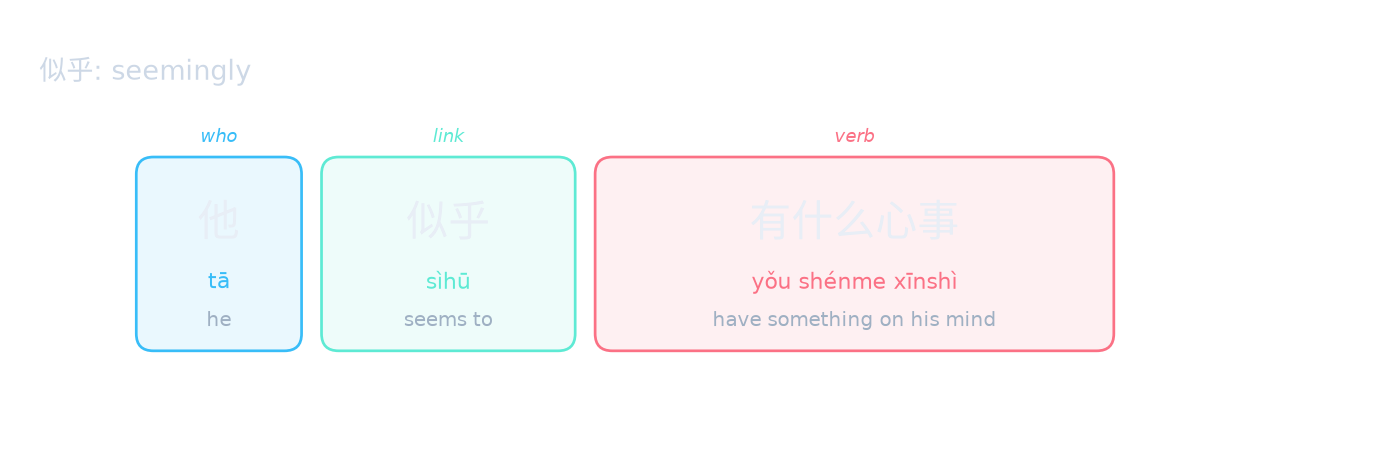
- he他seems似乎to have / there is有what什么a load on one's mind心事。 — "He seems to have something on his mind."
seems似乎 + guess = it seems, apparently
- seems似乎 gives a tentative impression or guess, a more formal seems to好像: seems似乎not不too太happy高兴, seems似乎clear明白(completed / change)了.
- It goes after the subject or at the start of the clause.
she她seems似乎not very不太happy高兴。
Complete (formal): “The plan seems to have problems.” 这个计划____有问题。
Độ khó 1/5 · 100 xu + một phần thưởng nhỏ cho lần hoàn thành đầu tiên trong ngày
似乎 gives a tentative impression.
Writing and careful speech
- the problem问题seems似乎than比we我们thought想(modifier / structural particle)的more更complicated复杂。 — "The problem seems more complicated than we thought."
- seems似乎…same一样 = as if: he他seems似乎what什么all / both都to know知道same一样.
the problem问题seems似乎than比we我们thought想的more更complicated复杂。
Build: “The problem seems more complicated than we thought.”
Độ khó 3/5 · 200 xu + một phần thưởng nhỏ cho lần hoàn thành đầu tiên trong ngày
Subject + 似乎 + comparison.
Tentative, so not with definitely一定
- seems似乎 is soft; do not pair it with definitely一定 / to be certain肯定: he他seems似乎illness病(completed / change)了, not he他seems似乎to be certain肯定illness病(completed / change)了.
- It sounds formal; in conversation seems to好像 is more common.
Which is unnatural?
Độ khó 1/5 · 100 xu + một phần thưởng nhỏ cho lần hoàn thành đầu tiên trong ngày
Tentative 似乎 does not combine with 肯定.
seems似乎 versus seems to好像 and apparently看来
- seems to好像 = it seems (spoken): he他seems to好像have left走(completed / change)了.
- apparently看来 draws a conclusion from evidence: he他not / haven't没to come来,apparently看来to be / is是illness病(completed / change)了.
he他seems to好像have left走了。
好像 is more common than 似乎 in conversation.
Độ khó 1/5 · 100 xu + một phần thưởng nhỏ cho lần hoàn thành đầu tiên trong ngày
True. Both mean “seem”, but 似乎 is more formal and written. In everyday speech 好像 is far more common: 他好像不太高兴.
Recap
- seems似乎 = it seems / apparently (formal, tentative); seems似乎…same一样 = as if.
- Spoken seems to好像; conclusion from evidence apparently看来; not with definitely一定.
Read the full reference: HSK 6 grammar — Adverbs.
Your usually cheerful colleague is quiet in the meeting and avoids eye contact. Close the examples. Say a Mandarin response, then write it in Chinese. Explain briefly in English what the lesson’s pattern adds. Compare with the model, then change one detail and try again.
This is supported productive practice. Compare meaning and structure; your answer need not copy the model. A partner or teacher must hear the spoken response to comment on pronunciation.