Kế hoạch học tập của bạn · Tiếp tục · Ôn tập →
从此 and 至今 (from then on / to this day)
Đã giới thiệuVị trí đã lưu của bạn vẫn nằm trong trình duyệt này. Việc tiếp tục sẽ không hoàn thành bài học hay trả lời các câu hỏi của nó.
The day it all changed
- On a trip to Chengdu, your friend tried hotpot for the first time — and never looked back.
- he他the first time第一次to go去Chengdu subprovincial city…成都then / just就to love爱on; above; last (week)上(completed / change)了hotpot火锅,from then on从此每个weekend周末(all)都want / will / need要to eat it吃。 — "On his first trip to Chengdu he fell for hotpot; from then on he had to have it every weekend."
- Goal: mark a turning point with from then on从此 ("from then on"), and look back from today with to this day至今 ("up to now").
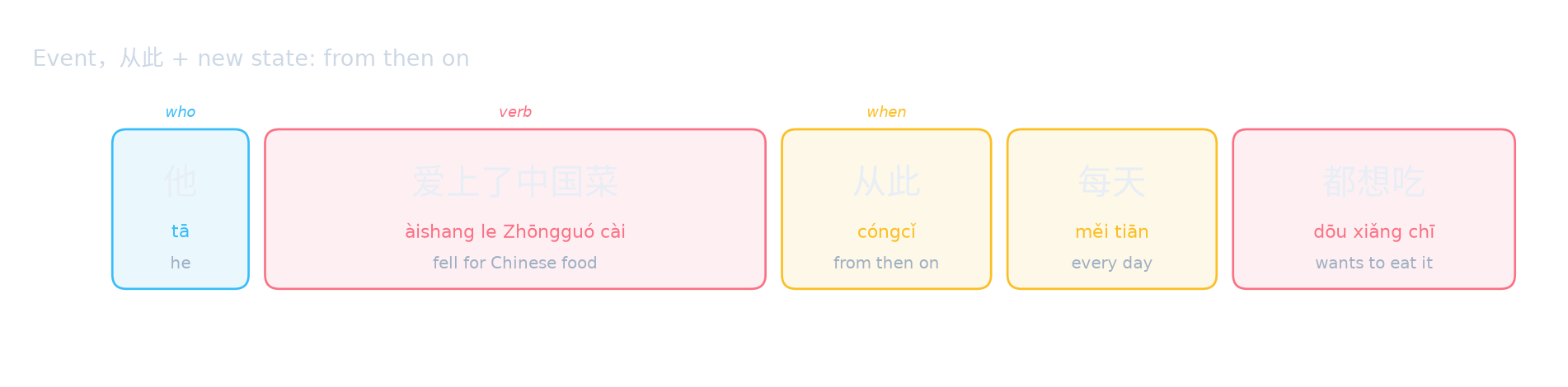
from then on从此 + new state
- from then on从此 (cóngcǐ) = "from then on, since then". First say what happened; from then on从此 then gives the new situation that started there and continued.
- he他(passive: by)被teacher老师to criticize批评(completed / change)了first一次,from then on从此(not) any more再也not / haven't没to arrive late迟到(experienced)过。 — "He was told off by the teacher once, and from then on he was never late again."
he他fell for爱上了Chinese food中国菜,from then on从此every day每天(all)都wants想to eat it吃。
Complete: “He was told off once, and from then on he was never late again.” 他被老师批评了一次,____再也没迟到过。
Độ khó 1/5 · 100 xu + phần thưởng nhỏ khi hoàn thành lần đầu tiên hôm nay
An event, then 从此 + the new situation.
to this day至今: up to now
- to this day至今 (zhìjīn) = "up to now, to this day". It looks back from today: something started in the past and is still true. still还 or still仍然 often follows.
- 这件matter事I我to this day至今still还remember记得。 — "I still remember this to this day."
this这件事I我to this day至今still还remember记得。
Complete: “I still remember this to this day.” 这件事我____还记得。
Độ khó 1/5 · 100 xu + phần thưởng nhỏ khi hoàn thành lần đầu tiên hôm nay
至今 looks back from today.
from then on从此 needs a turning point
- from then on从此 must follow an event that changed things: ✗ I我from then on从此to like喜欢hotpot火锅 (from when?) ✓ I我at / in在Chengdu subprovincial city…成都to eat it吃(completed / change)了first一次hotpot火锅,from then on从此then / just就to like喜欢on; above; last (week)上(completed / change)了。
- from then on从此 looks forward from the event; to this day至今 looks back from now. With to this day至今, the sentence is about today: he他十年front前to depart离开(completed / change)了hometown家乡,to this day至今not have / haven't没有to return回去(experienced)过。 — "He left his hometown ten years ago and hasn't been back since."
Which sentence is correct?
Độ khó 1/5 · 100 xu + phần thưởng nhỏ khi hoàn thành lần đầu tiên hôm nay
从此 needs an event before it.
Build: “He left his hometown ten years ago and hasn't been back since.”
Độ khó 3/5 · 200 xu + phần thưởng nhỏ khi hoàn thành lần đầu tiên hôm nay
至今 + 没(有) … 过 = hasn't … up to now.
from then on从此, to this day至今 and always (so far); never (with 不 / 没)从来
- from then on从此 = from that event on. to this day至今 = up to now, still.
- always (so far); never (with 不 / 没)从来 = ever, at any time, usually with not不 / not / haven't没: he他never从来不喝咖啡。 — "He never drinks coffee." It has no turning point.
“He never drinks coffee.” (a habit, no turning point) 他____不喝咖啡。
Độ khó 1/5 · 100 xu + phần thưởng nhỏ khi hoàn thành lần đầu tiên hôm nay
从来不 = never, as a general habit.
Recap
- Event,from then on从此 + new state = from then on.
- to this day至今 (still还 / still仍然) … = to this day. never从来不 / not / haven't没 = never (no turning point).
Read the full reference: HSK 5 grammar — Adverbs.
Tell about one moment that changed one of your habits. Use 从此 for the change and 至今 for how things are today.
Your answer need not copy the model. A partner or teacher must hear the spoken response to comment on pronunciation.