Your learning plan · Continue · Review →
Adj + 得不得了 (extremely)
Đã giới thiệuVị trí đã lưu của bạn vẫn giữ nguyên trong trình duyệt này. Tiếp tục sẽ không hoàn thành bài học hay trả lời câu hỏi của nó.
The final whistle
- Your school team has just won the city championship after a penalty shoot-out.
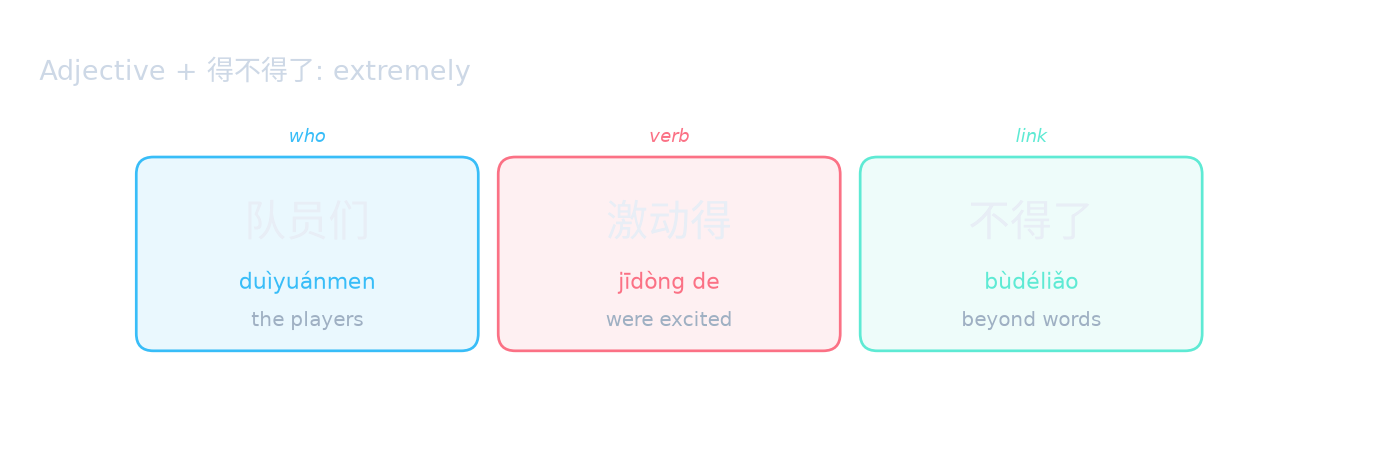
- team member队员(plural)们to move emotionally激动(degree marker)得terrible不得了。 — "The players were beside themselves with excitement."
Adj / feeling verb + (degree marker)得terrible不得了
- Adj + (degree marker)得terrible不得了 = "extremely, terribly": 热得terrible不得了, busy忙(degree marker)得terrible不得了, happy高兴(degree marker)得terrible不得了.
- (degree marker)得 links the adjective to terrible不得了 (literally "beyond what can be stood"), which ends the clause.
the subway地铁(in)里crowded挤extremely得不得了。
Complete: “I'm terribly busy this week.” 这个星期我忙____不得了。
Độ khó 1/5 · 100 xu + một phần thưởng nhỏ cho lần hoàn thành đầu tiên trong ngày
Adj + 得 + 不得了.
Good and bad extremes
- Bad: today今天热得terrible不得了,I / me我erhua variant of 一点一点儿also也unexpectedly不想to go out出门。 — "It's unbearably hot today; I don't want to go out at all."
- Good: to hear (sth said)听说you你want / will / need要to come来,child孩子(plural)们happy高兴(degree marker)得terrible不得了。 — "When they heard you were coming, the children were overjoyed."
the children孩子们happy高兴extremely得不得了。
Build: “When they heard you were coming, the children were overjoyed.”
Độ khó 3/5 · 200 xu + một phần thưởng nhỏ cho lần hoàn thành đầu tiên trong ngày
Cause, then subject + Adj + 得不得了.
One degree word, and (degree marker)得 is needed
- No degree / adjective linker很 / very非常 before the adjective: busy忙(degree marker)得terrible不得了, not degree / adjective linker很busy忙(degree marker)得terrible不得了.
- Keep (degree marker)得: rope累(degree marker)得terrible不得了, not rope累terrible不得了.
Which sentence is correct?
Độ khó 1/5 · 100 xu + một phần thưởng nhỏ cho lần hoàn thành đầu tiên trong ngày
他高兴得不得了 is right: a bare adjective + 得不得了 already means "extremely", so 很 is not added.
terrible不得了 on its own
- Alone, terrible不得了 means "terrible, serious": terrible不得了(completed / change)了,on fire着火(completed / change)了! — "Oh no, there's a fire!"
- terrific了不得 is different: "amazing, remarkable": he / him他really真terrific了不得 — "He's really something."
terrible不得了了,on fire着火了!
Match each expression to its meaning.
Độ khó 2/5 · 140 xu + một phần thưởng nhỏ cho lần hoàn thành đầu tiên trong ngày
The position and order of 不得了 / 了不得 change the meaning.
Recap
- Adj + (degree marker)得terrible不得了 = extremely (good or bad), spoken; no degree / adjective linker很 before it.
- terrible不得了! = disaster!; terrific了不得 = remarkable.
Read the full reference: HSK 5 grammar — Adjectives.
Your school team has just won the city championship after a penalty shoot-out. Close the examples. Say a Mandarin response, then write it in Chinese. Explain briefly in English what the lesson’s pattern adds. Compare with the model, then change one detail and try again.
This is supported productive practice. Compare meaning and structure; your answer need not copy the model. A partner or teacher must hear the spoken response to comment on pronunciation.