Your learning plan · Continue · Review →
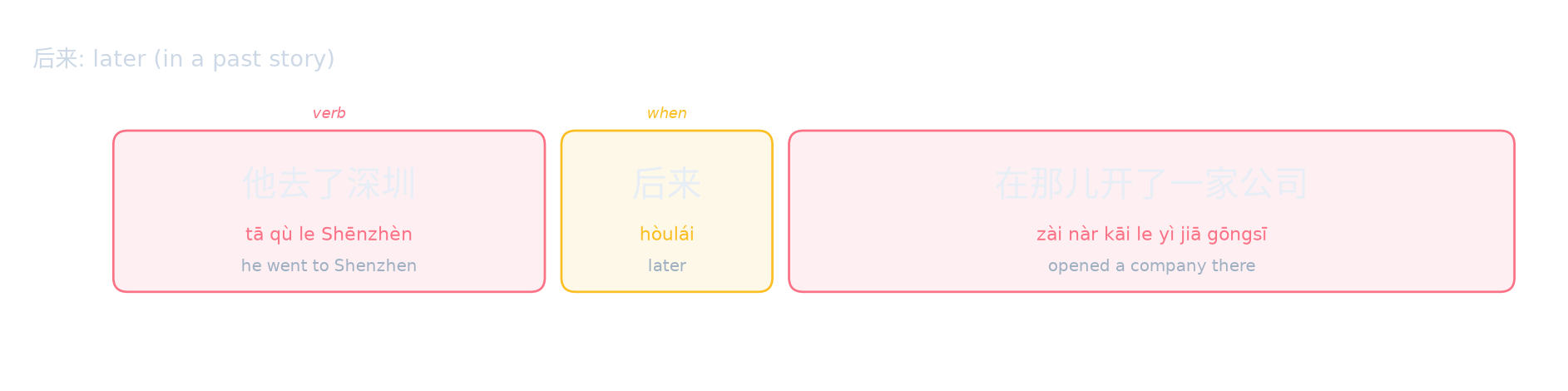
… ,后来 … (afterwards / later — past)
Đã giới thiệuVị trí đã lưu của bạn vẫn giữ nguyên trong trình duyệt này. Tiếp tục sẽ không hoàn thành bài học hay trả lời câu hỏi của nó.
How the story ended
- You are telling a friend about a classmate who moved to Shenzhen two years ago.
- he他to go去(completed / change)了Shenzhen subprovincial city…深圳,later后来at / in在there那儿to open (transitive or…开(completed / change)了the whole family一家company公司。 — "He went to Shenzhen, and later he started a company there."
…,later后来 … (afterwards, later on)
- later后来 = "afterwards, later on", for what happened next in a past story.
- It starts the second clause, after a comma: we我们first先were是classmates同学,later后来became成(completed / change)了good好friend朋友.
we我们first先were是classmates同学,later后来became成了good friends好朋友。
Complete the story: “At first I didn't like him, but later we became friends.” 开始我不喜欢他,____我们成了朋友。
Độ khó 1/5 · 100 xu + một phần thưởng nhỏ cho lần hoàn thành đầu tiên trong ngày
后来 introduces what happened later in a past story.
Asking what happened next
- later后来(and …? / softener)呢? — "And then what happened?" A natural way to keep a story going.
- later后来how怎么样(completed / change)了? — "How did it turn out in the end?"
later后来how怎么样了?
Ask to continue a story: “And how did it turn out?”
Độ khó 3/5 · 200 xu + một phần thưởng nhỏ cho lần hoàn thành đầu tiên trong ngày
后来怎么样了?
Past stories only
- later后来 is only for the past. For "later" in a plan, use after以后 or then / after然后: we我们after以后to say again再说.
- It stands alone as a time word; it is not added after an event: graduation毕业after以后, not graduation毕业later后来.
Which fits a plan? “Let's eat first, then go shopping.”
Độ khó 1/5 · 100 xu + một phần thưởng nhỏ cho lần hoàn thành đầu tiên trong ngày
后来 is only for past stories; a plan uses 然后.
later后来 versus then / after然后
- then / after然后 links steps closely, one after another, in the past or future: first先to wash one's hands洗手,then / after然后to have a meal吃饭。
- later后来 jumps forward in a story, often with a gap of time: he他as a child小时候very很thin瘦,later后来grow长fat胖(completed / change)了。
he他as a child小时候very很thin瘦,later后来grow长fat胖了。
他小时候很瘦,后来长胖了 describes a change with a gap of time.
Độ khó 1/5 · 100 xu + một phần thưởng nhỏ cho lần hoàn thành đầu tiên trong ngày
后来 jumps forward in a past story.
Recap
- …,later后来 … = afterwards, later on, in a past story; later后来(and …? / softener)呢? = And then?
- Not for plans (use after以后 / then / after然后), not after an event (graduation毕业after以后).
Read the full reference: HSK 3 grammar — Nouns.
You are telling a friend about a classmate who moved to Shenzhen two years ago. Close the examples. Say a Mandarin response, then write it in Chinese. Explain briefly in English what the lesson’s pattern adds. Compare with the model, then change one detail and try again.
This is supported productive practice. Compare meaning and structure; your answer need not copy the model. A partner or teacher must hear the spoken response to comment on pronunciation.