Your learning plan · Continue · Review →
Past simple — events and states
Đã giới thiệuVị trí đã lưu của bạn vẫn giữ nguyên trong trình duyệt này. Tiếp tục sẽ không hoàn thành bài học hay trả lời câu hỏi của nó.
Talking about the past
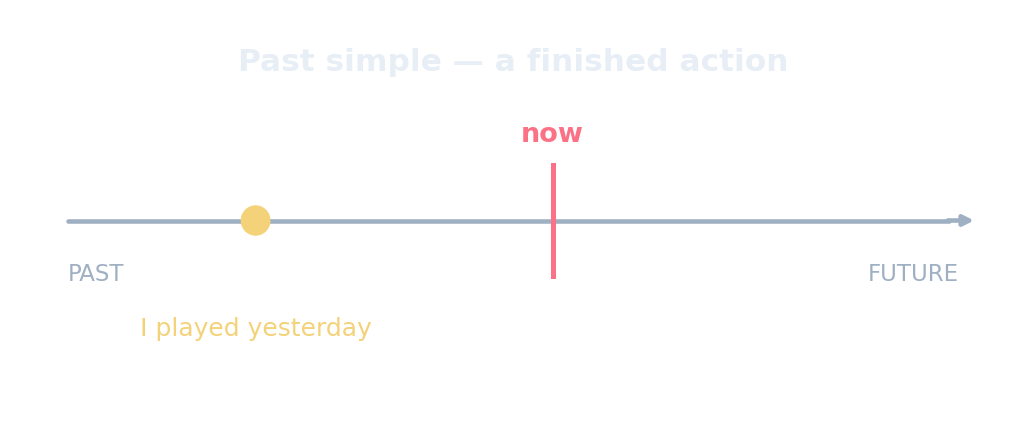
-
The past simple can report past events, states and repeated actions: I visited on Monday. She knew the route. We walked there each week. A past-time report does not by itself prove a situation is no longer true.
-
I watched a film yesterday. We went to Beijing last year.
-
Words such as yesterday, last week, … ago can locate the event. Outcome: tell what happened and preserve its time without inventing what is true now. Start with present-simple forms. Starting check: does I liked that book as a child prove I dislike it now? No.
-
Allow about 45–60 minutes across sessions, including later review. This is a study suggestion, not a test duration or proficiency estimate.
I lost my keys yesterday; they did not write a postcard.
Regular verbs: add -ed
- Most verbs add -ed: work → worked, play → played.
- Ending in -e: add only -d → like → liked.
- Consonant + y: change y to i, add -ed → study → studied.
- These ordinary main-verb past forms stay the same across subjects: I worked, she worked. Be is different: I was, you were. Do not extend the worked pattern to every verb.
What is the past simple of “study”?
Độ khó 1/5 · 100 xu + một phần thưởng nhỏ cho lần hoàn thành đầu tiên trong ngày
Consonant + y → change y to i, then add -ed: study → studied.
For a regular verb ending in e, add d. Choose the past of like.
Độ khó 1/5 · 100 xu + một phần thưởng nhỏ cho lần hoàn thành đầu tiên trong ngày
Like becomes liked by adding d. The other spellings add extra letters. Next try: form lived from live.
Irregular verbs (learn these!)
- Many common verbs do not follow the regular -ed pattern:
- go → went, have → had, see → saw, get → got, make → made, eat → ate.
- Two more useful pairs are find → found and give → gave: I found a key and gave it to Jo. Learn useful forms in sentences and notice groups such as buy → bought, bring → brought. Some have the same spelling in present and past, as in put → put. A suffix test alone does not explain every verb.
Regular or irregular past?
Sort the past forms of these supplied verbs: walked/played/studied follow regular patterns, while went/saw/ate/bought use learned irregular forms. Be uses was/were; this is not a universal same-form rule.
Write the past simple of “go”.
Độ khó 1/5 · 100 xu + một phần thưởng nhỏ cho lần hoàn thành đầu tiên trong ngày
“go” is irregular: go → went (not “goed”).
Choose the learned irregular past of eat.
Độ khó 1/5 · 100 xu + một phần thưởng nhỏ cho lần hoàn thành đầu tiên trong ngày
Eat becomes ate in an ordinary past statement. Eated invents a regular form; eating is not that past form. Next try: use ate in a full past report.
Negatives & questions: did
- Negative: didn't + base verb → I didn't go.
- Question: Did + subject + base verb → Did you see it?
- After auxiliary did / didn't, use the base form: Did she go? She didn't go. Be uses Was she tired? She wasn't tired; a subject question can be Who called? without did.
Put the words in order to make a past question.
Độ khó 3/5 · 200 xu + một phần thưởng nhỏ cho lần hoàn thành đầu tiên trong ngày
This ordinary yes/no question uses Did you see the film? with auxiliary did and base see. Was she there? and the subject question Who saw it? use other patterns; not every past question needs did.
Translate into English: 我昨天看了一部电影。
Độ khó 3/5 · 200 xu + một phần thưởng nhỏ cho lần hoàn thành đầu tiên trong ngày
A finished past action → past simple: “I watched a film yesterday.”
Use did + subject + base verb. Choose the complete question.
Độ khó 1/5 · 100 xu + một phần thưởng nhỏ cho lần hoàn thành đầu tiên trong ngày
Did Jo go home? keeps base go after did. Went and goes do not fit there. Next try: give the negative with didn’t go.
Common mistakes
- For an ordinary report of that finished trip, use I went to Beijing last month, not I go to Beijing last month. This is the ordinary past-report pattern practised here; the time phrase tells the reader when the trip happened.
- Use the learned past form She bought a phone, not buyed. For a new verb, check its actual past form rather than guessing from one spelling rule.
- ❌ yesterday night → ✓ last night — but yesterday morning is fine.
Match the verb to its past simple.
Độ khó 2/5 · 140 xu + một phần thưởng nhỏ cho lần hoàn thành đầu tiên trong ngày
All irregular — learn them in pairs: buy → bought, think → thought, take → took, come → came.
Which sentence is correct?
Độ khó 1/5 · 100 xu + một phần thưởng nhỏ cho lần hoàn thành đầu tiên trong ngày
In the requested did-negative pattern, did carries the past marking and the following verb is base go. That does not mean every negative uses did: She wasn’t there uses be.
Use were before a plural subject for a past be-question.
Độ khó 1/5 · 100 xu + một phần thưởng nhỏ cho lần hoàn thành đầu tiên trong ngày
Were the visitors tired? uses plural were. Did were mixes frames; was does not agree in this ordinary plural model. Next try: give a short negative reply.
- Past simple can report past events, states or habits; the stated past time is not a complete account of what is true now.
- Regular verbs: + -ed; irregular verbs: learn each one.
- Ordinary main-verb negatives and yes/no questions use did / didn't + base; be and subject questions have other patterns. Later recall: tell a new past event and ask about it without adding an unsupported present result. Continue with present perfect. Choose the pattern that fits the verb and the question; do not apply did to every sentence.
Write one sentence about something you did yesterday. Use the past simple.
Độ khó 3/5 · 200 xu + một phần thưởng nhỏ cho lần hoàn thành đầu tiên trong ngày
Example: “I played basketball with my friends.” (play → played)
Use didn’t + base buy for a past negative.
Độ khó 1/5 · 100 xu + một phần thưởng nhỏ cho lần hoàn thành đầu tiên trong ngày
Didn’t buy keeps the base verb after auxiliary didn’t. Bought and buys do not fit that position. Next try: make the affirmative with bought.
Three worked contrasts
- Statement and did-question: Mia bought a ticket yesterday. Did Mia buy a ticket? Bought carries past marking in the statement; auxiliary did carries it in the question, with base buy. Near miss: Did Mia bought ...? repeats past marking in this frame. Repair it to Did Mia buy ...?
- Be and subject questions: Were the doors open? asks about a past state using be. Who opened the doors? asks which person did the action; who is its subject. Near miss: Did the doors were open? mixes frames. Use Were the doors open?; a fitting short negative answer is No, they weren’t.
- Past evidence and now: Jo liked the book as a child reports a past state; Jo walked to school each week that year reports repeated actions. Near miss: So Jo must dislike the book now adds a conclusion. Ask what Jo thinks now instead. Past simple covers more than a single finished action and does not supply every present fact.
Independent decisions
- Try the new situations without reopening the examples. Choose a complete ordinary past report, negative or question that keeps the stated facts. Check be separately and learn the actual irregular form; a suffix is not the whole test.
- After feedback, name the cause of an error: spelling/form, auxiliary pattern, agreement or an unsupported conclusion. Repair it and make another example. These written decisions do not measure spoken fluency.
Choose the standard past form of play.
Độ khó 1/5 · 100 xu + một phần thưởng nhỏ cho lần hoàn thành đầu tiên trong ngày
Play keeps y after a vowel and adds ed: played. The alternatives change the spelling incorrectly. Next try: contrast studied.
Choose the standard past form of work.
Độ khó 1/5 · 100 xu + một phần thưởng nhỏ cho lần hoàn thành đầu tiên trong ngày
Worked is the regular past form. Workted and workt are not its standard forms. Next try: use worked with she and then they.
Choose the complete ordinary past report with one named person.
Độ khó 1/5 · 100 xu + một phần thưởng nhỏ cho lần hoàn thành đầu tiên trong ngày
Studied fits this past statement. Study alone lacks past marking; did studied repeats it after an auxiliary. Next try: ask Did Rae study at home?
Choose the complete ordinary past report with a plural subject.
Độ khó 1/5 · 100 xu + một phần thưởng nhỏ cho lần hoàn thành đầu tiên trong ngày
Made is the learned past of make with a plural or singular subject. Makes is present and maked invents a form. Next try: describe one child instead.
Choose the learned past form of have for an ordinary past report.
Độ khó 1/5 · 100 xu + một phần thưởng nhỏ cho lần hoàn thành đầu tiên trong ngày
Had is the past form here. Has is present and haved is not the standard past form. Next try: report a past meal using had.
Choose the complete past-state report about one room.
Độ khó 1/5 · 100 xu + một phần thưởng nhỏ cho lần hoàn thành đầu tiên trong ngày
Singular room takes was in this ordinary be statement. Were gives the wrong agreement here; did was mixes frames. Next try: make it negative with wasn’t.
Choose the complete past-state report about two doors.
Độ khó 1/5 · 100 xu + một phần thưởng nhỏ cho lần hoàn thành đầu tiên trong ngày
Plural doors takes were. Was does not agree here and did were mixes patterns. Next try: ask whether the doors were open.
Choose the complete negative about a past event.
Độ khó 1/5 · 100 xu + một phần thưởng nhỏ cho lần hoàn thành đầu tiên trong ngày
Didn’t see uses base see after the past auxiliary. The alternatives retain saw or mix present do with a past form. Next try: make the positive with saw.
Choose the complete negative past be sentence.
Độ khó 1/5 · 100 xu + một phần thưởng nhỏ cho lần hoàn thành đầu tiên trong ngày
Wasn’t gives was not without did. The other options mix frames or place not incorrectly in this statement. Next try: ask Was Mia at the meeting?
Choose the complete ordinary did-question.
Độ khó 1/5 · 100 xu + một phần thưởng nhỏ cho lần hoàn thành đầu tiên trong ngày
Did you eat breakfast? keeps base eat after did. Ate is not the form used after that auxiliary. Next try: give a short yes reply.
Choose the complete past be-question about a plural subject.
Độ khó 1/5 · 100 xu + một phần thưởng nhỏ cho lần hoàn thành đầu tiên trong ngày
Were they ready? uses were before they. Did were mixes frames and was does not agree here. Next try: make a full negative reply.
A friend asks, “Did Rae call?” You know she did. Choose the matching short reply.
Độ khó 1/5 · 100 xu + một phần thưởng nhỏ cho lần hoàn thành đầu tiên trong ngày
Yes, she did matches the did-question. Was answers another pattern and called did does not form this short reply. Next try: give its negative short reply.
A friend asks, “Were the shops open?” You know they were closed. Choose the matching short reply.
Độ khó 1/5 · 100 xu + một phần thưởng nhỏ cho lần hoàn thành đầu tiên trong ngày
No, they weren’t matches plural were and the stated closed condition. Didn’t answers another frame; wasn’t lacks agreement. Next try: give a full sentence.
Choose the standard subject question asking which person called yesterday.
Độ khó 1/5 · 100 xu + một phần thưởng nhỏ cho lần hoàn thành đầu tiên trong ngày
Who called yesterday? uses who as the subject. The other choices add an auxiliary while retaining called. Next try: answer with a person’s name.
A diary says, “I liked that song as a child.” Which conclusion is supported?
Độ khó 1/5 · 100 xu + một phần thưởng nhỏ cho lần hoàn thành đầu tiên trong ngày
The diary supplies the past opinion, not the present opinion or memory. The other conclusions add facts. Next try: ask what the writer thinks now.
A report says, “We walked there every Friday that term.” What does it describe?
Độ khó 1/5 · 100 xu + một phần thưởng nhỏ cho lần hoàn thành đầu tiên trong ngày
Every Friday that term gives past repetition. Past simple can report it without establishing the current routine. Next try: ask about this term separately.
The verb put has the same spelling in present and past. Which is a standard past report?
Độ khó 1/5 · 100 xu + một phần thưởng nhỏ cho lần hoàn thành đầu tiên trong ngày
Put is also the learned past form. Putted and puted do not form put meaning place here. Next try: ask Did you put it there?
Choose the standard time phrase for the night before today.
Độ khó 1/5 · 100 xu + một phần thưởng nhỏ cho lần hoàn thành đầu tiên trong ngày
Last night is the ordinary expression practised here. Yesterday morning also works for the morning; that does not make yesterday night the standard equivalent. Next try: report something from yesterday morning.
Choose the standard time phrase for the morning before today.
Độ khó 1/5 · 100 xu + một phần thưởng nhỏ cho lần hoàn thành đầu tiên trong ngày
Yesterday morning is the ordinary phrase for that morning. The other options combine time expressions incorrectly. Next try: contrast last night.
A report says only, “The museum was closed on Monday.” Which claim preserves that information?
Độ khó 1/5 · 100 xu + một phần thưởng nhỏ cho lần hoàn thành đầu tiên trong ngày
The report establishes Monday’s state. It does not give today’s opening or permanent closure. Next try: ask whether it is open today.
Transfer: a visit report
- Write the given museum visit as an English past report. Keep the closed museum, the tickets not bought and the later café visit; do not invent an exhibition visit.
- Attempt before opening the model, then compare facts and complete verb frames. Repair one real mismatch; a different natural sentence order can preserve the same sequence.
A diary records only this: on Sunday, Jo went to the station but did not buy a ticket. Which summary stays within the facts?
Độ khó 1/5 · 100 xu + một phần thưởng nhỏ cho lần hoàn thành đầu tiên trong ngày
Went and didn’t buy preserve the recorded visit and negative event. Boarding and a general travel habit are not established. Next try: ask what Jo did after the station visit.
Visit notes: time—yesterday; people—you and Jo; first destination—a museum; museum status—closed; ticket purchases—none by either person; next destination—a nearby café. Turn these notes into three or four English past-simple sentences. Preserve the sequence and do not invent an exhibition visit. Compare and revise.
Compare your English with the facts, model and checklist. Repair a real form or meaning mismatch, or explain why none is present. Several answers can fit; self-review does not automatically establish correctness or proficiency.
Recall later
- Tomorrow, recall one regular form, one irregular form and the difference between did and be questions. Try the later-review decisions and the new written report without rereading first.
- Continue with present perfect to compare past reporting with situations connected to now. A question can seek missing information without supplying an answer; self-review is not automatic correctness or independent mastery.
Usage guidance checked 2026-10-20: British Council, past simple.
Review later: choose the complete ordinary question using did and buy.
Độ khó 1/5 · 100 xu + một phần thưởng nhỏ cho lần hoàn thành đầu tiên trong ngày
Did Lea buy the book? keeps base buy. Bought and buys do not fit after auxiliary did. Next try: write the negative reply as a full sentence.
Review later: “I knew the route last year” is the only evidence. Which conclusion fits?
Độ khó 1/5 · 100 xu + một phần thưởng nhỏ cho lần hoàn thành đầu tiên trong ngày
The statement supplies past knowledge without establishing whether it continues. Both must claims add unsupported facts. Next try: ask whether the writer knows the route now.
Return later without rereading. Notes: time—last Friday; discovery—a wallet outside the library; person finding it—you; handover—to a teacher; teacher’s phone contact with the owner—unknown. Write two English past-simple fact sentences, then ask a past-simple question about phoning the owner. Leave its answer open. Compare and revise.
Compare your English with the facts, model and checklist. Repair a real form or meaning mismatch, or explain why none is present. Several answers can fit; self-review does not automatically establish correctness or proficiency.