Muscles and movement
Đã giới thiệu 10:16
Đơn vị 5: hô hấp, môi trường nội bộ, phối hợp và công nghệ gen
Sprinting để kịp xe buýt và cơ thể bạn biểu diễn một bản giao hưởng: cơ bắp đốt cháy glucose nhanh hơn, tim tăng gấp đôi sản lượng, nhịp thở sâu hơn, mồ hôi bắt đầu tiết ra, thận…
Thuyết minh tiếng Anh · Có thể chuyển đổi phụ đề tiếng Anh và tiếng Trung
Trong bài học này
| English | Ý nghĩa |
|---|---|
| tendon/ˈtendn/ | A tough cord of collagen-rich tissue joining muscle to bone. |
| ligament/ˈlɪɡəmənt/ | A strong band of connective tissue joining bone to bone at a joint. |
| actin/ˈæktɪn/ | A protein forming thin filaments in muscle fibres and participating with myosin in contraction. |
| myosin/ˈmaɪəsɪn/ | A motor protein whose heads bind actin and use ATP during muscle contraction. |
| sarcomere/ˈsɑːkəmɪə/ | A repeating contractile unit of striated muscle between two neighbouring Z lines. |
| tropomyosin/ˈtrɒpəmɪɒsɪn/ | A protein lying along actin filaments that blocks myosin-binding sites when a muscle fibre is relaxed. |
| troponin/ˈtrɒpənɪn/ | A regulatory protein complex on thin muscle filaments that binds calcium and helps expose myosin-binding sites on actin. |
| myoglobin/ˌmaɪəˈɡləʊbɪn/ |
A sprinter and a marathon runner use different muscle fibres
- A 100 m sprinter needs power for 10 seconds; a marathon runner needs steady work for over two hours.
- Both depend on the same machine inside every muscle fibre: two proteins that slide past each other.
Muscles, tendons and joints
- A tendon 肌腱 joins muscle to bone; a ligament 韧带 joins bone to bone across a joint.
- Muscles can only pull. They work in antagonistic pairs: at the elbow, the biceps contracts to bend the arm while the triceps relaxes, and the triceps contracts to straighten it.
Match each structure to what it joins.
Độ khó 2/5 · 140 xu + phần thưởng nhỏ khi hoàn thành lần đầu tiên hôm nay
Tendons transmit the pull of the muscle; ligaments hold the joint together.
Inside a muscle fibre
- A skeletal muscle fibre is one long cell with many nuclei. It is packed with myofibrils made of thin actin 肌动蛋白 and thick myosin 肌球蛋白 filaments.
- The repeating unit is the sarcomere 肌节, from one Z-line to the next. The overlapping filaments give the light and dark bands you see under a microscope.
The sliding filament model
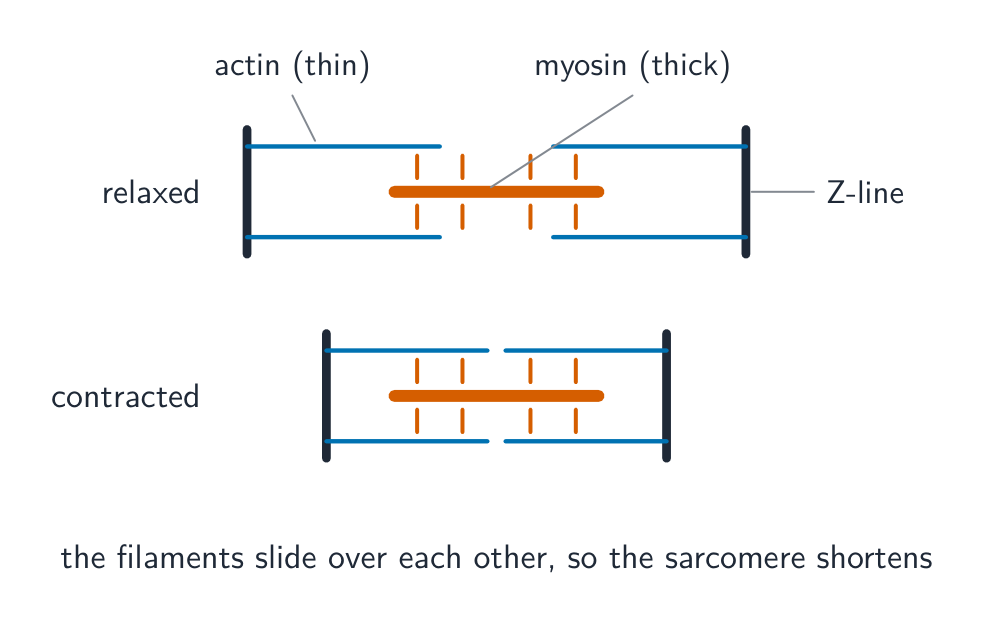
- When a muscle contracts, the actin filaments slide between the myosin filaments. The Z-lines move closer, so the sarcomere shortens.
- The filaments themselves keep the same length. Only the overlap changes.
Which change when a sarcomere contracts?
Độ khó 2/5 · 140 xu + phần thưởng nhỏ khi hoàn thành lần đầu tiên hôm nay
The filaments slide; they do not shorten.
Calcium unlocks the binding sites
- At rest, tropomyosin 原肌球蛋白 lies across the myosin-binding sites on actin, so myosin heads cannot attach.
- An impulse makes the sarcoplasmic reticulum release Ca²⁺. Calcium binds to troponin 肌钙蛋白, which moves tropomyosin away and exposes the binding sites.
What does calcium do in muscle contraction?
Độ khó 1/5 · 100 xu + phần thưởng nhỏ khi hoàn thành lần đầu tiên hôm nay
Calcium removes the block on the binding sites.
The cross-bridge cycle
- A myosin head attaches to actin, forming a cross-bridge. It tilts and pulls the actin towards the centre of the sarcomere (the power stroke), releasing ADP and phosphate.
- A new ATP binds and the head detaches. ATPase on the head hydrolyses that ATP, which re-cocks the head ready to attach further along.
Worked example: reading sarcomere lengths. A relaxed sarcomere is 2.4 µm long. When the muscle contracts, it is 1.8 µm long.
- Shortening = 2.4 − 1.8 = 0.6 µm.
- Percentage shortening = 0.6 ÷ 2.4 × 100 = 25 %. The myosin filament length stays the same throughout.
Put the cross-bridge cycle in order.
Độ khó 3/5 · 200 xu + phần thưởng nhỏ khi hoàn thành lần đầu tiên hôm nay
Attach, pull, detach, re-cock — then repeat further along.
A sarcomere shortens from 2.5 µm to 2.0 µm. What is the percentage shortening?
Độ khó 2/5 · 140 xu + phần thưởng nhỏ khi hoàn thành lần đầu tiên hôm nay
0.5 ÷ 2.5 × 100 = 20 %.
Fast-twitch and slow-twitch fibres
- Slow-twitch fibres contract slowly and keep going for a long time. They have many mitochondria, many capillaries and lots of myoglobin 肌红蛋白, which stores oxygen and makes them red. They respire aerobically.
- Fast-twitch fibres contract quickly and powerfully but tire fast. They have fewer mitochondria and capillaries, rely on anaerobic respiration, and store creatine phosphate to remake ATP quickly.
Slow-twitch fibres have more mitochondria and myoglobin than fast-twitch fibres.
Độ khó 1/5 · 100 xu + phần thưởng nhỏ khi hoàn thành lần đầu tiên hôm nay
They respire aerobically for a long time, so they need oxygen and mitochondria.
ATP is needed to let go, not only to pull. Without new ATP, myosin heads stay attached to actin. This is why muscles become stiff after death (rigor mortis).
Muscles pull on bones through tendons and work in antagonistic pairs. In a sarcomere, actin slides over myosin and the Z-lines move together. Ca²⁺ binds troponin, which moves tropomyosin off the binding sites; myosin heads attach, pull, and detach when ATP binds. Slow-twitch fibres suit endurance; fast-twitch fibres suit short bursts of power.
Explain why a muscle cannot relax properly if its supply of ATP runs out.
Link the missing ATP to the step it is needed for.
Đã xảy ra vấn đề gì? Chỉ đội ngũ trang web nhìn thấy thông tin này.