Kế hoạch học tập của bạn · Tiếp tục · Ôn tập →
Speaking Part 3: the discussion
Đã giới thiệuVị trí đã lưu của bạn vẫn nằm trong trình duyệt này. Việc tiếp tục sẽ không hoàn thành bài học hay trả lời các câu hỏi của nó.
Trong bài học này
| English | Ý nghĩa |
|---|---|
| anniversary/ˌænɪˈvɜːsəri/ | |
| summarise/ˈsʌməraɪz/ | |
| suggestion/səˈdʒestʃn/ | |
| disagree politely/ˌdɪsəˈɡriː pəˈlaɪtli/ | |
| interaction/ˌɪntəˈrækʃn/ | Communication or action in which people or things influence one another. |
Not a speech: a conversation
- Two candidates get the same task: plan the company's tenth-anniversary celebration. Candidate A talks for two minutes without stopping. Candidate B listens, agrees, disagrees politely and suggests something new.
- Candidate B scores higher on Interactive Communication. Part 3 tests how well you work with another person: suggest, respond, ask, and reach a decision together.
Why does Candidate B score higher in the example?
Độ khó 1/5 · 100 xu + phần thưởng nhỏ khi hoàn thành lần đầu tiên hôm nay
Part 3 rewards interaction, not long speeches.
The discussion task
| Preliminary | Vantage | Higher | |
|---|---|---|---|
| Task | a situation with pictures or written prompts | a business topic to discuss, with points | a short business situation with two discussion points |
| Talk together | about 2 minutes | about 3 minutes | most of the 7-minute part |
| Then | the examiner asks further questions on the theme | the same | the same |
- Imagine you are colleagues at work, facing a real decision. The opinions you give are your own.
- Aim to reach a decision, or at least to compare ideas and explain which you prefer.
Match each level with how long the candidates talk together.
Độ khó 2/5 · 140 xu + phần thưởng nhỏ khi hoàn thành lần đầu tiên hôm nay
Then the examiner asks further questions on the same theme.
In Part 3 you must pretend to have opinions you don't really hold.
Độ khó 1/5 · 100 xu + phần thưởng nhỏ khi hoàn thành lần đầu tiên hôm nay
You imagine a work situation, but the opinions you express are your own.
The conversation cycle
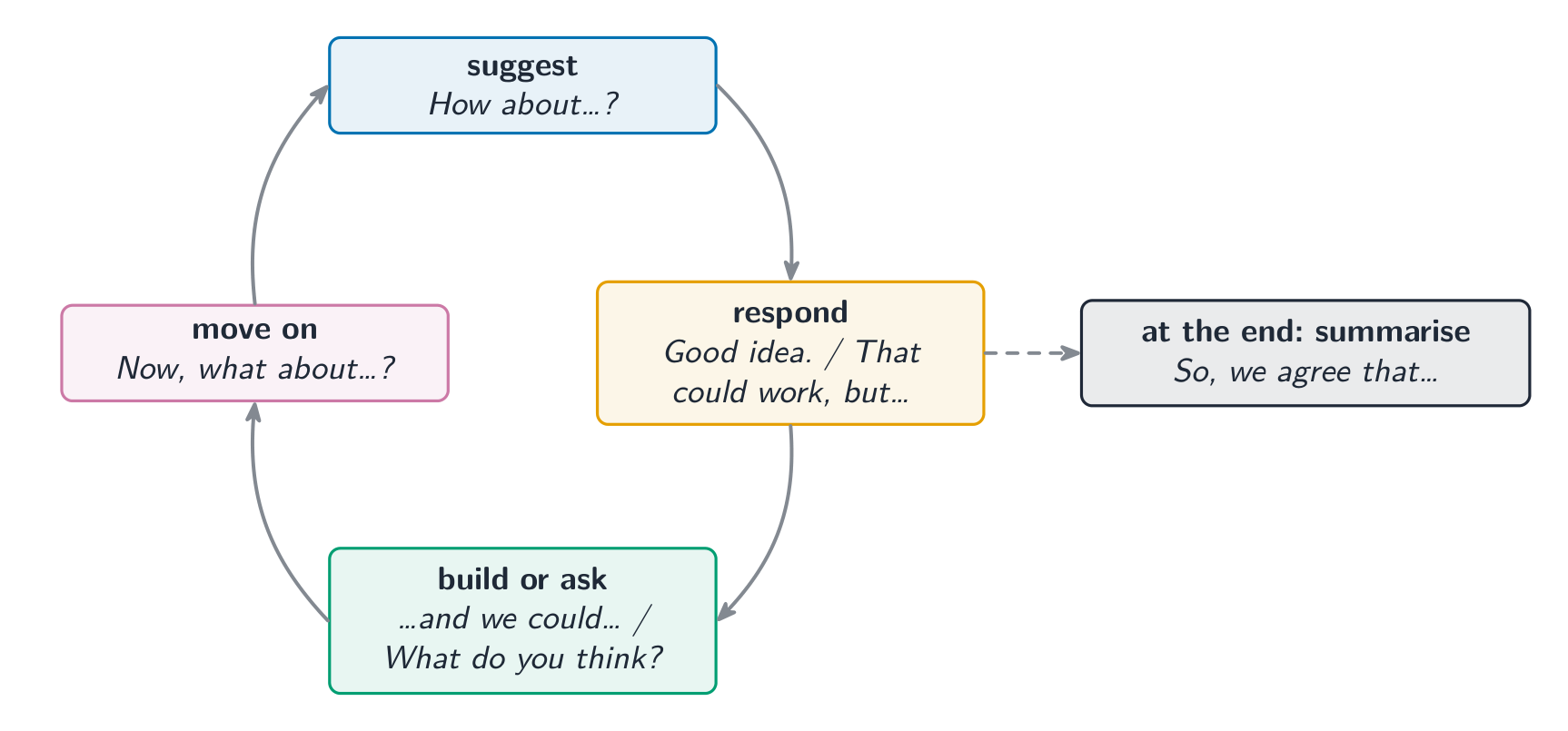
- Suggest → respond → build or ask → move on. Keep the turns short so the conversation goes back and forth.
- At the end, summarise: "So we agree that…". It shows you have reached a decision.
Put the conversation cycle in order.
Độ khó 3/5 · 200 xu + phần thưởng nhỏ khi hoàn thành lần đầu tiên hôm nay
Then repeat, and summarise at the end.
Listen: a model discussion
- Wei and Lucy plan the company's anniversary. Listen for suggestions, polite disagreement and the summary.
Transcript
Wei: So, we need to decide how to celebrate the company's tenth anniversary. Shall we start with the type of event? Lucy: Yes, good idea. What do you think about a dinner at a hotel? Wei: That could work, but it might be quite expensive for two hundred people. How about a party in our own building instead? Lucy: Hmm, I see what you mean about the cost. But our building isn't really big enough, is it? Wei: That's true. What about hiring a park for an afternoon? Families could come too. Lucy: I like that. It's cheaper than a hotel, and the staff's families would enjoy it. What about the weather, though? Wei: We could hold it in June, when it's usually dry, and book a large tent just in case. Lucy: OK, so we agree: a family afternoon in a park in June, with a tent. Now, who should we invite apart from staff?
Listen. Why does Wei not want a dinner at a hotel?
Độ khó 1/5 · 100 xu + phần thưởng nhỏ khi hoàn thành lần đầu tiên hôm nay
"That could work, but it might be quite expensive for two hundred people."
What do they decide?
Độ khó 1/5 · 100 xu + phần thưởng nhỏ khi hoàn thành lần đầu tiên hôm nay
"OK, so we agree: a family afternoon in a park in June, with a tent."
Language for working together
| Job | Phrases |
|---|---|
| Suggest | How about…? · What about…ing? · Shall we…? · Why don't we…? |
| Ask your partner | What do you think? · Do you agree? · …, don't you think? |
| Agree | Good idea. · I agree. · That's a good point. |
| Disagree politely | That could work, but… · I see what you mean, but… · I'm not sure about that, because… |
| Move on and summarise | Now, what about…? · So, we agree that… |
- Polite disagreement is not rude: it makes the conversation interesting. Always add a reason.
Match each phrase with its job.
Độ khó 2/5 · 140 xu + phần thưởng nhỏ khi hoàn thành lần đầu tiên hôm nay
A small set of phrases covers every move in the discussion.
Which is the best way to disagree?
Độ khó 1/5 · 100 xu + phần thưởng nhỏ khi hoàn thành lần đầu tiên hôm nay
Acknowledge the idea, then give your reason.
What lowers the Part 3 mark
- Long monologues. If you speak for a minute without stopping, your partner can't take part, and you lose interaction marks.
- Only agreeing. "Yes. Yes. I agree." gives the examiner nothing. Agree and add an idea.
- Ignoring what your partner said. Respond to their words: "I see what you mean about the cost, but…"
Saying "Yes, I agree" to everything your partner says is a good strategy.
Độ khó 1/5 · 100 xu + phần thưởng nhỏ khi hoàn thành lần đầu tiên hôm nay
Agree and add an idea, a reason or a question.
The three rules of Part 3
- Short turns, many of them: suggest, respond, ask.
- Disagree politely, with a reason: That could work, but…
- Finish with a decision: So, we agree that…
Your partner says: "I think we should give every customer a free gift at the trade fair." Record your reply: respond politely, give your view with a reason, and add a suggestion or a question.
Replay and check that your partner could easily answer you. If not, end with a question.
Đã xảy ra vấn đề gì? Chỉ đội ngũ trang web nhìn thấy thông tin này.