Planning a Study
Đã giới thiệu| English | Ý nghĩa |
|---|---|
| observational study/ɒbzəˈveɪʃənl ˈstʌdi/ | nghiên cứu quan sát |
| experiment/ekˈsperɪmənt/ | thí nghiệm |
| cause-and-effect/kɔːz ænd ɪˈfekt/ | nguyên nhân - kết quả |
| sample/ˈsæmpl/ | mẫu |
| confounding variable/kənˈfaʊndɪŋ ˈveərɪəbl/ | biến nhiễu |
Watching vs. doing
- Two ways to gather data: an observational study 观察性研究 or an experiment 实验.
- In an observational study you watch and measure — you don't change anything.
- In an experiment you impose a treatment and see what happens.
- The difference decides whether you can claim cause-and-effect 因果关系.
Population and sample
- The population is the whole group you want to learn about.
- The sample 样本 is the smaller part you actually study.
- You measure the sample, then hope to generalize back to the population.
- Good design keeps the sample a fair stand-in for the population.
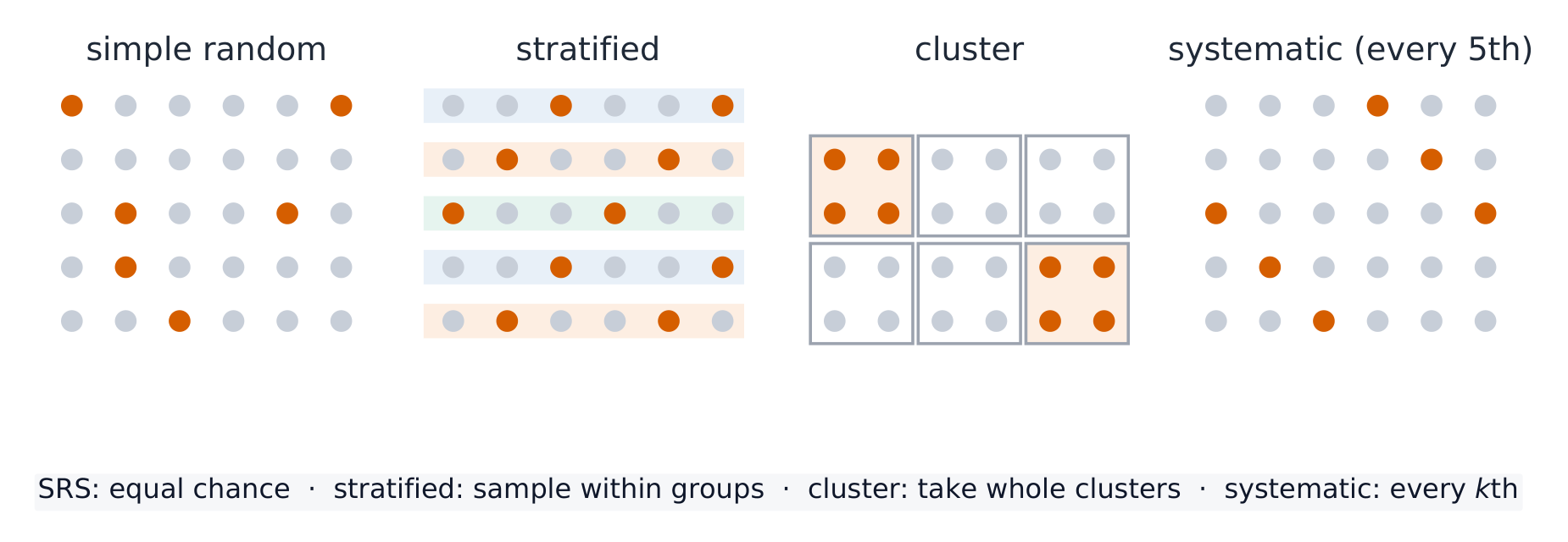
Simple random and stratified and cluster and systematic samples of the same population
Only experiments prove cause
- To show $X$ causes $Y$, you must actively assign $X$ and hold other things comparable.
- That's what an experiment does — and why only it can establish cause-and-effect.
- An observational study can reveal an association but never prove the cause.
- If you didn't control who got the treatment, you can't rule out other explanations.
The confounding trap
- In an observational study, a confounding variable 混杂变量 can create a misleading link.
- A confounder is tied to both the explanatory and the response variable.
- It makes two things look causally linked when a third factor drives both.
- This is exactly why "observed association" ≠ "cause."
The single most important distinction in Unit 3: only a well-designed experiment (with random assignment) can establish cause-and-effect. An observational study — however large or careful — can show association but is always open to a confounding variable, so it cannot prove that the explanatory variable caused the response.
Do vitamins improve health?
- Observational: compare people who choose to take vitamins vs. those who don't. Vitamin-takers may also exercise more — a confounder. No causal claim.
- Experiment: randomly assign people to vitamins or placebo. Random assignment balances exercise across groups → a causal conclusion is possible.
An observational study watches without intervening; an experiment imposes a treatment. You study a sample to learn about a population. Only an experiment with random assignment can establish cause-and-effect — an observational study is always vulnerable to a confounding variable.
Write from an experiment for cause
- A study randomly assigns a tutoring method.
- Another study only surveys students who already chose a method.
Which study can support a cause?
Random assignment is the experimental route to cause.
Which study can support a cause?
Độ khó 1/5 · 100 xu + một phần thưởng nhỏ cho lần hoàn thành đầu tiên trong ngày
Assignment, not a survey, supports cause.
A sample drawn from a population
The sample is a slice we study to learn about the whole.
Which type of study can establish a cause-and-effect relationship?
Độ khó 1/5 · 100 xu + một phần thưởng nhỏ cho lần hoàn thành đầu tiên trong ngày
Only random assignment in an experiment supports causation.
In an observational study, the researcher imposes a treatment on the subjects.
Độ khó 1/5 · 100 xu + một phần thưởng nhỏ cho lần hoàn thành đầu tiên trong ngày
Observational = watch and measure without intervening; experiments impose treatments.
The whole group you want to learn about is the ___.
Độ khó 1/5 · 100 xu + một phần thưởng nhỏ cho lần hoàn thành đầu tiên trong ngày
You study a sample to learn about the population.
Vitamin-takers also exercise more, muddying a study of vitamins and health. Exercise is a...
Độ khó 1/5 · 100 xu + một phần thưởng nhỏ cho lần hoàn thành đầu tiên trong ngày
It's tied to both taking vitamins and to health — a confounder.
Which are true of experiments (vs. observational studies)?
Độ khó 2/5 · 140 xu + một phần thưởng nhỏ cho lần hoàn thành đầu tiên trong ngày
Experiments impose treatments and, with randomization, support causation.