Kirchhoff's Loop Rule
Đã giới thiệu| English | Ý nghĩa |
|---|---|
| Kirchhoff's loop rule/ˈkɜːkhɒfs luːp ruːl/ | luật vòng Kirchhoff |
Walk a full loop and you end up at the same height
- Hike around a mountain trail that returns to the start — your net change in height is zero.
- Trace a charge around a full circuit loop and its net change in potential is zero too.
- This simple truth is Kirchhoff's loop rule 基尔霍夫回路定律.
- It lets you crack circuits too tangled for the series/parallel shortcuts alone.
The loop rule
- Around any complete loop, the voltage gains and drops sum to zero: $\sum V = 0$.
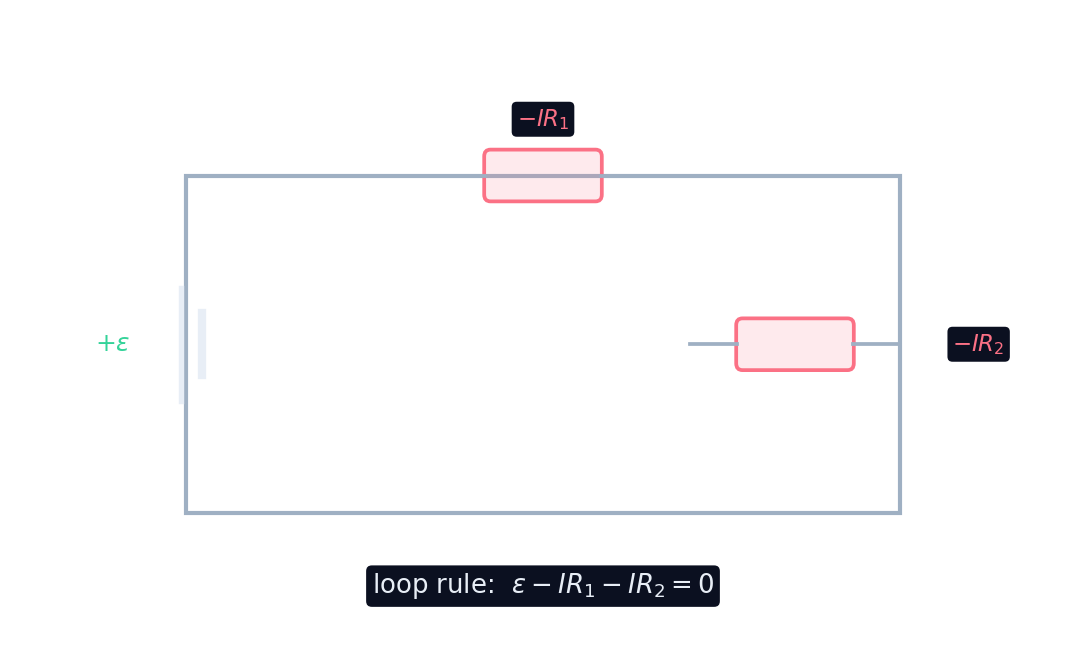
- A battery is a gain (+EMF); each resistor is a drop ($-IR$).
- It is really conservation of energy: energy gained per charge equals energy given up.
- Add them up going once around, and the total must return to zero.
Kirchhoff's loop rule is a statement of the conservation of:
Độ khó 1/5 · 100 xu + một phần thưởng nhỏ cho lần hoàn thành đầu tiên trong ngày
Voltages sum to zero because energy per charge is conserved around a loop.
Around any complete loop, the sum of the voltage gains and drops equals ____.
Độ khó 1/5 · 100 xu + một phần thưởng nhỏ cho lần hoàn thành đầu tiên trong ngày
$\sum V = 0$ around a loop.
Gains and drops
- Cross a battery from − to + and you gain its EMF (energy added per charge).
- Cross a resistor in the current's direction and you lose $IR$ (energy given to heat).
- The supply voltage is shared out among the components as drops.
- For a simple loop: $\varepsilon = IR_1 + IR_2 + \cdots$ — the EMF equals the total of the drops.
Crossing a battery from − to + in a loop, the potential:
Độ khó 1/5 · 100 xu + một phần thưởng nhỏ cho lần hoàn thành đầu tiên trong ngày
A battery adds energy per charge, a rise equal to its EMF.
In a simple single-loop circuit, the battery's EMF equals the sum of the resistor voltage drops.
Độ khó 1/5 · 100 xu + một phần thưởng nhỏ cho lần hoàn thành đầu tiên trong ngày
$\varepsilon = IR_1 + IR_2 + \cdots$ — the loop rule for a single loop.
Using it to solve circuits
- Write $\sum V = 0$ for each independent loop, then solve for the unknown currents.
- The loop rule handles multi-battery and bridge circuits that series/parallel cannot.
- Combined with the junction rule (next lesson), it solves any DC circuit.
- Keep the signs consistent: gains positive, drops negative, going one way round.
Kirchhoff's loop rule
Around any closed loop, the voltage gains equal the voltage drops. Sort each crossing.
A $9\ \text{V}$ battery drives current through $R_1 = 2\ \Omega$ and $R_2 = 1\ \Omega$ in series. Using the loop rule, what is the current, in $\text{A}$?
Độ khó 2/5 · 140 xu + một phần thưởng nhỏ cho lần hoàn thành đầu tiên trong ngày
$9 - 2I - I = 0 \Rightarrow 9 = 3I \Rightarrow I = 3\ \text{A}$.
Select all correct statements about the loop rule.
Độ khó 2/5 · 140 xu + một phần thưởng nhỏ cho lần hoàn thành đầu tiên trong ngày
The loop rule ($\sum V = 0$, gains + / drops −) works for any loop, not just single-resistor ones.
The loop rule is about energy per charge, so mind the signs: a battery adds voltage (+EMF), a resistor removes it ($-IR$). Go consistently one way around the loop. Mixing up the direction of a drop is the most common loop-rule error.
A $9\ \text{V}$ battery drives current through two resistors in series, $R_1 = 2\ \Omega$ and $R_2 = 1\ \Omega$. Find the current.
- Loop rule: $9 - I(2) - I(1) = 0 \Rightarrow 9 = 3I$.
- $I = \dfrac{9}{3} = 3\ \text{A}$ — the same result as adding the resistances.
Kirchhoff's loop rule: around any closed loop, $\sum V = 0$ — the battery's gain (+EMF) equals the sum of the resistor drops ($IR$). It is energy conservation for charge, and (with the junction rule) it solves any circuit. Keep the signs consistent.
Write from a loop current of 1 A
- A 10 V battery drives two series resistors, 6 ohm and 4 ohm.
- Use the loop rule to find the current.
A 10 V battery is in series with a 6 ohm resistor and a 4 ohm resistor. Using the loop rule, what is the current, in amperes?
The drops share one current, and 10 divided by 10 is 1.
What is the current in the loop?
Độ khó 1/5 · 100 xu + một phần thưởng nhỏ cho lần hoàn thành đầu tiên trong ngày
EMF divided by the series total is 1 A. Other options — 3 A (the lesson current); 10 A (the voltage used as the current).