Spatial Organization of Agriculture
Đã giới thiệu| English | Ý nghĩa |
|---|---|
| bid-rent theory/bɪd rent ˈθɪəri/ | lý thuyết trả tiền thuê |
Land, cost, and distance
- Where a farm locates depends on land cost and distance to market.
- Bid-rent theory 竞租理论 explains why land near a market is used more intensively.
- Land near the market is expensive, so it must earn more per hectare.
Bid-rent theory says land close to the market is used...
Độ khó 1/5 · 100 xu + một phần thưởng nhỏ cho lần hoàn thành đầu tiên trong ngày
Expensive near-market land must earn more, so it is farmed intensively.
The bid-rent curve
- Land value falls with distance from the market (the bid-rent curve slopes down).
- So intensive, high-value farming crowds near the market.
- Extensive, low-value farming (ranching) locates far away where land is cheap.
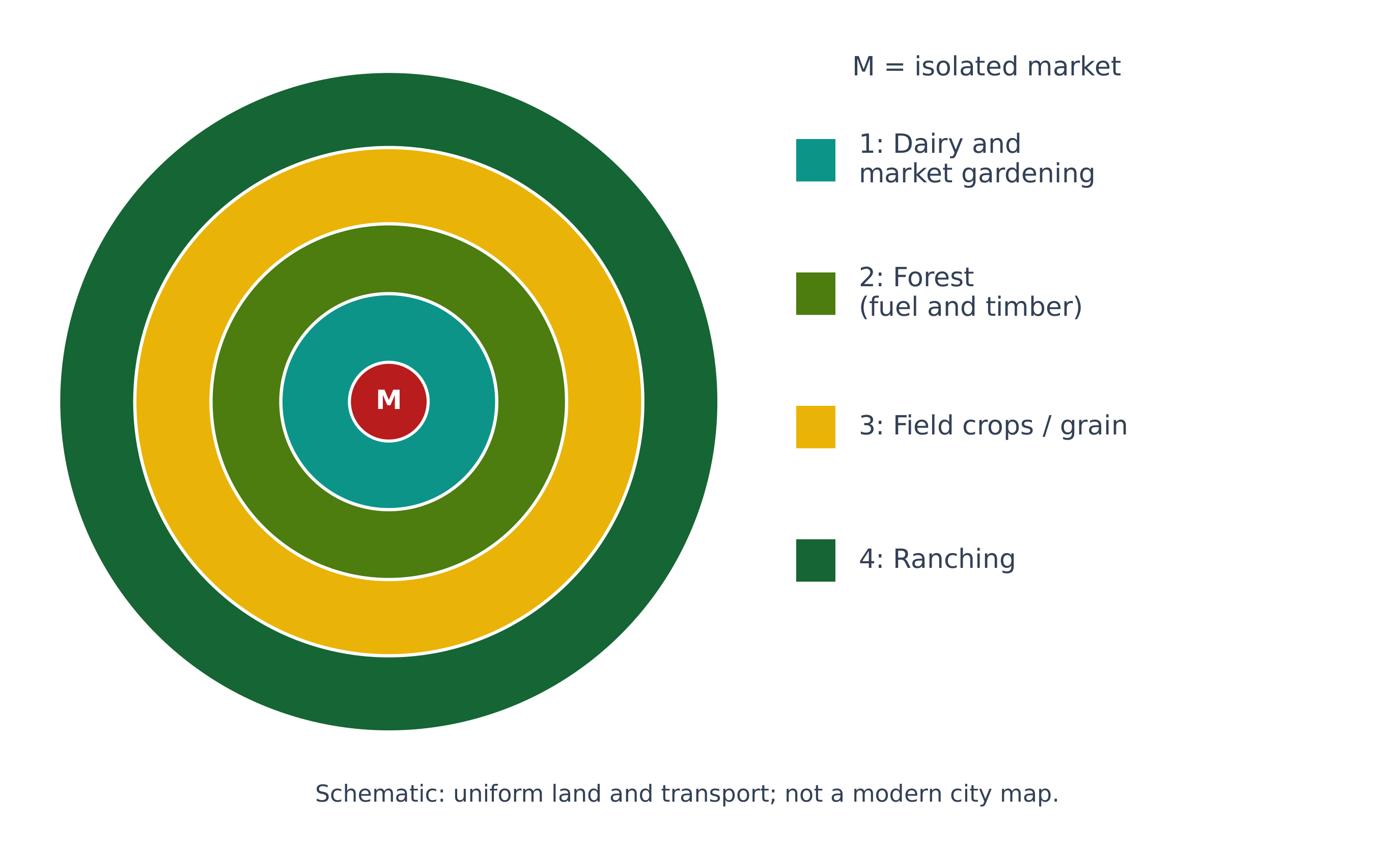
Simplified historical rings around an isolated market under uniform land and transport assumptions
Near or far from the market?
Sort each farm by where bid-rent theory puts it.
The bid-rent curve shows land value falling as distance from the market grows.
Độ khó 1/5 · 100 xu + một phần thưởng nhỏ cho lần hoàn thành đầu tiên trong ngày
Land is dearest at the market and cheaper farther out.
Select all farms that locate near the market.
Độ khó 2/5 · 140 xu + một phần thưởng nhỏ cho lần hoàn thành đầu tiên trong ngày
Perishable, intensive farming is near; extensive ranching is far.
Match each to its location.
Độ khó 2/5 · 140 xu + một phần thưởng nhỏ cho lần hoàn thành đầu tiên trong ngày
Dairy near; grain far; bid-rent = land value falling with distance.
Transport costs matter
- Perishable and heavy goods cost more to move, so they locate near the market.
- Durable, light goods can be grown far away.
- This trade-off between land cost and transport cost shapes land use.
Perishable, heavy goods locate near the market because they have high ____ costs.
Độ khó 1/5 · 100 xu + một phần thưởng nhỏ cho lần hoàn thành đầu tiên trong ngày
High transport cost pulls perishable goods close to the market.
Bid-rent is a trade-off, not a single rule. A crop near the market pays high land cost but low transport cost; far away it is the reverse. Farmers locate where the total of land + transport cost is lowest for their crop.
Fresh milk is perishable and heavy, so dairy farms cluster near the city despite high land prices. Grain stores and ships cheaply, so it grows far out where land is cheap. Each crop finds the spot where land + transport cost is lowest.
Bid-rent theory says land value falls with distance from the market, so intensive, high-value farming crowds near it and extensive, low-value farming locates far out. Farmers balance land cost against transport cost to choose a location.
Write from dairy closer to the market
- Milk spoils quickly and is expensive to haul far.
- Grain stores well and uses more land per unit of value.
Which farm sits closer to the city market, and why?
Perishable, high-value output outbids other uses near the market.
Which farm is closer to the city?
Độ khó 1/5 · 100 xu + một phần thưởng nhỏ cho lần hoàn thành đầu tiên trong ngày
Milk's perishability pulls dairy inward.