Sự suy giảm Tầng ozone
Đã giới thiệu| English | Ý nghĩa |
|---|---|
| ozone layer/ˈəʊzəʊn ˈleɪə/ | lớp ozone |
| ultraviolet/ˌʊltrəˈvaɪəlɪt/ | tia cực tím |
| CFCs/ˌsiː ef ˈsiːz/ | CFCs |
| chlorine/ˈklɔːriːn/ | clo |
Earth's sunscreen
- High in the atmosphere sits the ozone layer 臭氧层.
- It absorbs most of the sun's harmful ultraviolet 紫外线 rays.
- Without it, that UV would damage life on the surface.
- In the 20th century, we accidentally started destroying it.
The culprit: CFCs
- CFCs 氯氟烃 were chemicals used in fridges and spray cans.
- They seemed safe — stable, cheap, and non-toxic.
- But when they leak, they drift slowly up into the atmosphere.
- It takes years for them to reach the ozone layer.
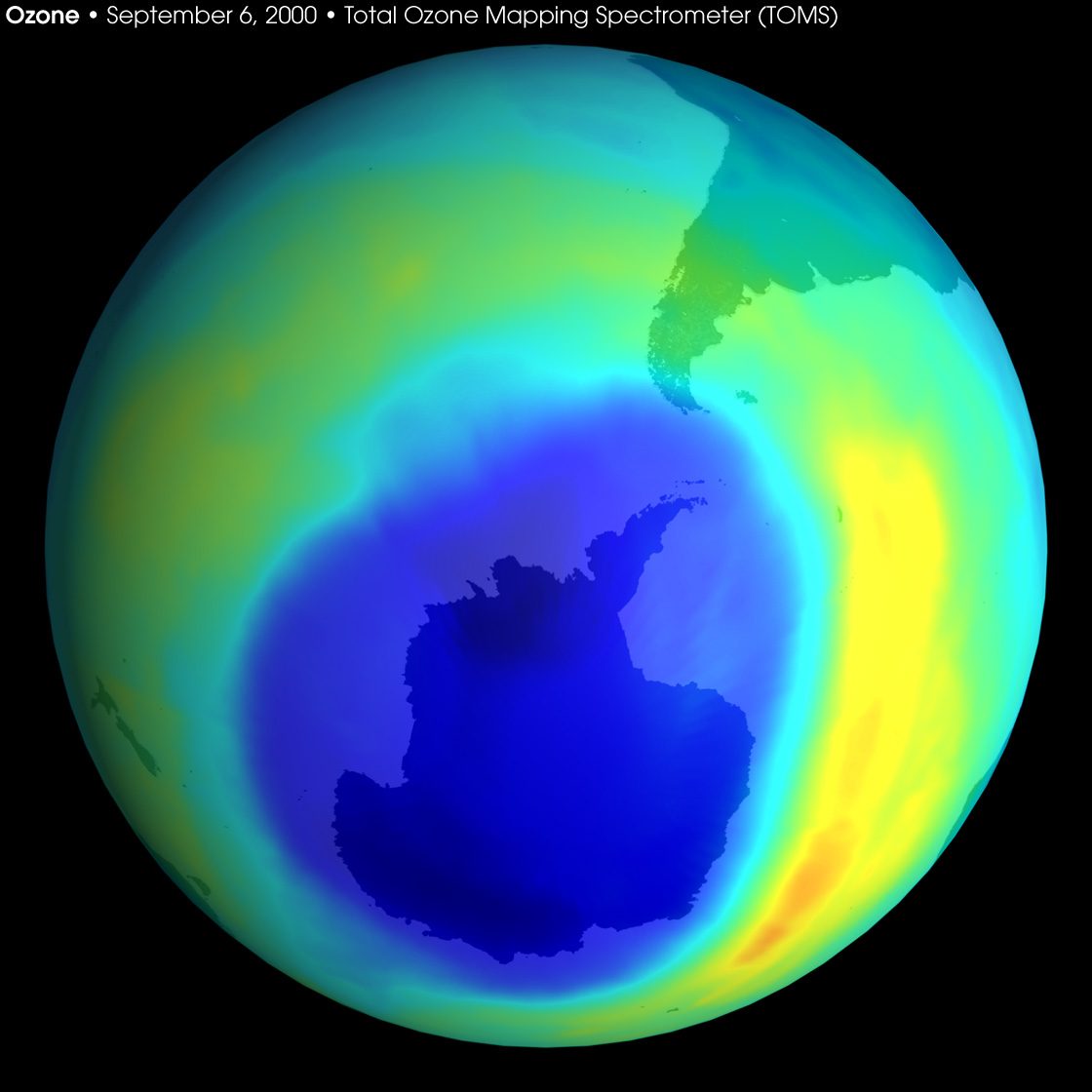
The ozone hole over Antarctica (dark blue) on a NASA satellite map: this is where the ozone layer has thinned the most
Lớp ozone ở độ cao trong khí quyển rất quan trọng vì nó…
Độ khó 1/5 · 100 xu + một phần thưởng nhỏ cho lần hoàn thành đầu tiên trong ngày
Lớp ozone hấp thụ hầu hết tia UV có hại của mặt trời, bảo vệ sự sống bên dưới.
How they destroy ozone
- High up, the sun's UV breaks a CFC apart.
- This frees a chlorine 氯 atom.
- The chlorine atom rips apart ozone molecules.
- Worse, it keeps going — one atom destroys thousands.
Cách CFCs phá hủy lớp ozone
Theo dõi một phân tử CFC từ bình xịt lên đến tầng bình lưu, nơi nó phá hủy ozone.
Sự suy giảm ozone chủ yếu do CFCs, những chất hóa học từng được dùng trong…
Độ khó 1/5 · 100 xu + một phần thưởng nhỏ cho lần hoàn thành đầu tiên trong ngày
CFCs (chlorofluorocarbons) đã được sử dụng trong làm mát và phun xịt cho đến khi phát hiện ra chúng phá hủy ozone.
Lớp ozone mỏng hơn cho phép nhiều bức xạ ____ có hại hơn tiếp cận mặt đất.
Độ khó 1/5 · 100 xu + một phần thưởng nhỏ cho lần hoàn thành đầu tiên trong ngày
Ít ozone hơn nghĩa là nhiều UV hơn sẽ đến với chúng ta, làm tăng nguy cơ ung thư da và tổn thương mắt.
The ozone hole
- Over Antarctica, so much ozone was lost it became a "hole".
- A thinner layer lets more UV reach the ground.
- More UV means more skin cancer and eye damage.
- It also harms crops and the ocean's plankton.
Một nguyên tử clo duy nhất có thể phá hủy hàng nghìn phân tử ozone.
Độ khó 1/5 · 100 xu + một phần thưởng nhỏ cho lần hoàn thành đầu tiên trong ngày
Clo hoạt động như một chất xúc tác — nó liên tục phá hủy ozone mà không bị tiêu hao.
Chọn tất cả các tác hại của lớp ozone mỏng đi.
Độ khó 2/5 · 140 xu + một phần thưởng nhỏ cho lần hoàn thành đầu tiên trong ngày
Nhiều UV hơn dẫn đến nhiều ung thư da, tổn thương mắt và gây hại cho cây trồng cũng như sinh vật phù du. Nó không giúp xương chắc khỏe.
Don't confuse this with the greenhouse effect — they are different problems. Ozone depletion is about a thinning shield high up that lets harmful UV through (a radiation problem). The greenhouse effect is about gases trapping heat (a warming problem). A common exam trap is to mix them up. Also note: the ozone that shields us is high up (good); ground-level ozone in smog is a pollutant (bad).
The chlorine chain reaction:
- A CFC from an old fridge finally reaches the stratosphere after drifting up for years.
- The sun's UV splits it, freeing a chlorine atom.
- That one atom destroys an ozone molecule, then breaks free and destroys another, and another — thousands in all.
- Multiply by the billions of CFC molecules released, and the ozone layer thins into a hole.
The ozone layer shields Earth by absorbing the sun's harmful UV rays. CFCs from fridges and sprays drift up to the stratosphere, where UV frees a chlorine atom that destroys thousands of ozone molecules each. The thinning layer lets more UV through, causing skin cancer, eye damage, and harm to crops and plankton. (This is separate from the greenhouse effect.)