Thiết kế và Phát triển Chương trình
Đã giới thiệu| English | Ý nghĩa |
|---|---|
| process/ˈprəʊses/ | Quy trình |
| development process/dɪˈveləpmənt ˈprəʊses/ | Quy trình phát triển |
| iterative/ˈɪtərətɪv/ | Lặp lại |
| prototype/ˈprəʊtəʊtaɪp/ | Bản mẫu thử nghiệm |
| test/test/ | Kiểm tra |
| incremental/ˌɪŋkrɪˈmentl/ | Tăng tiến |
| program requirement/ˈprəʊɡræm rɪˈkwaɪəmənt/ | yêu cầu của chương trình |
| Pseudocode/ˈsuːdəʊkəʊd/ | giả mã |
| comment/ˈkɒment/ | ghi chú |
| Refining/rɪˈfaɪnɪŋ/ | tinh chỉnh |
Coding is a process, not one burst
- Writing a program is a process 过程, not a single burst of typing.
- Skipping design and coding right away usually wastes time.
- Experienced programmers follow a repeatable development process 开发流程.
- Best of all, the process loops — you improve a little each time around.
Thói quen tốt là bắt đầu viết mã ngay lập tức, bỏ qua thiết kế.
Độ khó 1/5 · 100 xu + một phần thưởng nhỏ cho lần hoàn thành đầu tiên trong ngày
Bỏ qua thiết kế thường lãng phí thời gian — hãy lên kế hoạch trước, sau đó mới viết mã.
The iterative cycle
- A common cycle has four stages: investigate, design, prototype 原型, test 测试.
- Investigate: understand the problem and the users — what inputs and outputs matter?
- Design the structure, build a rough prototype, then test it with many inputs.
- The process is iterative 迭代的 and incremental 增量的: repeat, improving a little each pass.
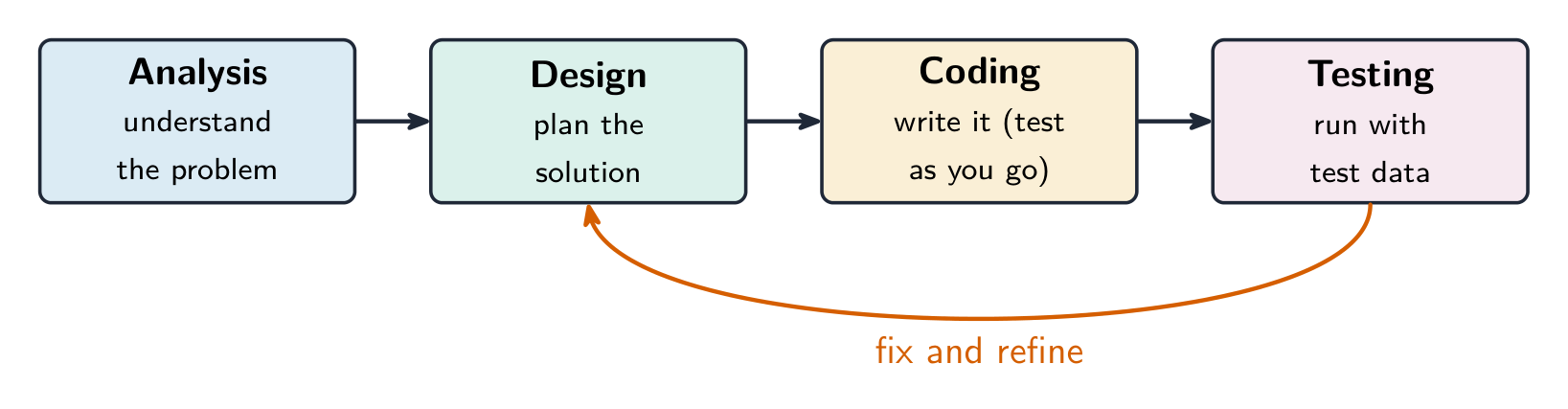
The stages of program development, with testing feeding back to fix and refine
Chu kỳ phát triển lặp lại
Phát triển vòng lặp qua khám phá, thiết kế, nguyên mẫu và thử nghiệm — cải thiện chương trình một chút ở mỗi lần lặp.
Sắp xếp thứ tự một vòng lặp của chu kỳ phát triển.
Độ khó 3/5 · 200 xu + một phần thưởng nhỏ cho lần hoàn thành đầu tiên trong ngày
Khám phá → Thiết kế → Nguyên mẫu → Thử nghiệm, sau đó quay lại.
Một quy trình lặp lại các giai đoạn của nó, cải thiện một chút mỗi lần, là ______.
Độ khó 1/5 · 100 xu + một phần thưởng nhỏ cho lần hoàn thành đầu tiên trong ngày
Phát triển lặp lại và tăng dần vòng lặp để tinh chỉnh chương trình.
Planning tools
- A program requirement 需求 is a specific thing the program must do — list them first to stay focused.
- Pseudocode 伪代码 is a plain-language sketch of the logic, written before real code.
- It reads like English but follows a program's step-by-step shape, so a team can agree on the plan.
Pseudocode for a guessing game: pick a secret number → ask the user for a guess → if it is too high or too low, say so and ask again → repeat until the guess is correct. No exact syntax, just the plan.
Pseudocode (Giả mã) là:
Độ khó 1/5 · 100 xu + một phần thưởng nhỏ cho lần hoàn thành đầu tiên trong ngày
Nó đọc giống tiếng Anh nhưng tuân theo cấu trúc từng bước của một chương trình.
Một comment (bình luận) trong mã nguồn là:
Độ khó 1/5 · 100 xu + một phần thưởng nhỏ cho lần hoàn thành đầu tiên trong ngày
Comment giải thích mã khó hiểu đối với người đọc con người.
Tinh chỉnh chương trình sau khi thử nghiệm là một phần bình thường, được mong đợi trong quá trình phát triển.
Độ khó 1/5 · 100 xu + một phần thưởng nhỏ cho lần hoàn thành đầu tiên trong ngày
Phiên bản đầu tiên hiếm khi là phiên bản cuối cùng.
Keeping it understandable
- A comment 注释 is a note in the source that the computer ignores but humans read.
- Teams also keep a development log recording their thinking.
- Key mindset: a first version is rarely the final one.
- Refining 改进 a program after testing is normal and expected, not a failure.
Programming is an iterative development process: investigate → design → prototype → test, looping to improve a little each pass. Plan with clear requirements and pseudocode, keep the code readable with comments, and expect to keep refining — a first version is rarely the last.