Xác Định Tọa Độ Cực Và Đạo Hàm Trong Dạng Cực
Đã giới thiệu| English | Ý nghĩa |
|---|---|
| Cartesian/kɑːˈtiːzɪən/ | tọa độ Descartes |
| Polar coordinates/ˈpəʊlə kəʊˈɔːdɪnəts/ | tọa độ cực |
Locating points by angle and distance
- Cartesian coordinates use "right $x$, up $y$." Polar coordinates 极坐标 use "angle and distance."
- A point is $(r,\theta)$: $r$ is how far from the origin, $\theta$ is the angle from the positive $x$-axis.
- Circles and spirals that are ugly in $x,y$ become simple in polar form.
- Curves are written $r=f(\theta)$ — radius as a function of angle.
Converting polar ⇄ Cartesian
- Polar to Cartesian 直角坐标: $x=r\cos\theta$, $y=r\sin\theta$.
- Cartesian to polar: $r=\sqrt{x^2+y^2}$ and $\tan\theta=\tfrac{y}{x}$.
- These come straight from right-triangle trig on the point.
- Switch whichever way makes the problem easier.
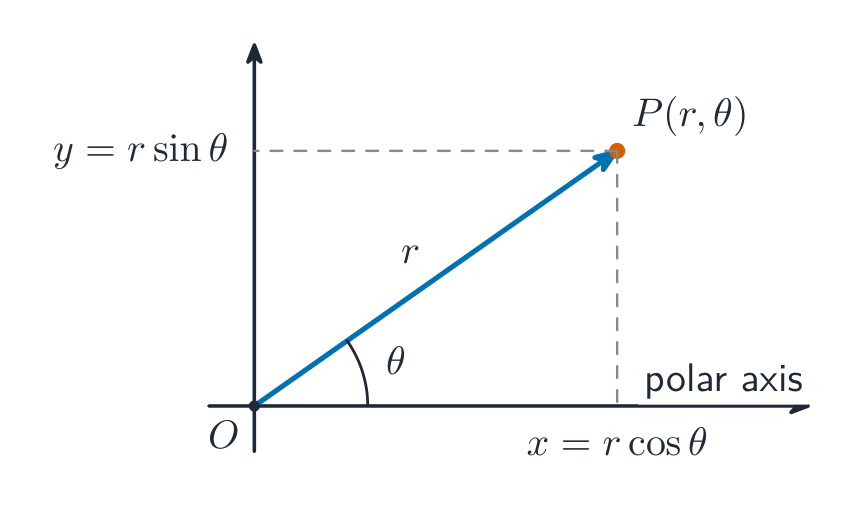
Polar coordinates give a point by its distance r and angle theta
Sin và cos xây dựng tọa độ cực
$x=r\cos\theta$, $y=r\sin\theta$ — tọa độ cực được xây dựng từ hai hàm lượng giác này của góc.
Sự chuyển đổi từ cực sang Descartes là...
Độ khó 1/5 · 100 xu + một phần thưởng nhỏ cho lần hoàn thành đầu tiên trong ngày
$x=r\cos\theta$, $y=r\sin\theta$.
Để chuyển đổi Descartes sang cực, $r=\sqrt{x^2+\ \_\_\_\ }$.
Độ khó 1/5 · 100 xu + một phần thưởng nhỏ cho lần hoàn thành đầu tiên trong ngày
$r=\sqrt{x^2+y^2}$.
A polar curve is secretly parametric
- Treat $r=f(\theta)$ as a parametric curve with $\theta$ as the parameter:
- $x=f(\theta)\cos\theta$ and $y=f(\theta)\sin\theta$.
- Now all the parametric machinery applies — including the slope $\tfrac{dy}{dx}=\tfrac{dy/d\theta}{dx/d\theta}$.
- So "differentiating in polar" just means parametric differentiation with these $x,y$.
Chuyển đổi $(2,\tfrac{\pi}{3})$: tìm tọa độ $x$.
Độ khó 2/5 · 140 xu + một phần thưởng nhỏ cho lần hoàn thành đầu tiên trong ngày
$2\cos\tfrac{\pi}{3}=2\cdot\tfrac12=1$.
Đường cong cực $r=f(\theta)$ có thể được xem xét như một đường cong tham số với tham số...
Độ khó 1/5 · 100 xu + một phần thưởng nhỏ cho lần hoàn thành đầu tiên trong ngày
$x=f(\theta)\cos\theta$, $y=f(\theta)\sin\theta$ với tham số $\theta$.
Finding the slope $\tfrac{dy}{dx}$
- Compute $\tfrac{dx}{d\theta}$ and $\tfrac{dy}{d\theta}$ from the product/chain rule on $f(\theta)\cos\theta$ and $f(\theta)\sin\theta$.
- Then $\tfrac{dy}{dx}=\tfrac{dy/d\theta}{dx/d\theta}$ — the ordinary parametric slope.
- Warning: $\tfrac{dy}{dx}$ is not $\tfrac{dr}{d\theta}$; the slope needs the full $x,y$ derivatives.
- The parameter is $\theta$, so differentiate the $x,y$ expressions with respect to $\theta$.
Độ dốc $\tfrac{dy}{dx}$ của một đường cong cực bằng $\tfrac{dr}{d\theta}$.
Độ khó 1/5 · 100 xu + một phần thưởng nhỏ cho lần hoàn thành đầu tiên trong ngày
Độ dốc là $\tfrac{dy/d\theta}{dx/d\theta}$, sử dụng đạo hàm $x,y$.
Tọa độ cực $(r,\theta)$ và $(r,\theta+2\pi)$ mô tả cùng một điểm.
Độ khó 1/5 · 100 xu + một phần thưởng nhỏ cho lần hoàn thành đầu tiên trong ngày
Thêm một vòng quay đầy đủ sẽ trở về cùng một điểm.
The slope of a polar curve is $\dfrac{dy/d\theta}{dx/d\theta}$, not $\dfrac{dr}{d\theta}$. You must convert to $x=r\cos\theta$, $y=r\sin\theta$ first and differentiate those (product rule!) with respect to $\theta$. And a point's polar coordinates aren't unique — $(r,\theta)$ and $(r,\theta+2\pi)$ are the same point.
Convert the polar point $\big(2,\tfrac{\pi}{3}\big)$ to Cartesian.
- $x=r\cos\theta=2\cos\tfrac{\pi}{3}=2\cdot\tfrac12=1$.
- $y=r\sin\theta=2\sin\tfrac{\pi}{3}=2\cdot\tfrac{\sqrt3}{2}=\sqrt3$.
- So the point is $\big(1,\sqrt3\big)$.
Polar coordinates $(r,\theta)$ give a point by distance and angle. Convert with $x=r\cos\theta$, $y=r\sin\theta$ (and back via $r=\sqrt{x^2+y^2}$). A polar curve $r=f(\theta)$ is a parametric curve in $\theta$, so its slope is $\frac{dy/d\theta}{dx/d\theta}$ — not $\frac{dr}{d\theta}$.