Xác Định và Đạo Hàm Các Hàm Giá Trị Vector
Đã giới thiệu| English | Ý nghĩa |
|---|---|
| vector-valued function/ˈvektə ˈvæljuːd ˈfʌŋkʃn/ | hàm vector |
Packaging motion into a single arrow
- A parametric curve gives $x(t)$ and $y(t)$ separately. Bundle them into one object: a vector-valued function 向量值函数.
- $\mathbf{r}(t)=\langle x(t),\,y(t)\rangle$ is the position vector — an arrow from the origin to the moving point.
- It describes planar motion compactly, tracking both coordinates at once.
- Everything from parametric curves reappears here, in vector form.
Quỹ đạo do r(t) tạo ra
y = ax² + bx
Vector vị trí $\mathbf{r}(t)$ chỉ vào hạt đang chuyển động; đạo hàm của nó (theo từng thành phần) là vector vận tốc.
Differentiate component by component
- To differentiate a vector-valued function, just differentiate each component separately:
-
$$\mathbf{r}'(t)=\langle x'(t),\,y'(t)\rangle$$
- No new rules — the derivative of a vector is the vector of the derivatives.
- $\mathbf{r}'(t)$ is the velocity vector, pointing in the direction of motion.
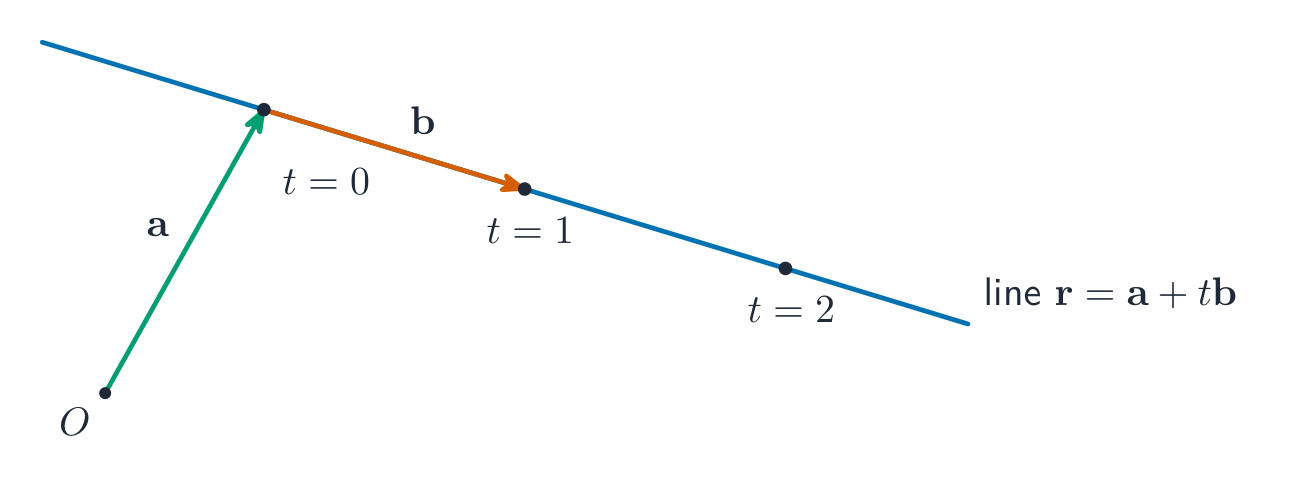
A vector-valued line: start at a, then slide by t lots of the direction b
Để đạo hàm $\mathbf{r}(t)=\langle x(t),y(t)\rangle$, bạn...
Độ khó 1/5 · 100 xu + một phần thưởng nhỏ cho lần hoàn thành đầu tiên trong ngày
$\mathbf{r}'=\langle x',y'\rangle$.
Velocity and acceleration vectors
- $\mathbf{v}(t)=\mathbf{r}'(t)=\langle x'(t),\,y'(t)\rangle$ — the velocity vector.
- $\mathbf{a}(t)=\mathbf{r}''(t)=\langle x''(t),\,y''(t)\rangle$ — the acceleration vector.
- Each is found by differentiating the components again.
- The velocity vector is tangent to the path; its length is the speed.
Đối với $\mathbf{r}(t)=\langle t^2,\sin t\rangle$, vận tốc là $\mathbf{v}(t)=$
Độ khó 1/5 · 100 xu + một phần thưởng nhỏ cho lần hoàn thành đầu tiên trong ngày
Đạo hàm từng thành phần.
Vector gia tốc là...
Độ khó 1/5 · 100 xu + một phần thưởng nhỏ cho lần hoàn thành đầu tiên trong ngày
Đạo hàm vị trí hai lần: $\mathbf{a}=\mathbf{r}''$.
Speed is the magnitude of velocity
- Speed is not a vector — it's the magnitude $|\mathbf{v}(t)|=\sqrt{\big(x'(t)\big)^2+\big(y'(t)\big)^2}$.
- That's the same speed integrand as parametric arc length.
- So velocity carries direction and size; speed is just the size.
- Differentiate to go position → velocity → acceleration, component by component.
Đối với $\mathbf{v}(0)=\langle 0,1\rangle$, tìm tốc độ $|\mathbf{v}(0)|$.
Độ khó 2/5 · 140 xu + một phần thưởng nhỏ cho lần hoàn thành đầu tiên trong ngày
$\sqrt{0^2+1^2}=1$.
Tốc độ là một vector, giống hệt vận tốc.
Độ khó 1/5 · 100 xu + một phần thưởng nhỏ cho lần hoàn thành đầu tiên trong ngày
Tốc độ là độ lớn vô hướng $|\mathbf{v}|$.
Tốc độ bằng ____ của vector vận tốc.
Độ khó 1/5 · 100 xu + một phần thưởng nhỏ cho lần hoàn thành đầu tiên trong ngày
$|\mathbf{v}|=\sqrt{(x')^2+(y')^2}$.
Differentiate a vector component by component — don't try to differentiate the "whole vector" as one messy expression. And keep velocity (a vector) distinct from speed (its magnitude, a scalar): $|\mathbf{v}|=\sqrt{(x')^2+(y')^2}$, never just $x'+y'$.
For $\mathbf{r}(t)=\langle t^2,\ \sin t\rangle$, find $\mathbf{v}(t)$ and the speed at $t=0$.
- $\mathbf{v}(t)=\mathbf{r}'(t)=\langle 2t,\ \cos t\rangle$.
- At $t=0$: $\mathbf{v}(0)=\langle 0,\ 1\rangle$.
- Speed $=|\mathbf{v}(0)|=\sqrt{0^2+1^2}=1$.
A vector-valued function $\mathbf{r}(t)=\langle x(t),y(t)\rangle$ describes planar motion. Differentiate it component by component: $\mathbf{v}=\mathbf{r}'=\langle x',y'\rangle$ (velocity), $\mathbf{a}=\mathbf{r}''$ (acceleration). Speed is the magnitude $|\mathbf{v}|=\sqrt{(x')^2+(y')^2}$ — a scalar, distinct from the velocity vector.