Tìm Nghiệm Tổng Quát Bằng Phương Pháp Tách Biến
Đã giới thiệu| English | Ý nghĩa |
|---|---|
| separable/ˈsepərəbl/ | có thể tách biến |
Get the $x$'s and $y$'s on opposite sides
- To actually solve a differential equation (not just sketch it), we integrate — but first we sort the variables.
- A differential equation is separable 可分离 if you can write it so one side has only $y$ and the other only $x$.
- $\dfrac{dy}{dx}=g(x)\,h(y)$ is the tell-tale form: a product of an $x$-part and a $y$-part.
- Then each side can be integrated on its own.
Phương trình nào có thể tách biến?
Độ khó 1/5 · 100 xu + một phần thưởng nhỏ cho lần hoàn thành đầu tiên trong ngày
$xy$ phân tích thành (phần ⟨$x$⟩)$\times$(phần ⟨$y$⟩); một tổng thì không.
$\dfrac{dy}{dx}=x+y$ không thể tách biến vì bạn không thể tách một ____.
Độ khó 1/5 · 100 xu + một phần thưởng nhỏ cho lần hoàn thành đầu tiên trong ngày
Tách biến yêu cầu một tích, không phải một tổng.
Separate the variables
- Treat $\dfrac{dy}{dx}$ as a ratio of differentials and move each variable to its own side.
- From $\dfrac{dy}{dx}=g(x)\,h(y)$: divide by $h(y)$ and multiply by $dx$:
-
$$\frac{1}{h(y)}\,dy = g(x)\,dx$$
- Now each side involves only one variable and its differential — ready to integrate.
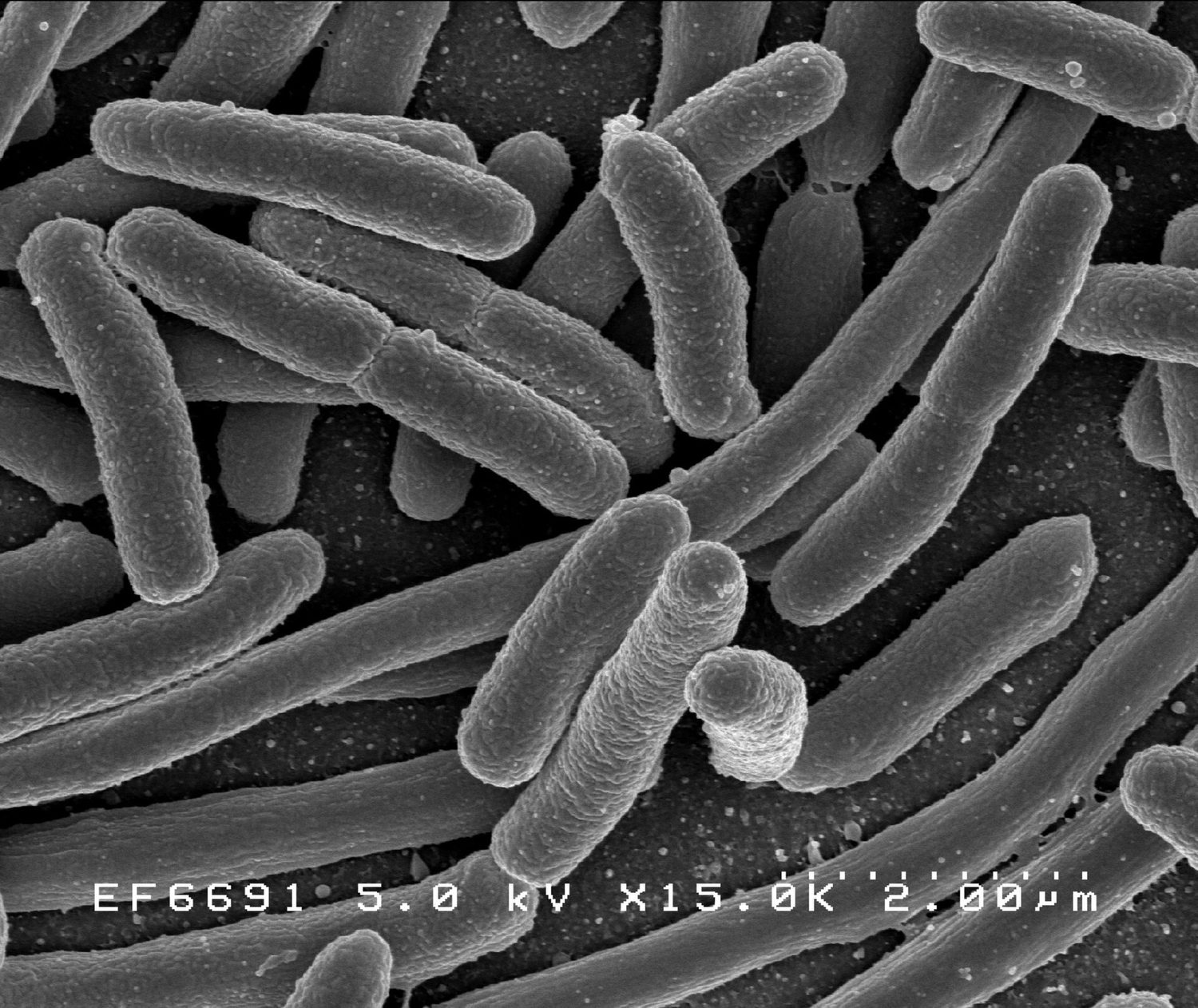
E. coli under a microscope: differential equations model exponential growth
Tách $\dfrac{dy}{dx}=xy$ cho ra...
Độ khó 1/5 · 100 xu + một phần thưởng nhỏ cho lần hoàn thành đầu tiên trong ngày
Chia cho $y$, nhân với $dx$: $\tfrac1y\,dy=x\,dx$.
Integrate both sides
- Integrate the left in $y$ and the right in $x$: $\displaystyle\int\frac{1}{h(y)}\,dy=\int g(x)\,dx$.
- Add a single constant $+C$ (one is enough — combine both sides' constants).
- Then solve for $y$ if you can, to get the general solution.
- The result is a family of functions with the constant $C$.
Nghiệm tổng quát là một họ
Giải $\tfrac{dy}{dx}=ay$ cho ra $y=Ce^{ax}$ — một đường cong cho mỗi hằng số, tất cả đều khớp với cùng một trường.
Tích phân $\dfrac{1}{y}\,dy = x\,dx$ cho ra...
Độ khó 1/5 · 100 xu + một phần thưởng nhỏ cho lần hoàn thành đầu tiên trong ngày
$\int\tfrac1y\,dy=\ln|y|$; $\int x\,dx=\tfrac{x^2}{2}$; cộng thêm $+C$.
Keep the $+C$ (and solve for $y$)
- The constant of integration is what makes this a family — never drop it.
- Often you'll exponentiate or rearrange to isolate $y$; the $C$ transforms but stays.
- Leaving the answer as an implicit relation is fine if $y$ can't be cleanly isolated.
- A later initial condition (lesson 7.7) will nail down $C$.
Bạn nên bao gồm hằng số $+C$ khi giải phương trình vi phân bằng phương pháp tách biến.
Độ khó 1/5 · 100 xu + một phần thưởng nhỏ cho lần hoàn thành đầu tiên trong ngày
$+C$ cho ra nghiệm tổng quát (họ nghiệm).
Nghiệm tổng quát của $\dfrac{dy}{dx}=xy$ là...
Độ khó 1/5 · 100 xu + một phần thưởng nhỏ cho lần hoàn thành đầu tiên trong ngày
Lũy thừa $\ln|y|=\tfrac{x^2}{2}+C$ để lấy $y=A e^{x^2/2}$.
Separation works only if the equation factors as (function of $x$) $\times$ (function of $y$). Something like $\frac{dy}{dx}=x+y$ is not separable — you can't split a sum. And don't forget the $+C$ after integrating: without it you have one curve, not the general family.
Solve $\dfrac{dy}{dx}=xy$ (general solution).
- Separate: $\dfrac{1}{y}\,dy = x\,dx$.
- Integrate: $\ln|y| = \dfrac{x^2}{2}+C$.
- Exponentiate: $y = e^{x^2/2+C}=A\,e^{x^2/2}$ (writing $A=e^C$). General solution: $y=A\,e^{x^2/2}$.
Separation of variables solves a separable equation $\frac{dy}{dx}=g(x)h(y)$: rearrange to $\frac{1}{h(y)}\,dy=g(x)\,dx$, integrate both sides (one $+C$), and solve for $y$ to get the general solution. It only works when the equation factors into an $x$-part times a $y$-part.