xấp xỉ nghiệm bằng phương pháp Euler
Đã giới thiệu| English | Ý nghĩa |
|---|---|
| Euler's method/ˈɔɪləz ˈmeθəd/ | phương pháp Euler |
| step size/step saɪz/ | bước nhảy |
Walking a solution one small step at a time
- Not every differential equation can be solved with a formula — but you can still approximate the solution numerically.
- Euler's method 欧拉法 follows the slope field in tiny straight steps from a starting point.
- At each point, use the differential equation to get the slope, then step forward along it.
- Repeat, and you trace an approximate solution curve.
The update rule
- Given $\dfrac{dy}{dx}=f(x,y)$ and a start $(x_0,y_0)$, take a fixed step size 步长 $h$:
-
$$y_{n+1}=y_n+h\,f(x_n,y_n),\qquad x_{n+1}=x_n+h$$
- The new $y$ = old $y$ + (slope there) × (step $h$).
- It's "current value plus slope times step" — a tangent-line jump.
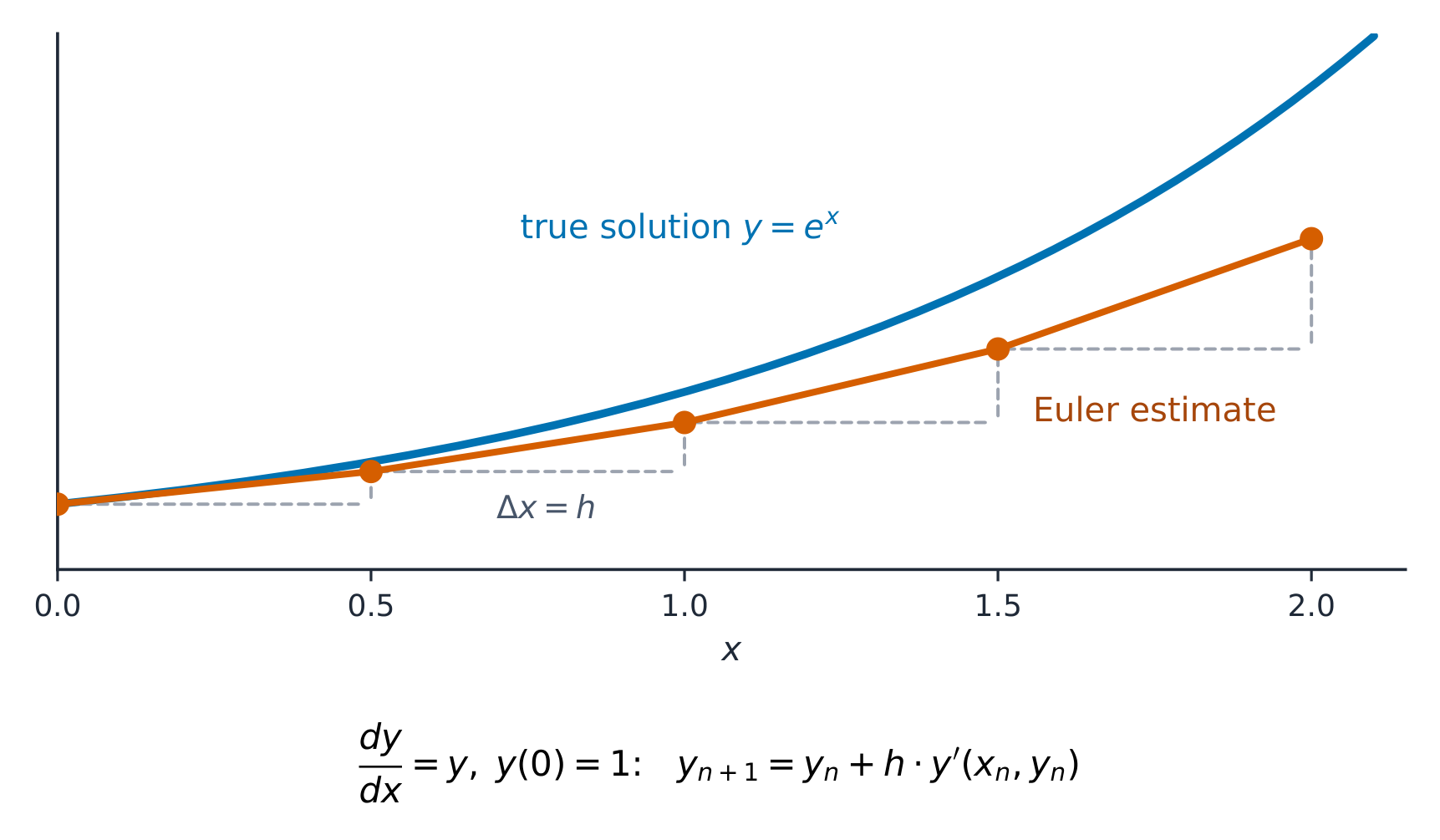
Euler's method steps along the tangent; the estimate drifts from the true solution
Bước dọc theo trường độ dốc
Phương pháp Euler thực hiện những bước thẳng ngắn dọc theo trường độ dốc — bước càng nhỏ càng bám sát đường cong thực tế.
Quy tắc cập nhật của Euler là $y_{n+1}=$
Độ khó 1/5 · 100 xu + một phần thưởng nhỏ cho lần hoàn thành đầu tiên trong ngày
Giá trị cũ $y$ cộng độ dốc nhân bước.
Khoảng tăng cố định $h$ được dùng trong mỗi bước Euler được gọi là kích thước ____.
Độ khó 1/5 · 100 xu + một phần thưởng nhỏ cho lần hoàn thành đầu tiên trong ngày
$x$ tiến lên theo kích thước bước $h$ ở mỗi lần lặp.
Marching through a table
- Organize the work in a table: at each row, read $(x_n,y_n)$, compute the slope $f(x_n,y_n)$, then get $y_{n+1}$.
- Advance $x$ by $h$ each row and repeat until you reach the target $x$.
- Each step is just arithmetic; the differential equation supplies the slope.
- After a few rows you have an approximate $y$ at the target.
Đối với $\dfrac{dy}{dx}=x+y$, $y(0)=1$, $h=0.5$: độ dốc tại $(0,1)$ là $1$. Tìm $y_1$.
Độ khó 2/5 · 140 xu + một phần thưởng nhỏ cho lần hoàn thành đầu tiên trong ngày
$1+0.5(1)=1.5$.
Tiếp tục ($y_1=1.5$ tại $x=0.5$, độ dốc $=2$), tìm $y(1)\approx y_2$.
Độ khó 2/5 · 140 xu + một phần thưởng nhỏ cho lần hoàn thành đầu tiên trong ngày
$1.5+0.5(2)=2.5$.
Accuracy and step size
- Euler's method is only an approximation — it follows straight tangents, so it drifts from the true curve.
- A smaller step size $h$ gives a more accurate estimate (but more steps).
- On a concave-up curve Euler tends to underestimate; concave-down, overestimate.
- More steps, less error — the classic accuracy trade-off.
Sử dụng kích thước bước nhỏ hơn $h$ nói chung làm ước lượng của Euler...
Độ khó 1/5 · 100 xu + một phần thưởng nhỏ cho lần hoàn thành đầu tiên trong ngày
Bước nhỏ lệch ít hơn khỏi đường cong thực tế.
Bạn phải tính lại độ dốc tại mỗi điểm mới, không tái sử dụng độ dốc ban đầu.
Độ khó 1/5 · 100 xu + một phần thưởng nhỏ cho lần hoàn thành đầu tiên trong ngày
Độ dốc $f(x_n,y_n)$ thay đổi ở mỗi bước.
Use the slope at the current point $(x_n,y_n)$ for each step, not a fixed slope. And each step updates both $x$ (by $h$) and $y$ (by $h\cdot f$). A common error is reusing the initial slope for every step — the slope must be recomputed at each new point.
Approximate $y(1)$ for $\dfrac{dy}{dx}=x+y$, $y(0)=1$, with step $h=0.5$.
- Step 1: slope at $(0,1)$ is $0+1=1$; $y_1=1+0.5(1)=1.5$, $x_1=0.5$.
- Step 2: slope at $(0.5,1.5)$ is $0.5+1.5=2$; $y_2=1.5+0.5(2)=2.5$, $x_2=1$.
- So $y(1)\approx 2.5$.
Euler's method approximates a differential equation's solution by stepping along tangents: $y_{n+1}=y_n+h\,f(x_n,y_n)$ with fixed step size $h$, recomputing the slope at each point. It's approximate (straight steps drift from the curve); a smaller $h$ improves accuracy.