Giải thích Hành vi của Các hàm Tích lũy Liên quan đến Diện tích
Đã giới thiệu| English | Ý nghĩa |
|---|---|
| extrema/ekˈstremə/ | cực trị |
Reading $g$ from the graph of $f$
- If $g(x)=\int_a^x f(t)\,dt$, then by FTC Part 1, $g'=f$ — so $f$ is the derivative of $g$.
- That means everything from Unit 5 applies: use $f$ (as $g'$) to analyze $g$.
- The sign of $f$ tells you where $g$ increases and decreases.
- The zeros of $f$ (where it changes sign) locate the extrema of $g$.
Khi phân tích $g(x)=\int_a^x f\,dt$, đồ thị của $f$ đóng vai trò như đồ thị của $g'$.
Độ khó 1/5 · 100 xu + một phần thưởng nhỏ cho lần hoàn thành đầu tiên trong ngày
Định lý cơ phần 1: $g'=f$.
Increase/decrease from the sign of $f$
- Where $f(x)>0$: $g$ is increasing (area is being added).
- Where $f(x)<0$: $g$ is decreasing (area is being subtracted).
- So look at the graph of $f$: above the axis → $g$ climbs; below → $g$ falls.
- $g$ is the running total of signed area, so its direction follows $f$'s sign.
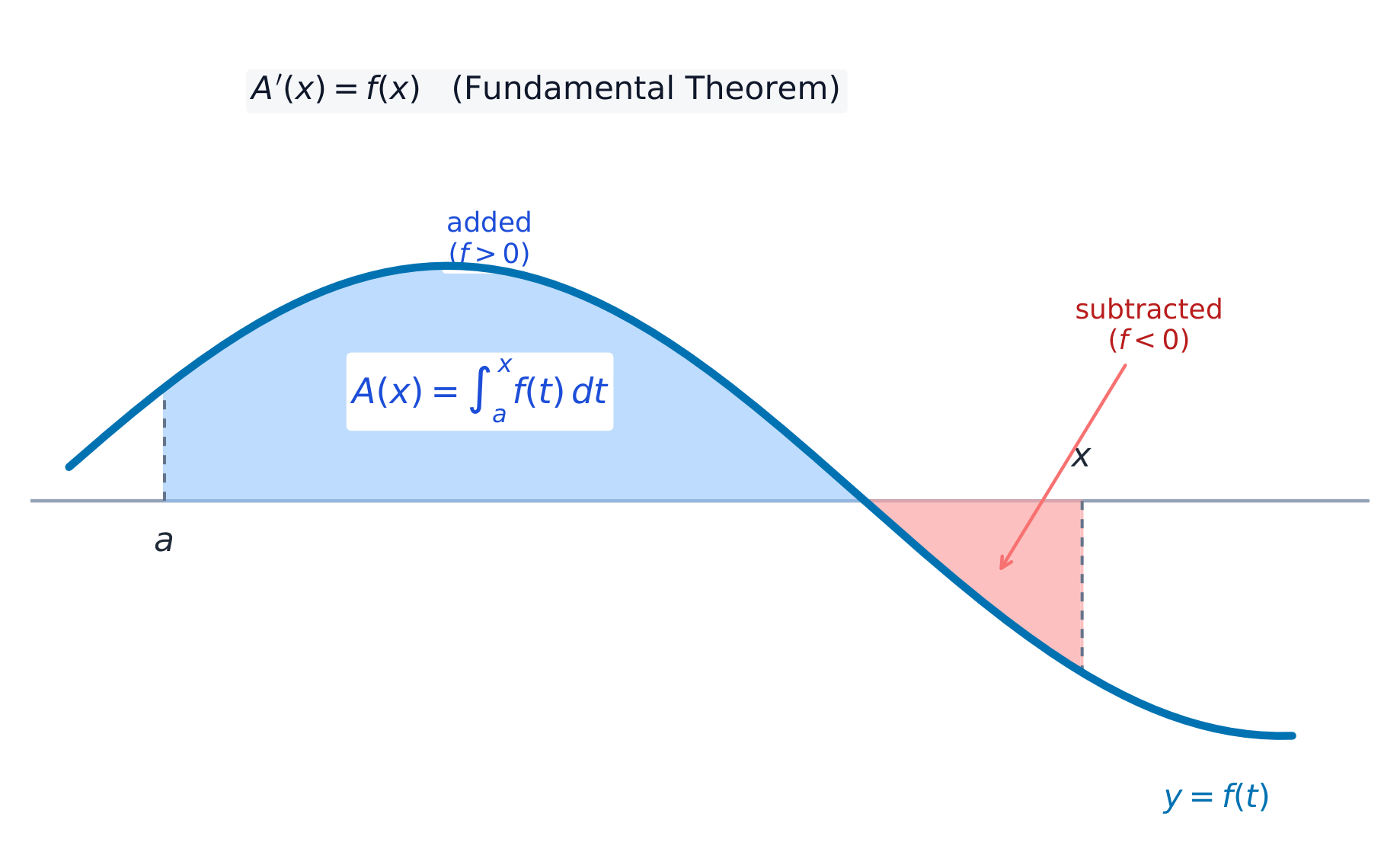
An accumulation function adds area where f > 0 and subtracts it where f < 0
g tăng ở những nơi f dương
y = f(t) (hàm dưới dấu tích phân = g′)
Khi $f$ (chiều cao được tô) dương, diện tích tích lũy $g$ tăng; khi $f$ chuyển sang âm, $g$ giảm.
Đối với $g(x)=\int_a^x f(t)\,dt$, $g$ đang tăng đúng ở những nơi...
Độ khó 1/5 · 100 xu + một phần thưởng nhỏ cho lần hoàn thành đầu tiên trong ngày
$g'=f$, do đó $g$ tăng khi $f>0$.
Extrema of $g$ where $f$ changes sign
- $g$ has a local max where $f$ (its derivative) changes from positive to negative.
- $g$ has a local min where $f$ changes from negative to positive.
- These are just the First Derivative Test applied to $g$, using $f$ as $g'$.
- The extrema 极值 of the accumulation function sit at the $x$-axis crossings of $f$.
$g$ đạt cực đại địa phương tại nơi $f$ chuyển đổi từ...
Độ khó 1/5 · 100 xu + một phần thưởng nhỏ cho lần hoàn thành đầu tiên trong ngày
$g'=f$ đi từ $+\to-$ → cực đại địa phương của $g$.
Từ đồ thị $f$, bạn có thể đọc được đặc điểm nào của $g=\int_a^x f\,dt$?
Độ khó 2/5 · 140 xu + một phần thưởng nhỏ cho lần hoàn thành đầu tiên trong ngày
Tăng/giảm, cực trị, độ lồi — tất cả đều từ $f$. Giá trị chính xác cần tính diện tích thực tế.
Concavity of $g$ from the slope of $f$
- Since $g'=f$, we get $g''=f'$ — so the concavity of $g$ follows the slope of $f$.
- Where $f$ is increasing, $g$ is concave up; where $f$ is decreasing, $g$ is concave down.
- An inflection point of $g$ sits where $f$ has a local max or min (where $f'$ changes sign).
- One graph of $f$ tells you increase/decrease and concavity of $g$.
Vì $g''=f'$, $g$ lồi lên (concave up) khi $f$ là ____.
Độ khó 1/5 · 100 xu + một phần thưởng nhỏ cho lần hoàn thành đầu tiên trong ngày
$g''=f'>0$ tại nơi $f$ tăng.
Một giá trị dương lớn của $f$ tại $x$ có nghĩa là $g$ đang...
Độ khó 1/5 · 100 xu + một phần thưởng nhỏ cho lần hoàn thành đầu tiên trong ngày
$f=g'$ là tốc độ; một giá trị $f$ lớn có nghĩa là $g$ tăng nhanh, chứ không phải $g$ lớn.
To analyze $g(x)=\int_a^x f\,dt$, treat the graph of $f$ as the graph of $g'$. Don't read $f$'s height as $g$'s height — read $f$'s sign for $g$'s increase/decrease, and $f$'s sign changes for $g$'s extrema. A big positive $f$ means $g$ is rising fast, not that $g$ is large.
$g(x)=\int_0^x f(t)\,dt$, where $f>0$ on $(0,3)$, $f(3)=0$, and $f<0$ on $(3,5)$.
- On $(0,3)$: $f>0$ → $g$ increasing. On $(3,5)$: $f<0$ → $g$ decreasing.
- At $x=3$: $f$ changes $+\to-$ → $g$ has a local maximum.
- So $g$ climbs to a peak at $x=3$, then falls.
For $g(x)=\int_a^x f(t)\,dt$, use $g'=f$: $g$ increases where $f>0$, decreases where $f<0$, and has extrema where $f$ changes sign. Since $g''=f'$, $g$ is concave up where $f$ is increasing. Read the graph of $f$ as the graph of $g'$.