xấp xỉ Diện tích bằng Tổng Riemann
Đã giới thiệu| English | Ý nghĩa |
|---|---|
| Riemann sum/ˈriːmən sʌm/ | Tổng Riemann |
| left/left/ | Đầu trái |
| right/raɪt/ | Đầu phải |
| midpoint/ˈmɪdpɔɪnt/ | trung điểm |
| trapezoid/ˈtræpɪzɔɪd/ | hình thang |
| trapezoidal rule/ˈtræpɪzɔɪdl ruːl/ | phương pháp hình thang |
Estimate a curvy area with rectangles
- The area under a curve is rarely a neat rectangle — so approximate it with many thin rectangles.
- Slice the interval into strips, build a rectangle on each, and add up their areas.
- This sum of rectangle areas is a Riemann sum 黎曼和.
- More, thinner rectangles → a better estimate of the true area.
Diện tích mà chúng ta xấp xỉ
y = x²
Các hình chữ nhật hoặc hình thang lấp đầy diện tích được tô màu dưới đường cong — càng nhiều, càng mỏng thì ước lượng càng tốt.
Sử dụng nhiều hình chữ nhật hơn, mỏng hơn nói chung cải thiện ước lượng tổng Riemann.
Độ khó 1/5 · 100 xu + một phần thưởng nhỏ cho lần hoàn thành đầu tiên trong ngày
Các dải mỏng hơn ôm sát đường cong tốt hơn.
Left, right, and midpoint rectangles
- Each rectangle's height comes from the function — but where in the strip do you measure it?
- Left 左端 sum: height from the left edge of each strip.
- Right 右端 sum: height from the right edge.
- Midpoint 中点 sum: height from the middle — usually the most accurate of the three.
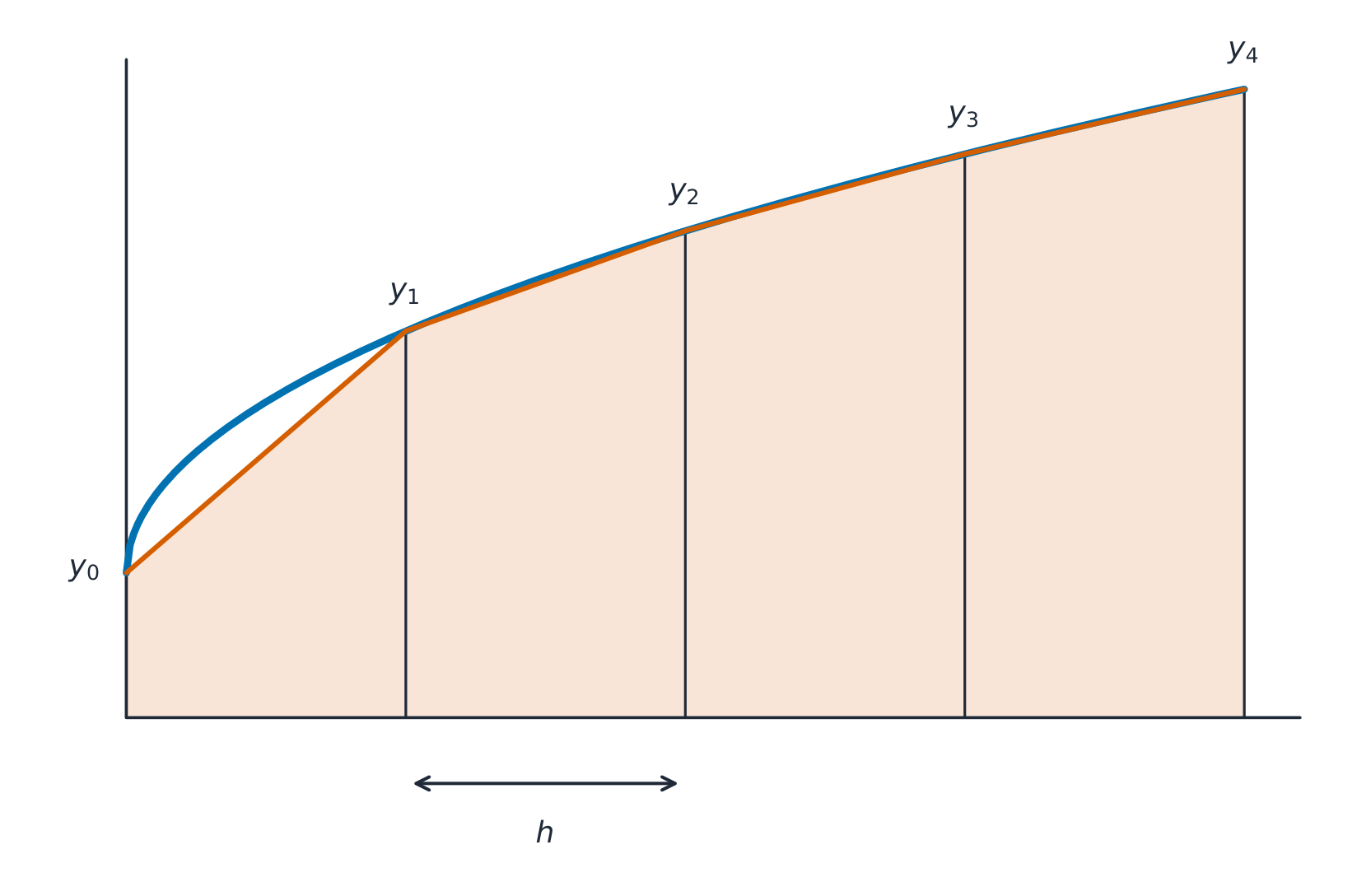
Strips of width h approximate the area under a curve
Đối với $f(x)=x^2$ trên $[0,2]$ với $2$ hình chữ nhật bên phải (chiều rộng $1$): chiều cao $f(1)=1$, $f(2)=4$. Tìm tổng Riemann bên phải.
Độ khó 2/5 · 140 xu + một phần thưởng nhỏ cho lần hoàn thành đầu tiên trong ngày
$1\cdot1+4\cdot1=5$.
Cùng thiết lập, nhưng là tổng Riemann bên trái: chiều cao $f(0)=0$, $f(1)=1$. Tìm nó.
Độ khó 2/5 · 140 xu + một phần thưởng nhỏ cho lần hoàn thành đầu tiên trong ngày
$0\cdot1+1\cdot1=1$.
Những cách nào là tiêu chuẩn để chọn chiều cao của hình chữ nhật trong tổng Riemann?
Độ khó 2/5 · 140 xu + một phần thưởng nhỏ cho lần hoàn thành đầu tiên trong ngày
Trái, phải và điểm giữa là các lựa chọn tiêu chuẩn.
Trapezoids fit even better
- Instead of a flat-topped rectangle, connect the two edge heights with a slanted top: a trapezoid 梯形.
- The trapezoidal rule 梯形法则 averages the left and right heights on each strip.
- It hugs a smooth curve more closely than rectangles, so it's usually more accurate.
- Area of each trapezoid $=\tfrac12(\text{left height}+\text{right height})\times\text{width}$.
Quy tắc ____ sử dụng đỉnh nghiêng (trung bình của chiều cao hai cạnh) để khít hơn so với hình chữ nhật.
Độ khó 1/5 · 100 xu + một phần thưởng nhỏ cho lần hoàn thành đầu tiên trong ngày
Mỗi hình thang trung bình hóa chiều cao bên trái và bên phải.
Over- or underestimate?
- On an increasing function: left sums underestimate, right sums overestimate.
- On a decreasing function: it's the reverse — left over, right under.
- The trapezoidal rule's error depends on concavity (over on concave-up, under on concave-down).
- Knowing the direction of the error lets you bound the true area.
Đối với hàm đồng biến, tổng Riemann bên trái cho kết quả là một...
Độ khó 1/5 · 100 xu + một phần thưởng nhỏ cho lần hoàn thành đầu tiên trong ngày
Chiều cao bên trái là cạnh nhỏ hơn trên đường cong đồng biến → ước lượng thấp hơn.
The three rectangle rules can give quite different answers for a small number of strips — they are approximations, not the exact area. And whether a left or right sum over- or under-estimates depends on whether the function is increasing or decreasing, not on the rule alone. Always check the function's behavior.
Estimate the area under $f(x)=x^2$ on $[0,2]$ with $2$ right rectangles (width $1$).
- Right heights: $f(1)=1$ and $f(2)=4$.
- Right sum $=1\cdot1+4\cdot1=5$.
- (The true area is $\tfrac83\approx2.67$; since $x^2$ is increasing, the right sum overestimates — as expected.)
A Riemann sum approximates area with rectangles: left, right, or midpoint heights. The trapezoidal rule uses slanted tops (averaging edge heights) for a closer fit. For an increasing function, left sums underestimate and right sums overestimate; more strips → a better approximation.