Giới thiệu về Các bài toán Tối ưu hóa
Đã giới thiệu| English | Ý nghĩa |
|---|---|
| optimization/ˌɒptɪmaɪˈzeɪʃn/ | Tối ưu hóa |
| variable/ˈveərɪəbl/ | Biến số |
| objective function/ɒbˈdʒektɪv ˈfʌŋkʃn/ | Hàm mục tiêu |
| constraint/kənˈstreɪnt/ | Điều kiện ràng buộc |
Making something as big (or small) as possible
- Real problems ask: what dimensions give the largest area? the cheapest cost? the shortest time?
- These are optimization 最优化 problems — find the max or min of a quantity.
- Calculus solves them because extrema live where the derivative is zero.
- This lesson is about the setup; the solving comes next.
Name a variable and write the objective
- Choose a variable 变量 for the quantity you can control (a length, a radius, a price).
- Write the thing you want to maximize or minimize as a function of that variable — the objective function 目标函数.
- Example: for a rectangle of fixed perimeter, write the area in terms of one side length.
- Draw a picture and label it — most setup errors are unlabeled diagrams.
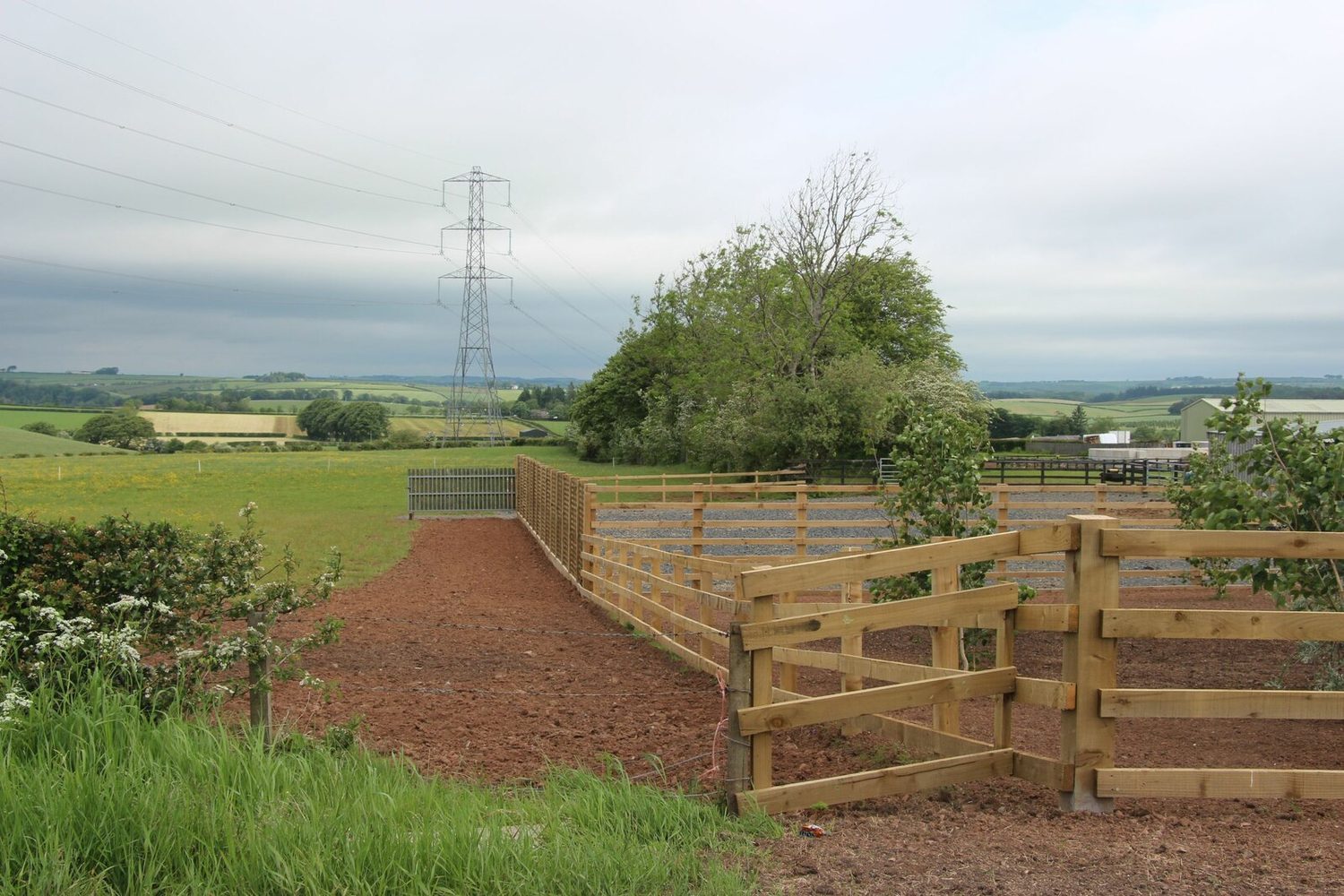
Fenced enclosures: optimization finds the dimensions that maximise area for a fixed fence length
Trong "tối đa hóa diện tích với chu vi cố định", diện tích là...
Độ khó 1/5 · 100 xu + một phần thưởng nhỏ cho lần hoàn thành đầu tiên trong ngày
Bạn tối ưu hóa mục tiêu (diện tích); chu vi là ràng buộc.
Use a constraint to get one variable
- Usually the objective starts with two variables (like length and width).
- A constraint 约束条件 equation relates them (a fixed perimeter, a fixed volume, a budget).
- Solve the constraint for one variable and substitute, so the objective depends on a single variable.
- Now it's an ordinary "find the extremum" problem.
Diện tích như một parabol hướng xuống duy nhất
y = ax² + bx
Sau khi áp dụng ràng buộc, diện tích trở thành $A=10x-x^2$ — một parabol hướng xuống với một đỉnh duy nhất cần tìm.
Phương trình ràng buộc được sử dụng để...
Độ khó 1/5 · 100 xu + một phần thưởng nhỏ cho lần hoàn thành đầu tiên trong ngày
Giải phương trình ràng buộc theo một biến và thay thế.
Mục đích của việc thiết lập là viết hàm mục tiêu theo một ____ biến.
Độ khó 1/5 · 100 xu + một phần thưởng nhỏ cho lần hoàn thành đầu tiên trong ngày
Một biến ⇒ một bài toán cực trị thông thường.
Sắp xếp các bước trong quy trình tối ưu hóa.
Độ khó 3/5 · 200 xu + một phần thưởng nhỏ cho lần hoàn thành đầu tiên trong ngày
Biến, mục tiêu, ràng buộc, thay thế.
A worked setup
- "A farmer has $40$ m of fence for a rectangular pen against a wall (no fence on the wall side)."
- Constraint: fence used $=2x+y=40$, so $y=40-2x$.
- Objective: area $A=xy=x(40-2x)=40x-2x^2$, now a function of $x$ alone.
- Ready to maximize $A(x)$ — that's lesson 5.11.
Với $2x+y=40$ (tường ở một bên), diện tích $A=xy$ trở thành...
Độ khó 1/5 · 100 xu + một phần thưởng nhỏ cho lần hoàn thành đầu tiên trong ngày
$y=40-2x$, do đó $A=x(40-2x)=40x-2x^2$.
Xác định miền xác định của biến (ví dụ: $0<x<10$) là một phần của quy trình tối ưu hóa chính xác.
Độ khó 1/5 · 100 xu + một phần thưởng nhỏ cho lần hoàn thành đầu tiên trong ngày
Các cận miền xác định nơi câu trả lời hợp lệ có thể nằm.
Keep the objective (what you optimize) separate from the constraint (the fixed relationship). You maximize/minimize the objective, and you use the constraint only to eliminate a variable. Also note the domain of the variable (e.g. $x>0$ and $y>0$) — it bounds where a valid answer can lie.
Set up: maximize the area of a rectangle with perimeter $20$.
- Let the sides be $x$ and $y$. Constraint: $2x+2y=20\Rightarrow y=10-x$.
- Objective: $A=xy=x(10-x)=10x-x^2$.
- Domain: $0<x<10$. The problem is now "maximize $A(x)=10x-x^2$."
An optimization problem finds a maximum or minimum. Set it up by naming a variable, writing the objective function to optimize, and using a constraint equation to reduce it to a single variable. Note the domain. Then it becomes a standard extremum problem (next lesson).