Xấp xỉ giá trị sử dụng tính tuyến tính cục bộ và tuyến tính hóa
Đã giới thiệu| English | Ý nghĩa |
|---|---|
| tangent line/ˈtændʒənt laɪn/ | tiếp tuyến |
| local linearity/ˈləʊkl lɪˈnɪərɪti/ | tính tuyến tính cục bộ |
| linearization/ˌlɪnɪəraɪˈzeɪʃn/ | tuyến tính hóa |
Zoom in far enough and a curve looks straight
- Pick any smooth curve, zoom in on one point, and it flattens into (almost) a straight line.
- That line is the tangent line 切线, and near the point it hugs the curve tightly.
- So the tangent is a great approximation to the function nearby — this is local linearity 局部线性性.
- It lets you estimate hard function values with just a slope and a point.
Tiếp tuyến áp sát đường cong
y = √x
Gần điểm tiếp xúc, đường thẳng và đường cong gần như trùng khớp — sự gần gũi đó là lý do $L(x)$ xấp xỉ $f(x)$.
Khái niệm rằng một đường cong trơn tru trông giống như đường thẳng khi nhìn gần được gọi là tuyến tính ____ cục bộ.
Độ khó 1/5 · 100 xu + một phần thưởng nhỏ cho lần hoàn thành đầu tiên trong ngày
Tính tuyến tính cục bộ là nền tảng của ước lượng bằng tiếp tuyến.
Build the tangent line
- The tangent at $x=a$ passes through $\big(a,f(a)\big)$ with slope $f'(a)$.
- Point-slope form gives the linearization 线性化:
-
$$L(x)=f(a)+f'(a)(x-a)$$
- This $L(x)$ is just the tangent line, renamed as an approximation formula.
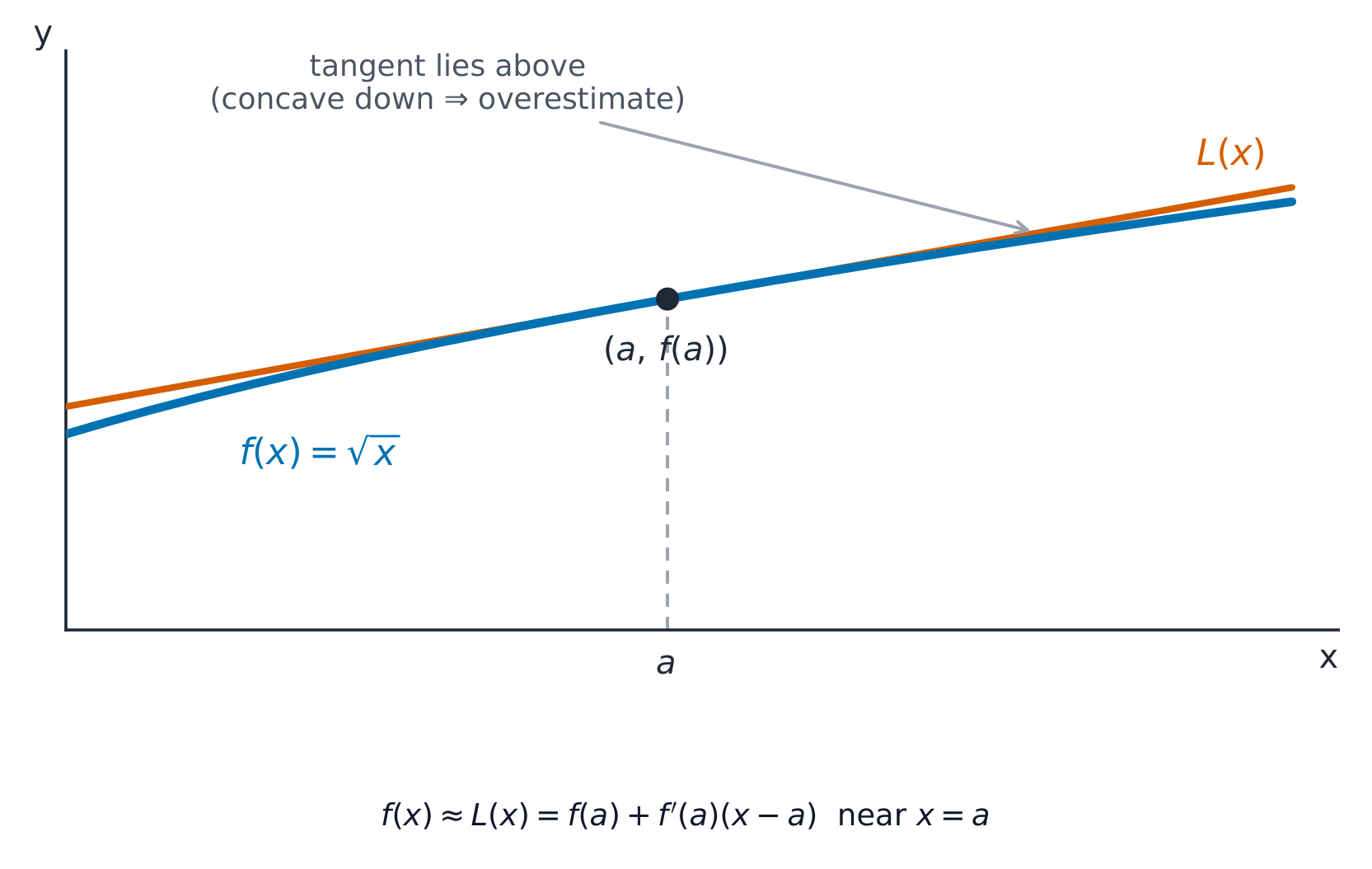
Near x = a the tangent line L(x) approximates f(x)
Tuyến tính hóa của $f$ tại $a$ là $L(x)=$
Độ khó 1/5 · 100 xu + một phần thưởng nhỏ cho lần hoàn thành đầu tiên trong ngày
Dạng điểm-độ dốc của tiếp tuyến: $f(a)+f'(a)(x-a)$.
Approximate a nearby value
- To estimate $f(x)$ for $x$ near $a$, compute $L(x)$ instead — it's usually easy arithmetic.
- Choose $a$ to be a nearby point where $f(a)$ and $f'(a)$ are simple (a "nice" number).
- The closer $x$ is to $a$, the better the approximation.
- Example: to estimate $\sqrt{4.1}$, use $f(x)=\sqrt x$ at $a=4$, where $f(4)=2$ is clean.
Sử dụng $L(x)=2+\tfrac14(x-4)$, ước lượng $\sqrt{4.1}=L(4.1)$.
Độ khó 2/5 · 140 xu + một phần thưởng nhỏ cho lần hoàn thành đầu tiên trong ngày
$2+\tfrac14(0.1)=2.025$.
Over- or underestimate? Ask concavity
- The tangent line lies on one side of a curved graph, so $L(x)$ leans one way.
- Concave up (curve bends upward, $f''>0$): the tangent is below the curve → $L$ is an underestimate.
- Concave down ($f''<0$): the tangent is above the curve → $L$ is an overestimate.
- Checking the sign of $f''$ tells you which way your approximation errs.
Nếu $f$ lõm xuống gần $a$, thì ước lượng bằng tiếp tuyến $L(x)$ là một...
Độ khó 1/5 · 100 xu + một phần thưởng nhỏ cho lần hoàn thành đầu tiên trong ngày
Lồi xuống → tiếp tuyến nằm trên đường cong → ước lượng cao.
Một hàm tuyến tính hóa chính xác nhất cho các đầu vào xa điểm tiếp xúc.
Độ khó 1/5 · 100 xu + một phần thưởng nhỏ cho lần hoàn thành đầu tiên trong ngày
Nó chính xác nhất gần điểm tiếp xúc; độ chính xác giảm khi bạn di chuyển ra xa.
Chọn tất cả các kết luận đúng về ước lượng thấp/cao.
Độ khó 2/5 · 140 xu + một phần thưởng nhỏ cho lần hoàn thành đầu tiên trong ngày
Lên → tiếp tuyến nằm dưới → thấp hơn; xuống → tiếp tuyến nằm trên → cao hơn; cả hai đều phụ thuộc vào $f''$.
Linearization is only accurate near the point of tangency — far from $a$ the straight line drifts away from the curve. And the over/under call depends on concavity: concave up → tangent below → underestimate; concave down → overestimate. Don't guess the direction; check the sign of $f''$.
Estimate $\sqrt{4.1}$ using linearization at $a=4$.
- $f(x)=\sqrt x=x^{1/2}$, so $f'(x)=\tfrac{1}{2\sqrt x}$; $\;f(4)=2$, $\;f'(4)=\tfrac14$.
- $L(x)=2+\tfrac14(x-4)$, so $L(4.1)=2+\tfrac14(0.1)=2.025$.
- Since $\sqrt x$ is concave down ($f''<0$), this is a slight overestimate (true value $\approx2.0248$).
Local linearity lets the tangent line approximate a function near a point. The linearization is $L(x)=f(a)+f'(a)(x-a)$; use it to estimate $f(x)$ for $x$ near $a$. Concavity sets the direction of error: concave up → underestimate, concave down → overestimate.