Giải các bài toán tốc độ liên quan
Đã giới thiệuA repeatable recipe for related rates
- Related-rates word problems feel hard until you follow a fixed procedure.
- Same five steps every time: picture, equation, differentiate, substitute, solve.
- The one rule people break: substitute numbers only after differentiating.
- Master the recipe and every related-rates problem becomes routine.
The five steps
- 1. Draw & label the changing quantities; note what's given and wanted.
- 2. Relate the variables with an equation (geometry/formula).
- 3. Differentiate both sides with respect to $t$ (chain rule → rate factors).
- 4. Substitute the known values at that instant.
- 5. Solve for the unknown rate; report with units and sign.
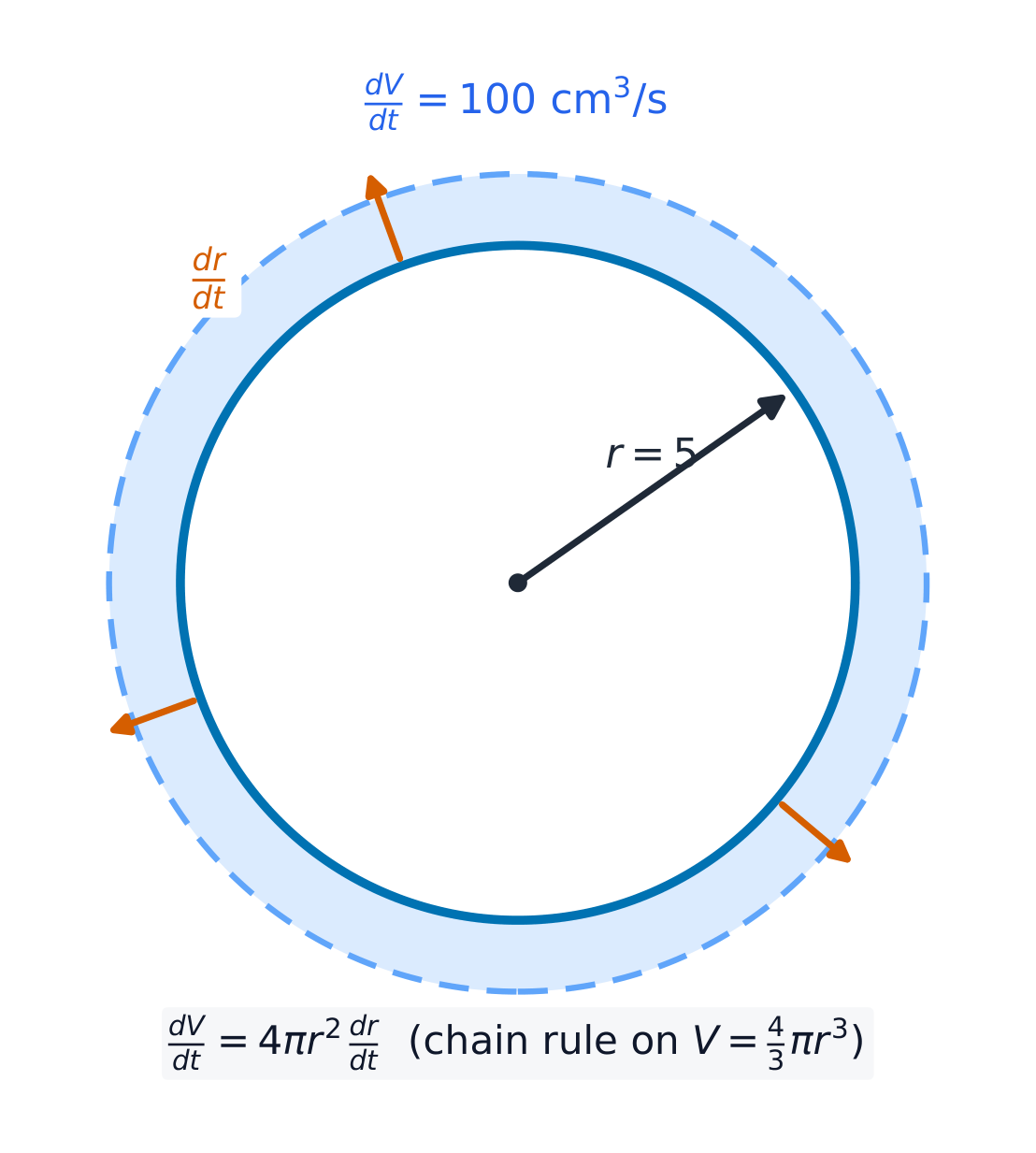
An inflating balloon: dV/dt and dr/dt are linked through V = (4/3)πr³
Thể tích tăng nhanh nhất khi lớn
y = a·x³ (V so với r)
Vì $\tfrac{dV}{dt}=4\pi r^2\tfrac{dr}{dt}$, một tốc độ bán kính cố định khiến tốc độ thể tích bay vọt khi $r$ tăng.
Sắp xếp các bước giải bài toán tốc độ liên quan theo thứ tự.
Độ khó 3/5 · 200 xu + một phần thưởng nhỏ cho lần hoàn thành đầu tiên trong ngày
Vẽ hình, liên hệ, vi phân, thay thế và giải.
Differentiate first, plug in last
- A number that is changing must stay a variable while you differentiate.
- If you set $r=5$ before differentiating, its rate $\tfrac{dr}{dt}$ vanishes — and the whole method collapses.
- Substitute the instant's values only at step 4, after the derivative is taken.
- The only things you may fix early are true constants (like a ladder's fixed length).
Với $\dfrac{dV}{dt}=4\pi r^2\dfrac{dr}{dt}$, $r=5$, và $\dfrac{dr}{dt}=2$, tìm $\dfrac{dV}{dt}$ dưới dạng bội số của $\pi$ (nhập số trước $\pi$).
Độ khó 2/5 · 140 xu + một phần thưởng nhỏ cho lần hoàn thành đầu tiên trong ngày
$4\pi(25)(2)=200\pi$.
Khi nào bạn nên thay thế các giá trị số tại thời điểm cụ thể?
Độ khó 1/5 · 100 xu + một phần thưởng nhỏ cho lần hoàn thành đầu tiên trong ngày
Vi phân trước; thay số chỉ sau đó, nếu không các hạng tử tốc độ sẽ biến mất.
Đặt $r=5$ trước khi vi phân là một cách tắt hợp lệ.
Độ khó 1/5 · 100 xu + một phần thưởng nhỏ cho lần hoàn thành đầu tiên trong ngày
Nó tiêu diệt $\tfrac{dr}{dt}$ và phá vỡ phương pháp.
Check units and reasonableness
- The answer is a rate — attach units of output per input (e.g. $\tfrac{\text{cm}^3}{\text{s}}$).
- Check the sign: growing quantity → positive; shrinking → negative.
- Ask if the size is reasonable for the situation.
- A tidy conclusion sentence ("the volume is increasing at ... per second") earns the interpretation marks.
Câu trả lời tốc độ liên quan là một tốc độ, vì vậy nó phải được báo cáo kèm theo ____.
Độ khó 1/5 · 100 xu + một phần thưởng nhỏ cho lần hoàn thành đầu tiên trong ngày
Ví dụ. cm³ mỗi giây.
Một kết quả bài toán liên quan đến tốc độ ra là $\dfrac{dV}{dt}=-30\,\tfrac{\text{cm}^3}{\text{s}}$. Điều này có nghĩa là thể tích đang...
Độ khó 1/5 · 100 xu + một phần thưởng nhỏ cho lần hoàn thành đầu tiên trong ngày
Tốc độ âm có nghĩa là thể tích đang thu nhỏ lại với tốc độ $30$ cm³/s.
The number-one related-rates mistake: plugging in the instant's values before differentiating. Keep every changing quantity symbolic through the differentiation step; substitute only afterward. Substituting early kills the rate terms and gives a wrong (often zero) answer.
A spherical balloon's radius grows at $\tfrac{dr}{dt}=2\,\tfrac{\text{cm}}{\text{s}}$. How fast is the volume growing when $r=5$ cm?
- Relate: $V=\tfrac43\pi r^3$. Differentiate: $\dfrac{dV}{dt}=4\pi r^2\dfrac{dr}{dt}$.
- Now substitute $r=5$, $\tfrac{dr}{dt}=2$: $\dfrac{dV}{dt}=4\pi(25)(2)=200\pi$.
- The volume is increasing at $200\pi\approx628\ \tfrac{\text{cm}^3}{\text{s}}$.
Solve a related rates problem in five steps: draw/label, write a relating equation, differentiate with respect to $t$, substitute the instant's values only after differentiating, and solve for the unknown rate. Report it with correct units and sign, and check the result is reasonable.