Vi phân hàm nghịch đảo
Đã giới thiệu| English | Ý nghĩa |
|---|---|
| inverse function/ɪnˈvɜːs ˈfʌŋkʃn/ | inverse function |
| reciprocals/rɪˈsɪprəklz/ | reciprocals |
Slopes of a function and its mirror
- An inverse function 反函数 $f^{-1}$ undoes $f$: it reflects the graph across the line $y=x$.
- Reflecting swaps the roles of rise and run — so it flips the slope upside down.
- That gives a neat shortcut: you can find the inverse's derivative from the original's.
- Best of all, you often don't need a formula for $f^{-1}$ at all.
The reciprocal-slope rule
- At matching points, the slopes of $f$ and $f^{-1}$ are reciprocals 倒数.
-
$$\big(f^{-1}\big)'(x)=\frac{1}{f'\!\big(f^{-1}(x)\big)}$$
- Read it as: the inverse's slope at $x$ is $1$ divided by $f$'s slope at the matching input.
- The matching input is $f^{-1}(x)$ — the point on $f$ that maps to $x$.
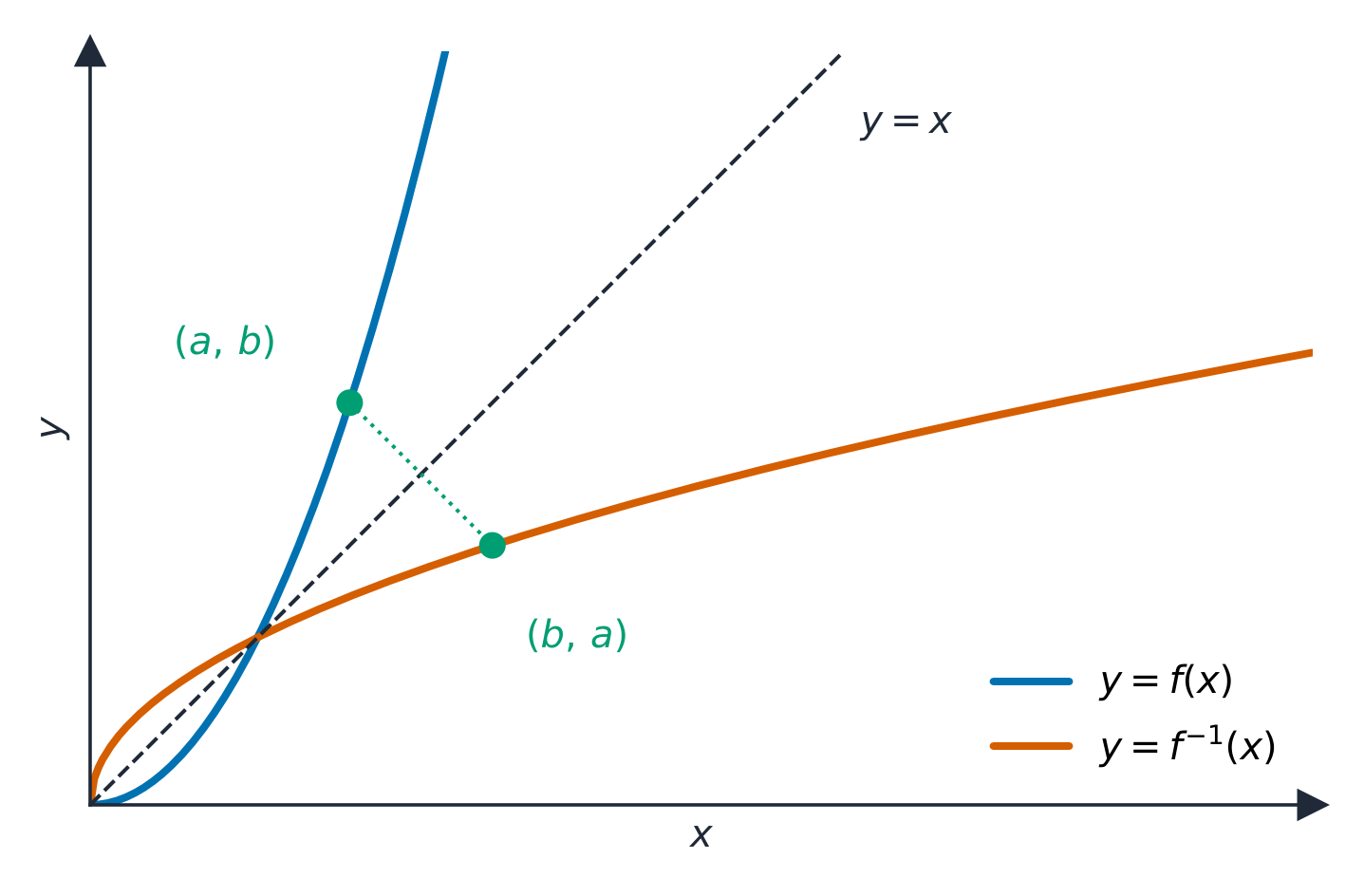
The inverse function is the mirror image of the function in the line y = x
Đạo hàm của hàm nghịch đảo là $\big(f^{-1}\big)'(x)=$
Độ khó 1/5 · 100 xu + một phần thưởng nhỏ cho lần hoàn thành đầu tiên trong ngày
Nghịch đảo của đạo hàm gốc tại điểm tương ứng $f^{-1}(x)$.
Evaluate without inverting
- Usually you only need the derivative at one point, and you can skip finding $f^{-1}$.
- Say $f(2)=5$ and $f'(2)=3$. Then the point $(5,2)$ is on $f^{-1}$, so $f^{-1}(5)=2$.
- Apply the rule: $\big(f^{-1}\big)'(5)=\dfrac{1}{f'(2)}=\dfrac{1}{3}$.
- You never needed a formula — just the matching pair and one derivative value.
Nếu biết $f(2)=5$ và $f'(2)=4$, hãy tìm $\big(f^{-1}\big)'(5)$.
Độ khó 2/5 · 140 xu + một phần thưởng nhỏ cho lần hoàn thành đầu tiên trong ngày
$f^{-1}(5)=2$, do đó $\big(f^{-1}\big)'(5)=\tfrac{1}{f'(2)}=\tfrac14$.
Để tính $\big(f^{-1}\big)'(c)$ tại một điểm, bạn cần gì?
Độ khó 2/5 · 140 xu + một phần thưởng nhỏ cho lần hoàn thành đầu tiên trong ngày
Bạn cần cặp đầu vào và $f'$ tương ứng ở đó (khác không, nên nghịch đảo tồn tại) — không cần công thức nghịch đảo đầy đủ.
Why reciprocal? See the reflection
- Reflecting across $y=x$ turns a "rise of $3$ over run of $1$" into a "rise of $1$ over run of $3$."
- So a slope of $3$ becomes a slope of $\tfrac13$ — literally flipped.
- This is why $f$ and $f^{-1}$ have reciprocal slopes at corresponding points.
- (It also warns you: if $f'=0$ at a point, the inverse has a vertical tangent there — its slope is undefined.)
Một độ dốc và nghịch đảo của nó
y = x³ + 1
Phản xạ đường cong qua $y=x$ sẽ đảo ngược chiều cao và chiều ngang — độ dốc $3$ sẽ trở thành $\tfrac13$ trên hàm nghịch đảo.
Để tìm $\big(f^{-1}\big)'(5)$, bạn cần tính $f'$ tại $5$.
Độ khó 1/5 · 100 xu + một phần thưởng nhỏ cho lần hoàn thành đầu tiên trong ngày
Bạn tính $f'$ tại điểm tương ứng $f^{-1}(5)$, không phải tại $5$.
Tại các điểm tương ứng, độ dốc của $f$ và $f^{-1}$ là ____ nhau.
Độ khó 1/5 · 100 xu + một phần thưởng nhỏ cho lần hoàn thành đầu tiên trong ngày
Phản xạ qua $y=x$ sẽ đảo ngược độ dốc.
Nếu $f'(a)=0$ tại điểm tương ứng, thì hàm nghịch đảo tại điểm tương ứng có...
Độ khó 1/5 · 100 xu + một phần thưởng nhỏ cho lần hoàn thành đầu tiên trong ngày
Chia cho $0$ là không xác định — tiếp tuyến phản xạ là đường thẳng đứng.
Use the derivative of $f$ at the matching input $f^{-1}(x)$, not at $x$ itself. For $\big(f^{-1}\big)'(5)$ you need $f'$ at the input that maps to $5$, i.e. $f'(f^{-1}(5))$, not $f'(5)$. Plugging $5$ straight into $f'$ is the classic error.
$f(x)=x^3+1$ has $f(1)=2$ and $f'(x)=3x^2$. Find $\big(f^{-1}\big)'(2)$.
- The matching input: $f^{-1}(2)=1$ (since $f(1)=2$).
- $f'(1)=3(1)^2=3$.
- $\big(f^{-1}\big)'(2)=\dfrac{1}{f'(1)}=\dfrac{1}{3}$.
The derivative of an inverse function is the reciprocal of the original's derivative at the matching point: $\big(f^{-1}\big)'(x)=\dfrac{1}{f'(f^{-1}(x))}$. Reflection across $y=x$ swaps rise and run, flipping the slope. You can evaluate it at a point using just a matching pair — no formula for $f^{-1}$ required.