Ước tính Đạo hàm của Hàm số tại Một Điểm
Đã giới thiệu| English | Ý nghĩa |
|---|---|
| estimate/ˈestɪmət/ | ước lượng |
| difference quotient/ˈdɪfrəns ˈkwəʊʃənt/ | thương sai phân |
Measuring a slope you can't compute exactly
- Sometimes you have a graph or a table, not a formula — but you still want $f'$ at a point.
- You can estimate the derivative from what you have.
- From a graph: measure the steepness of the tangent line by eye.
- From a table: use a difference quotient over the closest available inputs.
Ước lượng hệ số góc bằng mắt thường
y = x²
Di chuyển điểm và quan sát đường tiếp tuyến — độ dốc của nó chính là đạo hàm mà bạn sẽ ước lượng từ đồ thị.
From a graph: tangent steepness
- Draw (or imagine) the tangent line at the point, then read its slope as rise ÷ run.
- Pick two clear points on the tangent, not on the curve, and compute $\tfrac{\Delta y}{\Delta x}$.
- Steeper tangent → larger $|f'|$; a flat tangent → $f'\approx0$.
- Uphill tangent → positive derivative; downhill → negative.
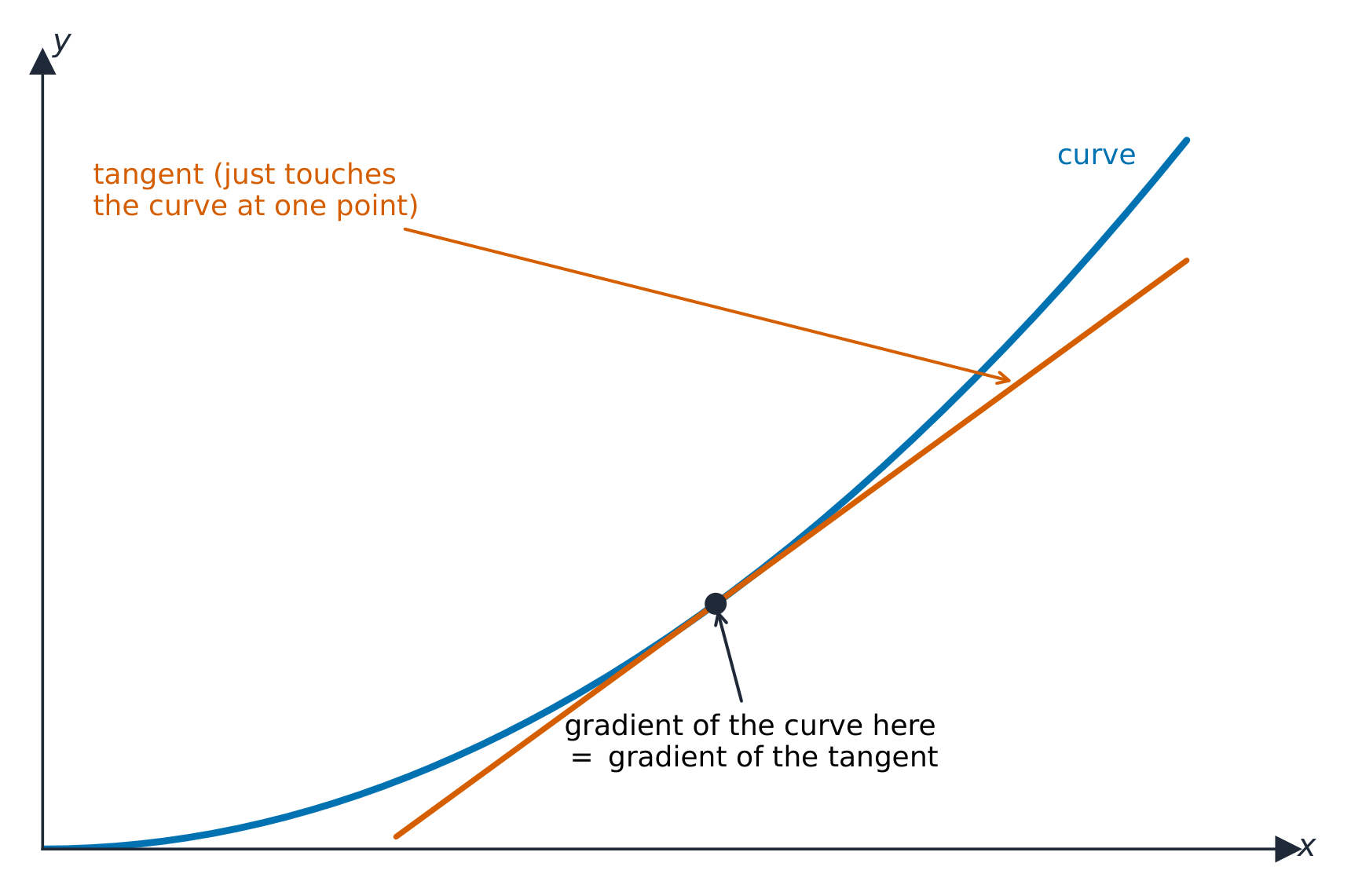
The instantaneous rate of change is the gradient of the tangent at a point
Để ước tính $f'(a)$ từ đồ thị, bạn nên đo hệ số góc của...
Độ khó 1/5 · 100 xu + một phần thưởng nhỏ cho lần hoàn thành đầu tiên trong ngày
Đạo hàm là hệ số góc tiếp tuyến, đọc từ các điểm trên đường tiếp tuyến.
From a table: nearest difference quotient
- With table values, approximate $f'(a)$ by the difference quotient over the closest points:
- A symmetric estimate is best: $f'(a)\approx\dfrac{f(a+h)-f(a-h)}{2h}$, using one point on each side.
- Or use a one-sided quotient $\dfrac{f(a+h)-f(a)}{h}$ if only one neighbor is available.
- Smaller $h$ (closer inputs) generally gives a better estimate 估计值.
Một bảng cho biết $f(1.9)=4.2$ và $f(2.1)=5.8$. Sử dụng thương sai phân đối xứng để ước tính $f'(2)$.
Độ khó 2/5 · 140 xu + một phần thưởng nhỏ cho lần hoàn thành đầu tiên trong ngày
$\dfrac{5.8-4.2}{2(0.1)}=\dfrac{1.6}{0.2}=8$.
Sử dụng các giá trị đầu vào gần hơn với điểm thường cải thiện ước tính đạo hàm dựa trên bảng.
Độ khó 1/5 · 100 xu + một phần thưởng nhỏ cho lần hoàn thành đầu tiên trong ngày
Khoảng cách nhỏ hơn xấp xỉ tốt hơn hệ số góc tiếp tuyến.
Đạo hàm đọc từ bảng hay đồ thị là một ____, không phải giá trị chính xác.
Độ khó 1/5 · 100 xu + một phần thưởng nhỏ cho lần hoàn thành đầu tiên trong ngày
Chỉ phép toán đại số trên công thức mới cho ra đạo hàm chính xác.
Từ $f(3)=10$ và $f(3.2)=11.4$, ước tính $f'(3)$ bằng thương sai phân một phía.
Độ khó 2/5 · 140 xu + một phần thưởng nhỏ cho lần hoàn thành đầu tiên trong ngày
$\dfrac{11.4-10}{3.2-3}=\dfrac{1.4}{0.2}=7$.
Reading sign and size
- The sign of the estimate says which way $f$ is heading: $+$ rising, $-$ falling.
- The size says how fast: a derivative of $12$ means $f$ changes about $12$ units per unit of $x$ there.
- Always attach units and interpret in context (e.g. "the temperature is rising about $2^\circ$C per minute").
- An estimate is an approximation — say so, and use the closest data you have.
Nếu đạo hàm ước tính tại một điểm mang dấu âm, thì hàm số tại đó...
Độ khó 1/5 · 100 xu + một phần thưởng nhỏ cho lần hoàn thành đầu tiên trong ngày
Tốc độ âm có nghĩa là hàm số đang giảm tại đó.
When estimating from a graph, read the slope of the tangent line, not of a nearby secant, and take your two points off the tangent, not off the curve. From a table, don't reuse the point $a$ itself as both inputs — you need two different inputs bracketing (or approaching) $a$.
A table gives $f(1.9)=4.2$, $f(2)=5.0$, $f(2.1)=5.9$. Estimate $f'(2)$.
- Symmetric difference quotient: $f'(2)\approx\dfrac{f(2.1)-f(1.9)}{2(0.1)}=\dfrac{5.9-4.2}{0.2}=\dfrac{1.7}{0.2}=8.5$.
- (A one-sided estimate $\dfrac{5.9-5.0}{0.1}=9$ is close but less balanced.)
- So $f'(2)\approx8.5$ — $f$ is rising at about $8.5$ units per unit of $x$.
To estimate a derivative: from a graph, read the slope of the tangent line (rise ÷ run using points on the tangent); from a table, use a difference quotient over the closest inputs — the symmetric quotient $\frac{f(a+h)-f(a-h)}{2h}$ is most accurate. The sign gives direction, the size gives rate.