Color
Đã giới thiệu| English | Ý nghĩa |
|---|---|
| colour/ˈkʌlə/ | màu sắc |
| hue/hjuː/ | tông màu |
| saturation/ˌsætʃəˈreɪʃn/ | độ bão hòa |
| colour wheel/ˈkʌlə wiːl/ | vòng màu |
| primary/ˈpraɪməri/ | nguyên sắc |
| secondary/ˈsekəndəri/ | giữa sắc |
| complementary/ˌkɒmplɪˈmentəri/ | màu tương phản |
| analogous/əˈnæləɡəs/ | màu gần |
| warm/wɔːm/ | màu nóng |
| cool/kuːl/ | màu lạnh |
The three properties
- Colour 色彩 is light reflected from a surface, with three properties.
- Hue 色相 is the colour's name; value is its lightness; saturation 饱和度 is its intensity.
- These three describe any colour completely.
The name of a colour (red, blue, green) is its...
Độ khó 1/5 · 100 xu + một phần thưởng nhỏ cho lần hoàn thành đầu tiên trong ngày
Hue is the colour's name; value is lightness, saturation is intensity.
Select all three properties of colour.
Độ khó 2/5 · 140 xu + một phần thưởng nhỏ cho lần hoàn thành đầu tiên trong ngày
Hue, value, and saturation define a colour; weight is not a colour property.
The colour wheel
- The colour wheel 色轮 organises hues in a circle.
- Primary 三原色 colours (red, yellow, blue) mix to make secondary 间色 colours.
- Complementary 互补色 colours sit opposite; analogous 邻近色 colours sit next to each other.
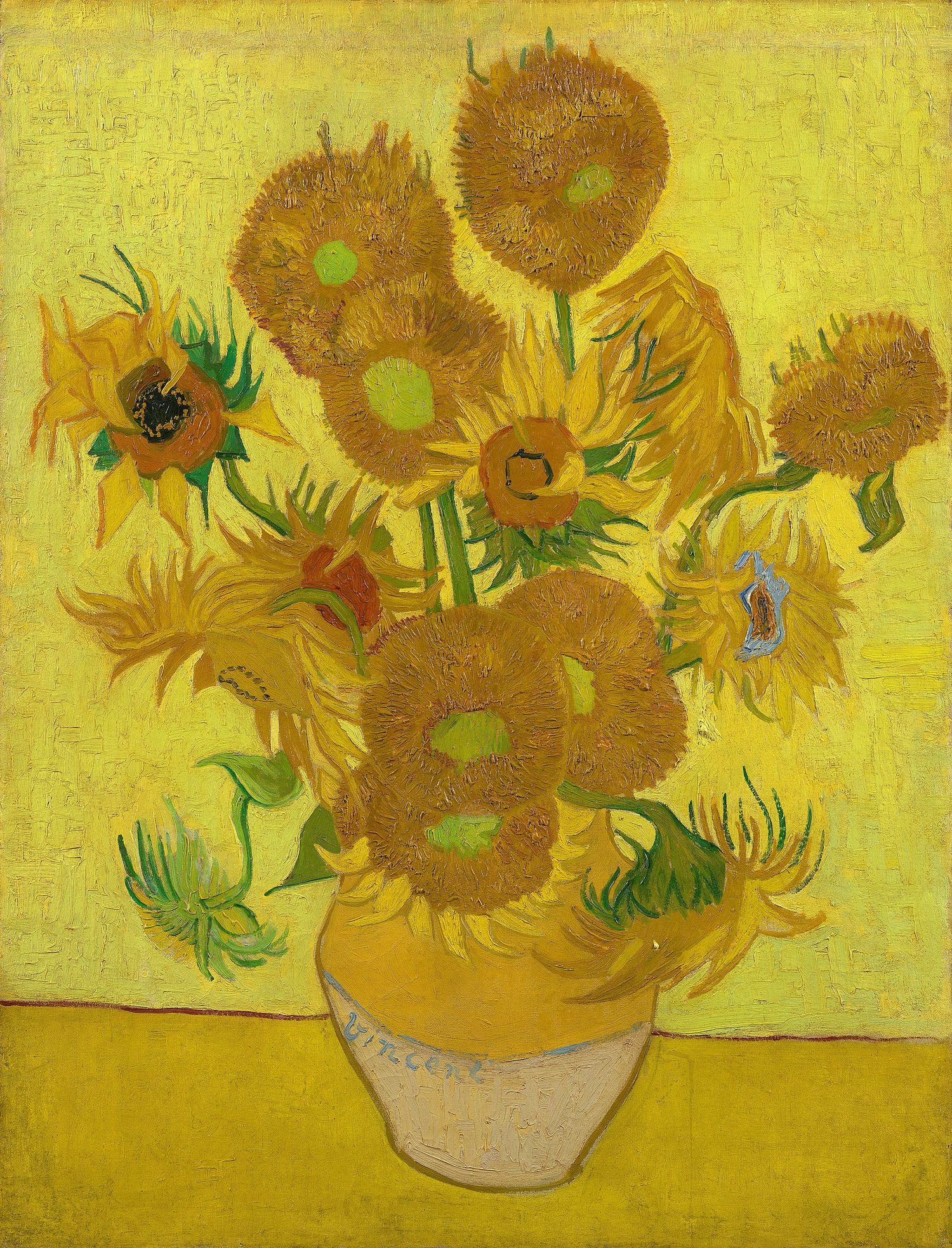
Van Gogh's Sunflowers is built almost entirely from warm 暖色 yellows and oranges— an analogous colour scheme that feels bright and unified
Warm or cool colour?
Sort each colour as warm or cool.
Complementary colours sit next to each other on the colour wheel.
Độ khó 1/5 · 100 xu + một phần thưởng nhỏ cho lần hoàn thành đầu tiên trong ngày
False. Complementary colours sit opposite each other on the wheel. Neighbouring colours are analogous.
Match each term to its meaning.
Độ khó 2/5 · 140 xu + một phần thưởng nhỏ cho lần hoàn thành đầu tiên trong ngày
Primaries = R/Y/B; complementary = opposite; analogous = neighbouring.
Warm and cool
- Warm colours (red, orange, yellow) advance and energise.
- Cool 冷色 colours (blue, green, violet) recede and calm.
- A tint adds white, a shade adds black.
Warm colours seem to advance, while ____ colours seem to recede.
Độ khó 1/5 · 100 xu + một phần thưởng nhỏ cho lần hoàn thành đầu tiên trong ngày
Cool colours recede and calm; warm colours advance.
Do not confuse the artist's RYB colour wheel (red-yellow-blue primaries) with the screen's RGB (red-green-blue). On paper, mixing red and yellow gives orange; on a screen, colours mix differently. Know which system you are working in.
Place a complementary pair — blue and orange — side by side and each looks more intense. Mix them together instead and they dull toward grey. This is why artists use complements both to make colours pop and to mix natural neutrals.
Colour has three properties: hue (name), value (light/dark), saturation (intensity). The colour wheel shows primary, secondary, complementary (opposite), and analogous (neighbouring) colours. Warm colours advance; cool colours recede.
Write from hue kept and saturation lowered
- The colour stays red.
- The student lightens it and then greys it.
A student starts with red, lightens it toward pink, then mixes in grey. Which colour properties changed, and which name stayed the same?
The name of the colour can stay while its lightness and intensity change.
What stayed the same when red became a light greyed pink?
Độ khó 1/5 · 100 xu + một phần thưởng nhỏ cho lần hoàn thành đầu tiên trong ngày
The colour is still a red hue. Its value is lighter and its saturation is lower. Other options — The value (because pink is as dark as red); The saturation (because grey makes a colour more intense).