Rational functions and graphs
Đã giới thiệu| English | Ý nghĩa |
|---|---|
| polynomial/ˌpɒlɪˈnəʊmɪəl/ | đa thức |
| vertical asymptote/ˈvɜːtɪkl ˈæsɪmptəʊt/ | tiếp tuyến đứng |
| oblique asymptote/əˈbliːk ˈæsɪmptəʊt/ | tiếp tuyến xiên |
| denominator/dɪˈnɒmɪneɪtə/ | mẫu số |
| rational function/ˈræʃənl ˈfʌŋkʃn/ | hữu tỉ hàm |
| remainder/rɪˈmeɪndə/ | dư |
| quotient/ˈkwəʊʃənt/ | thương |
The graph that breaks the rules
- Most functions you've met are polynomials 多项式 — smooth, continuous, defined everywhere. But divide one polynomial by another and you get something wilder: vertical asymptotes 垂直渐近线, oblique asymptotes 斜渐近线, and behaviour that changes dramatically near the zeros of the denominator 分母.
- Rational functions 有理函数 are the gateway to understanding more complex curves.
What is a rational function?
- A rational function is a fraction of two polynomials: $f(x) = \dfrac{P(x)}{Q(x)}$.
- The denominator's zeros give vertical asymptotes (where the function shoots to $\pm\infty$).
Worked example. $f(x) = \dfrac{x^2 - 1}{x - 2}$. Vertical asymptote at $x = 2$. Dividing: $f(x) = x + 2 + \dfrac{3}{x-2}$. The oblique asymptote is $y = x + 2$.
Rational functions
y = a/(x − b) + c
A rational function has asymptotes the curve approaches but never touches.
A rational function is a fraction of two polynomials.
Độ khó 1/5 · 100 xu + một phần thưởng nhỏ cho lần hoàn thành đầu tiên trong ngày
That is the definition — one polynomial over another.
Oblique (slant) asymptotes
- When the top has higher degree than the bottom, the graph has an oblique (slant) asymptote — find it by polynomial long division.
- The remainder 余数 term vanishes as $x \to \infty$, leaving the quotient 商 as the asymptote.
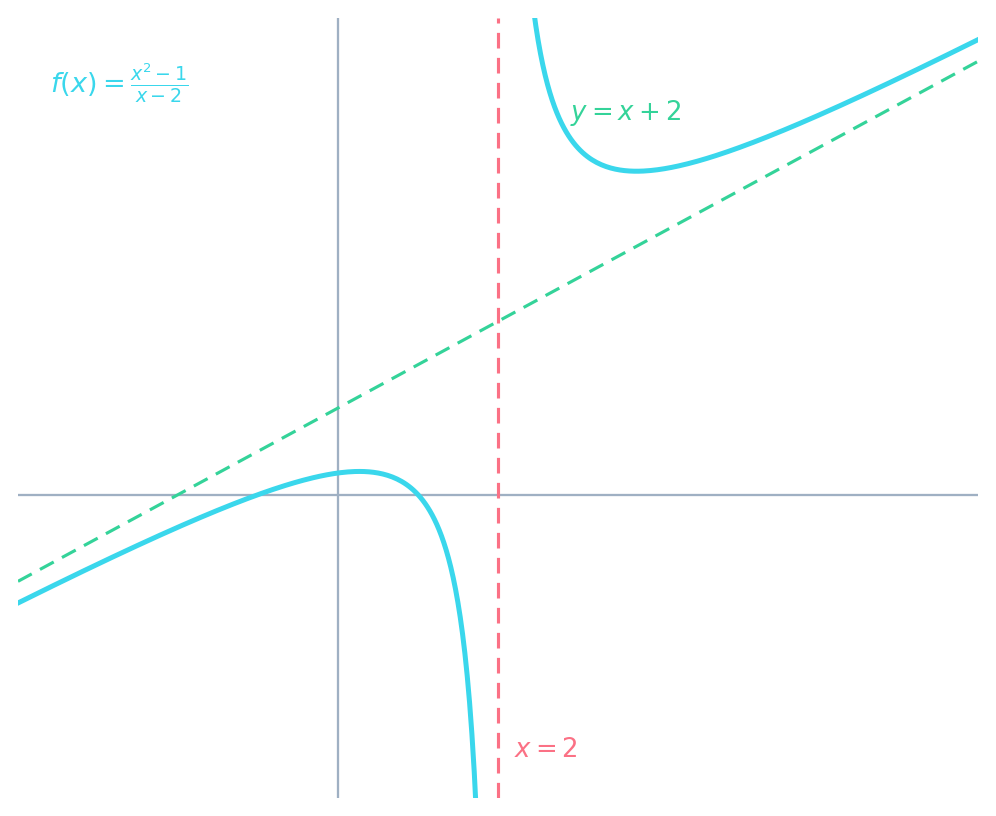
The curve hugs the vertical asymptote x = 2 and the oblique asymptote y = x + 2 far from the origin.
Don't forget the remainder. When dividing, the function equals the quotient plus the remainder over the divisor. The asymptote is just the quotient — the remainder tells you which side of the asymptote the curve approaches from.
A rational function has an oblique (slant) asymptote when the degree of the top is:
Độ khó 1/5 · 100 xu + một phần thưởng nhỏ cho lần hoàn thành đầu tiên trong ngày
When the numerator's degree exceeds the denominator's, dividing out leaves a slant line the curve approaches.
You find an oblique asymptote by:
Độ khó 1/5 · 100 xu + một phần thưởng nhỏ cho lần hoàn thành đầu tiên trong ngày
Polynomial division gives the straight-line part the curve approaches far from the origin.
For f(x) = (x²−1)/(x−2), divide to get f(x) = x + 2 + 3/(x−2). The oblique asymptote is y = x + ?
Độ khó 2/5 · 140 xu + một phần thưởng nhỏ cho lần hoàn thành đầu tiên trong ngày
The quotient is x + 2, so the oblique asymptote is y = x + 2.
Related graphs
- You should relate $y = f(x)$ to:
- $y^2 = f(x)$ — only exists where $f(x) \geq 0$, symmetric about the $x$-axis.
- $y = \dfrac{1}{f(x)}$ — zeros become asymptotes, asymptotes become zeros.
- $y = |f(x)|$ — reflects negative parts above the $x$-axis.
- $y = f(|x|)$ — reflects the right half to the left.
For y = 1/f(x), the zeros of f(x) become the zeros of y.
Độ khó 1/5 · 100 xu + một phần thưởng nhỏ cho lần hoàn thành đầu tiên trong ngày
False. Where f(x) = 0, 1/f(x) is undefined, so the zeros of f become vertical asymptotes of y = 1/f(x). 1/f(x) is never zero.
The graph of y = |f(x)| is obtained from y = f(x) by:
Độ khó 1/5 · 100 xu + một phần thưởng nhỏ cho lần hoàn thành đầu tiên trong ngày
The modulus reflects any part of the graph below the x-axis to above it.
Worked example — sketching $y = \dfrac{1}{f(x)}$
- If $f(x) = x^2 - 4$ (roots at $\pm 2$, minimum at $(0, -4)$):
- $\dfrac{1}{f(x)}$ has vertical asymptotes at $x = \pm 2$.
- The minimum of $f$ at $-4$ becomes a local maximum of $\dfrac{1}{f}$ at $-\dfrac{1}{4}$.
- Find the set of values a rational function takes using the discriminant, and its turning points.
You've got it
- a rational function = polynomial ÷ polynomial
- top degree > bottom degree → an oblique asymptote (found by division)
- learn the related graphs: $y^2 = f$, $1/f$, $|f|$, $f(|x|)$
Write from an asymptote y = x + 1
- Divide x squared plus 1 by x minus 1.
- The oblique asymptote is the quotient. The remainder is not the asymptote.
For (x squared plus 1) divided by (x minus 1), what is the oblique asymptote, and why is the remainder not that line?
Polynomial division writes the function as quotient plus remainder over divisor. Only the quotient survives as the oblique asymptote.
What is the constant added to x in the oblique asymptote?
Độ khó 1/5 · 100 xu + một phần thưởng nhỏ cho lần hoàn thành đầu tiên trong ngày
The quotient is x plus 1, so the constant is 1. The remainder is 2.