Skip to content · ⁨Bỏ qua nội dung⁩
Subjects · ⁨Môn học⁩

GAC Mathematics · ⁨Toán học GAC⁩

Tips · ⁨Mẹo⁩

GAC Mathematics is four modules. GAC004 rebuilds the fundamentals in English, from arithmetic and algebra through coordinate geometry, plane and solid geometry, trigonometry and the exponential and logarithmic functions. GAC010 turns to sequences, financial mathematics, probability and statistics. GAC016 is single-variable calculus. GAC024 is discrete mathematics, from sets and counting systems to algorithms, graphs and Boolean logic.

Language is assessed alongside method. A terminology logbook, kept unit by unit and inspected during the semester, is a real component of GAC004, so being able to say what a gradient or a residual is matters as much as computing one.

GAC016 is the module universities most often credit. Several publish a calculus equivalency for it, which makes the derivative and integral work here worth treating as a first-year course rather than as school revision.

The events are a mixture. Expect a short in-class test on the early units, one or two projects built in a spreadsheet, an examination covering everything at the end, and coursework marks that accumulate quietly all semester.

Worked examples, drills and mock papers here are ours, written to the outcomes and the format of those events.

  • 1

    GAC004 Mathematics I: Fundamentals · ⁨GAC004 Toán học I: Nền tảng⁩

    1.1

    What this module is, and how it is marked

    A price can fall by 20% and then rise by 20% without returning to its starting value. Mathematics I helps you explain such results with a method, units and a clear interpretation. The six units connect arithmetic, algebra, graphs, geometry, trigonometry and exponential models.

    Your centre's current assessment brief is the authority for tasks, weights, permitted tools and deadlines. An in-class test 课堂测验 is completed under stated classroom conditions. Projects 项目 can involve collecting data, calculating and reporting; an examination 考试 and coursework 平时作业 may have different instructions. Do not infer an official assessment pattern from these practice sheets.

    A terminology logbook 术语记录本 can record the English term, a meaning in your own words and a small example. Follow your centre's instructions if it is submitted or assessed.

    Read the command word 指令词: solve asks for values satisfying a condition, simplify for an equivalent expression, and justify for a reason. Show a valid method so a reader can check how the result follows. The mark scheme for each task determines its marks.

    The six accompanying practice sheets are original GAC004-aligned material, not official papers. Their solutions award marks for stated mathematical steps rather than for the length of a written report.

    Vocabulary · ⁨Từ vựng⁩ Train · ⁨Luyện tập⁩
    English Tiếng Việt
    in-class test/ɪn klæs test/ kiểm tra trong lớp
    projects/ˈprɒdʒekts/ dự án
    examination/eɡˌzæmɪˈneɪʃn/ bài kiểm tra
    coursework/ˈkɔːsjuːɜːk/ bài tập trên lớp
    terminology logbook/ˌtɜːmɪˈnɒlədʒi ˈlɒɡbʊk/ sổ tay thuật ngữ
    command word/kəˈmænd wɜːd/ từ chỉ thị
    1.1

    Terminology and arithmetic review

    Syllabus · ⁨Chương trình⁩
    English

    Unit 1 of 6 in GAC004 Mathematics I: Fundamentals (Level I). The module is taught over about 40 class hours plus 20 hours of independent study, and is assessed at the teaching centre and moderated by ACT — there is no external exam.

    Module purpose: On completion of this module, students should be able to demonstrate an understanding of the basic concepts of mathematics, and the language used, in preparation for tertiary study within an English-speaking environment.

    The module outcomes this unit works towards:

    Learning Objective GAC004.1: Solve elementary math problems using basic arithmetic operations.

    Tiếng Việt

    Đơn vị 1 trong 6 đơn vị của GAC004 Toán học I: Cơ bản (Mức độ I). Mô-đun được giảng dạy trong khoảng 40 giờ học trên lớp cộng thêm 20 giờ tự học, và được đánh giá tại trung tâm giảng dạy dưới sự giám sát của ACT — không có bài thi bên ngoài.

    Mục tiêu mô-đun: Sau khi hoàn thành mô-đun này, học sinh sẽ có khả năng thể hiện sự hiểu biết về các khái niệm cơ bản của toán học và ngôn ngữ được sử dụng, để chuẩn bị cho việc học tập đại học trong môi trường nói tiếng Anh.

    Các kết quả học tập mà đơn vị này hướng tới:

    Mục tiêu học tập GAC004.1: Giải các bài toán toán học sơ cấp bằng cách sử dụng các phép toán số học cơ bản.

    Source: Cambridge International syllabus · ⁨Nguồn: Chương trình Cambridge International⁩

    The vocabulary of number is assumed by every later unit.

    An integer 整数 is a whole number, including negative whole numbers and zero. A rational number 有理数 can be written as a fraction of two integers with a nonzero denominator; an irrational number 无理数 cannot, and $\pi$ and $\sqrt{2}$ are the standard examples. A prime number 质数 is a positive integer greater than 1 with exactly two positive factors, itself and 1.

    The order of operations 运算顺序 fixes what a written expression means: brackets, then indices, then multiplication and division, then addition and subtraction, working left to right within a level.

    $$3 + 4 \times 2^2 = 3 + 4 \times 4 = 3 + 16 = 19$$
    • A factor 因数 divides a number exactly; a multiple 倍数 is what you get by multiplying it. 6 is a factor of 24, and 24 is a multiple of 6.
    • The highest common factor (HCF) 最大公因数 and lowest common multiple (LCM) 最小公倍数 come from the prime factors: $24 = 2^3 \times 3$ and $36 = 2^2 \times 3^2$, so the HCF is $2^2 \times 3 = 12$ and the LCM is $2^3 \times 3^2 = 72$.
    • A percentage 百分比 is a fraction with denominator 100. An increase of 15% multiplies by $1.15$; a decrease of 15% multiplies by $0.85$. Reversing a percentage change means dividing, never subtracting the same percentage back.
    • Significant figures 有效数字 are the digits retained to express a value at a stated precision. They do not alone establish the accuracy of a measurement. $0.004\,072$ to three significant figures is $0.004\,07$.
    • Standard form 科学记数法 writes a number as $a \times 10^n$ with $1 \le |a| < 10$ for a nonzero number, with integer n. It is how a calculator shows a very large or very small answer.

    Worked example. a decrease and increase use different bases

    The worked price moves from 80 to 64 to 76.8 because each percentage uses the price at that stage.

    Known: an invented price of 80 units falls by 20%, then rises by 20%. Why use successive multipliers? Each change is calculated from the current price.

    $$P_{new}=P_{old}(1-r/100)$$
    $$P_1=80(1-20/100)=64$$
    $$P_{new}=P_{old}(1+r/100)$$
    $$P_2=64(1+20/100)=76.8$$

    The price is not back at 80. The decrease was 16, while the later increase was 12.8, because the bases differ.

    Continue with practice sheet 1.1. Solve before opening the solutions, and check both the method and the final units.

    Vocabulary · ⁨Từ vựng⁩ Train · ⁨Luyện tập⁩
    English Tiếng Việt
    integer/ˈɪntɪdʒə/ integer
    rational number/ˈræʃənl ˈnʌmbə/ số hữu tỷ
    irrational number/ɪˈræʃənl ˈnʌmbə/ số vô tỷ
    prime number/praɪm ˈnʌmbə/ số nguyên tố
    order of operations/ˈɔːdə ɒv ˌɒpəˈreɪʃnz/ thứ tự thực hiện phép tính
    factor/ˈfæktə/ yếu tố
    multiple/ˈmʌltɪpl/ bội
    highest common factor (HCF)/ˈhaɪɪst ˈkɒmən ˈfæktə/ ước chung lớn nhất (UCLN)
    lowest common multiple (LCM)/ˈləʊɪst ˈkɒmən ˈmʌltɪpl/ bội chung nhỏ nhất (BCNN)
    percentage/pəˈsentɪdʒ/ tỷ lệ phần trăm
    Significant figures/sɪɡˈnɪfɪkənt ˈfɪɡəz/ Số có ý nghĩa
    Standard form/ˈstændəd fɔːm/ Dạng chuẩn
    1.2

    Algebra I: introductory algebra

    Syllabus · ⁨Chương trình⁩
    English

    Unit 2 of 6 in GAC004 Mathematics I: Fundamentals (Level I). The module is taught over about 40 class hours plus 20 hours of independent study, and is assessed at the teaching centre and moderated by ACT — there is no external exam.

    The module outcomes this unit works towards:

    Learning Objective GAC004.2: Perform basic algebraic operations and solve equations and inequations using algebraic methods.

    Tiếng Việt

    Đơn vị 2 trong tổng số 6 đơn vị của GAC004 Toán học I: Cơ bản (Cấp độ I). Mô-đun được giảng dạy trong khoảng 40 giờ học trên lớp cộng với 20 giờ tự học, và được đánh giá tại trung tâm giảng dạy dưới sự giám sát của ACT — không có kỳ thi ngoài.

    Các kết quả học tập mà đơn vị này hướng tới:

    Mục tiêu học tập GAC004.2: Thực hiện các phép toán đại số cơ bản và giải phương trình cũng như bất phương trình bằng các phương pháp đại số.

    Source: Cambridge International syllabus · ⁨Nguồn: Chương trình Cambridge International⁩

    Algebra is arithmetic with letters standing for numbers, and it has its own vocabulary.

    In $5x^2 - 3x + 7$, the whole thing is an expression 表达式; $5x^2$, $-3x$ and $7$ are its terms 项; 5 is the coefficient 系数 of $x^2$; and 7 is a constant 常数.

    An equation 方程 says two expressions are equal and is solved for a value. An identity 恒等式 is true for every value in its domain. An inequality 不等式 compares two expressions with $<$, $\le$, $>$ or $\ge$.

    To expand 展开 is to remove brackets; to factorise 因式分解 is to put them back.

    $$(x + 3)(x - 5) = x^2 - 5x + 3x - 15 = x^2 - 2x - 15$$
    • Solving a linear equation 一元一次方程 means doing the same operation to both sides until the letter stands alone.
    • A quadratic equation 一元二次方程 has the form $ax^2+bx+c=0$ with $a\ne0$. Factorise when suitable, or use $x = \dfrac{-b \pm \sqrt{b^2 - 4ac}}{2a}$.
    • Simultaneous equations 联立方程 are two equations in two unknowns, solved by substitution or by elimination. For two linear equations, a unique solution is their intersection. Parallel distinct lines have no solution; identical lines have infinitely many.
    • ⚠ An inequality reverses 反向 when you multiply or divide both sides by a negative number: from $-2x > 6$ it follows that $x < -3$.

    Worked example. reverse the inequality sign when dividing by a negative

    A number line shows x less than 2, with an open circle at 2.

    Known: solve $7-3x>1$. Subtract 7 from both sides, then divide by negative 3. The last operation reverses the inequality.

    $$7-3x>1\quad\Longrightarrow\quad -3x>-6$$
    $$x<\frac{-6}{-3}=2$$

    The open circle excludes 2. Check $x=1$: $7-3(1)=4>1$; the boundary $x=2$ gives equality and is excluded.

    Continue with practice sheet 1.2. Solve before opening the solutions, and check both the method and the final units.

    Vocabulary · ⁨Từ vựng⁩ Train · ⁨Luyện tập⁩
    English Tiếng Việt
    expression/ekˈspreʃn/ biểu hiện
    terms/tɜːmz/ số hạng
    coefficient/ˌkəʊɪˈfɪʃənt/ hệ số
    constant/ˈkɒnstənt/ không đổi
    equation/ɪˈkweɪʒn/ phương trình
    identity/aɪˈdentɪti/ bản sắc
    inequality/ɪniːˈkwɒlɪti/ bất bình đẳng
    expand/ekˈspænd/ khai triển
    factorise/ˈfæktəraɪz/ phân tích nhân tử
    linear equation/ˈlɪnɪə ɪˈkweɪʒn/ phương trình bậc nhất
    quadratic equation/kwɒˈdrætɪk ɪˈkweɪʒn/ phương trình bậc hai
    Simultaneous equations/ˌsɪməlˈteɪnɪəs ɪˈkweɪʒnz/ hệ phương trình
    reverses/rɪˈvɜːsɪz/ đảo ngược
    1.3

    Algebra: graphs and coordinate geometry

    Syllabus · ⁨Chương trình⁩
    English

    Unit 3 of 6 in GAC004 Mathematics I: Fundamentals (Level I). The module is taught over about 40 class hours plus 20 hours of independent study, and is assessed at the teaching centre and moderated by ACT — there is no external exam.

    The module outcomes this unit works towards:

    Learning Objective GAC004.3: Graph algebraic relations and use coordinate geometry to solve problems.

    Tiếng Việt

    Đơn vị 3 trong tổng số 6 đơn vị của GAC004 Toán học I: Cơ bản (Cấp độ I). Mô-đun được giảng dạy trong khoảng 40 giờ học trên lớp cộng với 20 giờ tự học, và được đánh giá tại trung tâm giảng dạy dưới sự giám sát của ACT — không có kỳ thi ngoài.

    Các kết quả học tập mà đơn vị này hướng tới:

    Mục tiêu học tập GAC004.3: Vẽ đồ thị các quan hệ đại số và sử dụng hình học tọa độ để giải quyết các vấn đề.

    Source: Cambridge International syllabus · ⁨Nguồn: Chương trình Cambridge International⁩

    A graph turns an equation into a picture, and coordinate geometry measures that picture.

    A nonvertical straight line can be written $y = mx + c$, where $m$ is the gradient 斜率 and $c$ the y-intercept y 轴截距. The gradient is the rise divided by the run.

    $$m = \frac{y_2 - y_1}{x_2 - x_1}$$
    • Distinct nonvertical lines are parallel 平行 when their gradients are equal. Two nonvertical lines are perpendicular 垂直 when their gradients multiply to $-1$. Vertical lines have undefined gradient; a vertical and a horizontal line are perpendicular.
    • The midpoint 中点 of a segment is the average of the endpoints, and the distance 距离 between two points comes from Pythagoras: $d = \sqrt{(x_2 - x_1)^2 + (y_2 - y_1)^2}$.
    • A quadratic graphs as a parabola 抛物线. Its vertex 顶点 is the turning point, and the roots 根 are the x-values where it meets the $x$-axis, the solutions of $y=0$. A repeated root touches the axis without crossing; some quadratics have no real roots.
    • To solve two equations graphically 用图像求解, draw both and read the coordinates of the intersection. The answer is only as accurate as the drawing, which is why an algebraic check matters.

    Worked example. a rising line through two given points

    The line passes through A at (1,2) and B at (4,8), with dashed coordinate-change guides.

    Known: $A=(1,2)$ and $B=(4,8)$. Use gradient because the line is nonvertical.

    $$m=\frac{y_B-y_A}{x_B-x_A}=\frac{8-2}{4-1}=2$$

    The line equation is $y=mx+c$. Substitute A to find the intercept.

    $$c=y_A-mx_A=2-2(1)=0$$

    Thus $y=2x$. The diagram's horizontal change is 3 and vertical change is 6.

    Continue with practice sheet 1.3. Solve before opening the solutions, and check both the method and the final units.

    Vocabulary · ⁨Từ vựng⁩ Train · ⁨Luyện tập⁩
    English Tiếng Việt
    gradient/ˈɡreɪdɪənt/ hệ số góc
    y-intercept/waɪ ˌɪntəˈsept/ Giao điểm với trục tung
    parallel/ˈpærəlel/ song song
    perpendicular/ˌpɜːpənˈdɪkjʊlə/ vuông góc
    midpoint/ˈmɪdpɔɪnt/ trung điểm
    distance/ˈdɪstəns/ quãng đường
    parabola/pəˈræbələ/ parabol
    vertex/ˈvɜːteks/ đỉnh
    roots/ruːts/ nghiệm
    graphically/ˈɡræfɪkli/ theo dạng đồ thị
    1.4

    Geometry: plane, solid and Euclidean geometry

    Syllabus · ⁨Chương trình⁩
    English

    Unit 4 of 6 in GAC004 Mathematics I: Fundamentals (Level I). The module is taught over about 40 class hours plus 20 hours of independent study, and is assessed at the teaching centre and moderated by ACT — there is no external exam.

    The module outcomes this unit works towards:

    Learning Objective GAC004.4: Analyze simple problems involving planar shapes and solids and solve problems in Euclidean geometry.

    Tiếng Việt

    Đơn vị 4 trong tổng số 6 đơn vị của GAC004 Toán học I: Cơ bản (Cấp độ I). Mô-đun được giảng dạy trong khoảng 40 giờ học trên lớp cộng với 20 giờ tự học, và được đánh giá tại trung tâm giảng dạy dưới sự giám sát của ACT — không có kỳ thi ngoài.

    Các kết quả học tập mà đơn vị này hướng tới:

    Mục tiêu học tập GAC004.4: Phân tích các vấn đề đơn giản liên quan đến các hình phẳng và khối, và giải các vấn đề trong hình học Euclid.

    Source: Cambridge International syllabus · ⁨Nguồn: Chương trình Cambridge International⁩

    Plane geometry is about flat shapes, solid geometry about three-dimensional ones, and Euclidean geometry is the reasoning that connects them.

    Angles on a straight line add to $180°$, angles around a point to $360°$, and the interior angles of a plane Euclidean triangle to $180°$. In a simple polygon 多边形 of $n$ sides the interior angles add to $(n - 2) \times 180°$.

    • Congruent 全等 shapes are identical in size and shape; similar 相似 shapes have the same shape with all lengths in one ratio.
    • Pythagoras' theorem 勾股定理 holds in a right-angled triangle: $a^2 + b^2 = c^2$, where $c$ is the hypotenuse 斜边.
    • Area 面积 is measured in square units and volume 体积 in cubic units. A cylinder has volume $\pi r^2 h$; a sphere has volume $\tfrac{4}{3}\pi r^3$ and surface area $4\pi r^2$.
    • ⚠ Scaling is not linear. If every length of a solid is doubled, its area is multiplied by $2^2 = 4$ and its volume by $2^3 = 8$.

    Worked example. a triangular prism has a constant cross-section

    A triangular prism has a right-triangle cross-section with perpendicular sides 3 and 4 cm and length 10 cm; perspective is not to scale.

    Known: perpendicular triangle sides are 3 and 4 cm; prism length is 10 cm. Find the cross-sectional area, then multiply by the prism length.

    $$A=\frac12 bh=\frac12(3)(4)=6\ \text{cm}^2$$
    $$V=AL=6(10)=60\ \text{cm}^3$$

    The sloping triangle side is not its perpendicular height. Volume is not the area of the triangular end.

    Continue with practice sheet 1.4. Solve before opening the solutions, and check both the method and the final units.

    Vocabulary · ⁨Từ vựng⁩ Train · ⁨Luyện tập⁩
    English Tiếng Việt
    polygon/ˈpɒlɪɡən/ đa giác
    Congruent/ˈkɒŋɡruːənt/ đồng dạng
    similar/ˈsɪmɪlə/ tương đồng
    Pythagoras' theorem/paɪˈθæɡərəs ˈθɪərəm/ Định lý Pythagoras
    hypotenuse/haɪˈpɒtənjuːs/ cạnh huyền
    Area/ˈeərɪə/ Diện tích
    volume/ˈvɒljuːm/ thể tích
    1.5

    Trigonometry

    Syllabus · ⁨Chương trình⁩
    English

    Unit 5 of 6 in GAC004 Mathematics I: Fundamentals (Level I). The module is taught over about 40 class hours plus 20 hours of independent study, and is assessed at the teaching centre and moderated by ACT — there is no external exam.

    The module outcomes this unit works towards:

    Learning Objective GAC004.5: Calculate solutions to various problems using trigonometric methods.

    Tiếng Việt

    Đơn vị 5 trong tổng số 6 đơn vị của GAC004 Toán học I: Cơ bản (Cấp độ I). Mô-đun được giảng dạy trong khoảng 40 giờ học trên lớp cộng với 20 giờ tự học, và được đánh giá tại trung tâm giảng dạy dưới sự giám sát của ACT — không có kỳ thi ngoài.

    Các kết quả học tập mà đơn vị này hướng tới:

    Mục tiêu học tập GAC004.5: Tính toán lời giải cho nhiều loại vấn đề khác nhau bằng cách sử dụng các phương pháp lượng giác.

    Source: Cambridge International syllabus · ⁨Nguồn: Chương trình Cambridge International⁩

    Trigonometry connects the angles of a triangle to its sides.

    In a right-angled triangle, with $\theta$ one of the acute angles, the three ratios are $\sin \theta = \dfrac{\text{opposite}}{\text{hypotenuse}}$, $\cos \theta = \dfrac{\text{adjacent}}{\text{hypotenuse}}$ and $\tan \theta = \dfrac{\text{opposite}}{\text{adjacent}}$.

    For a nondegenerate plane Euclidean triangle, the sine rule 正弦定理 and the cosine rule 余弦定理 apply:

    $$\frac{a}{\sin A} = \frac{b}{\sin B} = \frac{c}{\sin C}, \qquad a^2 = b^2 + c^2 - 2bc\cos A$$
    • An angle can be measured in degrees 度 or in radians 弧度, where $\pi$ radians is $180°$. Check which mode your calculator is in before every question.
    • The unit circle 单位圆 extends the ratios beyond $90°$ and explains why $\sin$ and $\cos$ repeat every $360°$: they are periodic 周期的.
    • A bearing 方位角 is measured clockwise from north and always written with three figures, such as $075°$.
    • Angles of elevation and depression 仰角与俯角 are measured from the horizontal, upwards and downwards respectively. Add the observer or instrument height if the answer needs height above the ground. With side-side-angle data, the sine rule may allow two triangles: check both supplementary angles against the remaining angle sum.

    Worked example. height from a horizontal distance and angle

    A right triangle has a 12 m horizontal base and an angle of elevation of 30 degrees; the unknown height is opposite the angle.

    Known: horizontal distance $d=12$ m and elevation $\theta=30^\circ$. Height h is opposite and d is adjacent, so use tangent in degree mode.

    $$\tan\theta=\frac{h}{d}$$
    $$h=d\tan\theta=12\tan30^\circ\approx6.93\ \text{m}$$

    This is the height above the observer's horizontal sight level, not automatically the height above the ground.

    Continue with practice sheet 1.5. Solve before opening the solutions, and check both the method and the final units.

    Vocabulary · ⁨Từ vựng⁩ Train · ⁨Luyện tập⁩
    English Tiếng Việt
    sine rule/saɪn ruːl/ định lý sin
    cosine rule/ˈkəʊsaɪn ruːl/ định lý cos
    degrees/dɪˈɡriːz/ độ
    radians/ˈreɪdɪənz/ radian
    unit circle/ˈjuːnɪt ˈsɜːkl/ đường tròn đơn vị
    periodic/ˌpɪərɪˈɒdɪk/ tuần hoàn
    bearing/ˈbeərɪŋ/ phương vị
    Angles of elevation and depression/ˈæŋɡlz ɒv ˌelɪˈveɪʃn ænd dɪˈpreʃn/ góc nâng và góc hạ
    1.6

    Exponential and logarithmic functions

    Syllabus · ⁨Chương trình⁩
    English

    Unit 6 of 6 in GAC004 Mathematics I: Fundamentals (Level I). The module is taught over about 40 class hours plus 20 hours of independent study, and is assessed at the teaching centre and moderated by ACT — there is no external exam.

    The module outcomes this unit works towards:

    Learning Objective GAC004.6: Solve and graph exponential and logarithmic functions and equations.

    Tiếng Việt

    Đơn vị 6 trong tổng số 6 đơn vị của GAC004 Toán học I: Cơ bản (Cấp độ I). Mô-đun được giảng dạy trong khoảng 40 giờ học trên lớp cộng với 20 giờ tự học, và được đánh giá tại trung tâm giảng dạy dưới sự giám sát của ACT — không có kỳ thi ngoài.

    Các kết quả học tập mà đơn vị này hướng tới:

    Mục tiêu học tập GAC004.6: Giải và vẽ đồ thị các hàm mũ, hàm logarit và các phương trình tương ứng.

    Source: Cambridge International syllabus · ⁨Nguồn: Chương trình Cambridge International⁩

    These two functions describe growth and decay, and they undo each other.

    An exponential function 指数函数 has the form $y=a^x$ with $a>0$ and $a\ne1$: the variable is in the exponent 指数. Each unit step multiplies its value by a. It grows when $a>1$ and decays when $0. Its y-intercept is 1 and its values stay positive; the x-axis is a horizontal asymptote.

    A logarithm 对数 answers the reverse question. $\log_a y = x$ means exactly $a^x = y$, so $\log_{10}1000=3$. For real logarithms the argument must be positive, and the base must be positive and different from 1. The graph $y=\log_a x$ passes through $(1,0)$ and has vertical asymptote $x=0$.

    $$\log(mn) = \log m + \log n, \qquad \log\!\left(\frac{m}{n}\right) = \log m - \log n, \qquad \log(m^k) = k \log m$$
    • For positive arguments and the same valid base, the laws turn multiplication into addition, which is what makes a logarithm useful for solving an equation with the unknown in the exponent.
    • Natural logarithms 自然对数 use the base $e \approx 2.718$ and are written $\ln$.
    • Compound interest 复利 is exponential: $A = P(1 + r)^n$ after $n$ periods.
    • Exponential decay 指数衰减 has a base between 0 and 1, and can describe a retained proportion each period under stated assumptions. It does not guarantee that a real process follows that model indefinitely.

    Worked example. repeated reductions multiply rather than subtract a fixed amount

    A model starting at 100 is multiplied by 0.8 each period, giving 80 then 64.

    Known: an invented quantity starts at 100 units and decreases by 20% per whole period. The retained proportion is 0.8, so use a multiplicative model.

    $$Q(n)=Q_0(1-r)^n$$
    $$Q(2)=100(1-0.20)^2=64$$

    The first decrease is 20 units and the second is 16. A fixed subtraction of 20 each period would be a different model.

    Continue with practice sheet 1.6. Solve before opening the solutions, and check both the method and the final units.

    Vocabulary · ⁨Từ vựng⁩ Train · ⁨Luyện tập⁩
    English Tiếng Việt
    exponential function/ˌekspəˈnenʃl ˈfʌŋkʃn/ hàm mũ
    exponent/ekˈspəʊnənt/ số mũ
    logarithm/ˈlɒɡərɪθəm/ logarit
    Natural logarithms/ˈnætʃərəl ˈlɒɡərɪθəmz/ logarit tự nhiên
    Compound interest/ˈkɒmpaʊnd ˈɪntrest/ Lãi suất kép
    Exponential decay/ˌekspəˈnenʃl dɪˈkeɪ/ Phân rã theo hàm mũ
  • 2

    GAC010 Mathematics II: Probability, Statistics and Finance · ⁨GAC010 Toán học II: Xác suất, Thống kê và Tài chính⁩

    2.1

    What this module is, and how it is marked · ⁨Mô-đun này là gì và cách chấm điểm⁩

    English

    A cheaper headline rate need not produce the cheaper total, and a larger survey need not produce a more representative result. Mathematics II uses explicit rules, calculations and evidence limits to examine such questions.

    GAC010 covers sequences, finance, probability and statistics. Your centre's current brief determines assessment tasks, weights, tools and deadlines. A test 测验, projects 项目, an examination 考试 and coursework 平时作业 may use different instructions; these original practice sheets do not establish their official pattern or university credit.

    Show the known data, why the formula applies, the symbolic equation and the substitution. State the unit and interpret the result. A statistical summary describes a defined set of observations or a stated model; it does not automatically establish a cause or a whole-population finding.

    All financial amounts, rates, fees and pay rules in the examples are invented teaching conditions. Use their stated timing and rounding assumptions rather than assuming an actual tax or lending rule.

    Tiếng Việt

    Tỷ lệ tổng thể thấp hơn không nhất thiết dẫn đến tổng chi phí thấp hơn, và một khảo sát lớn hơn không nhất thiết tạo ra kết quả đại diện hơn. Toán học II sử dụng các quy tắc cụ thể, phép tính và giới hạn bằng chứng để xem xét các câu hỏi như vậy.

    GAC010 bao gồm dãy số, tài chính, xác suất và thống kê. Chương trình hiện tại của trung tâm bạn sẽ quyết định nhiệm vụ đánh giá, trọng số, công cụ và thời hạn. Một bài kiểm tra, dự án, bài thi và bài tập trên lớp có thể sử dụng các hướng dẫn khác nhau; các tờ thực hành gốc này không thiết lập mẫu chính thức hay tín chỉ đại học cho chúng.

    Trình bày dữ liệu đã biết, lý do áp dụng công thức, phương trình ký hiệu và phép thay thế. Nêu đơn vị và diễn giải kết quả. Một tóm tắt thống kê mô tả một tập quan sát xác định hoặc một mô hình được nêu rõ; nó không tự động thiết lập nguyên nhân hay kết luận về toàn bộ quần thể.

    Tất cả các khoản tiền, tỷ lệ, phí và quy tắc thanh toán trong các ví dụ là điều kiện giảng dạy giả định. Hãy sử dụng các giả định về thời điểm và làm tròn được nêu rõ thay vì giả định một quy tắc thuế hoặc vay thực tế nào.

    2.1

    Sequences and series · ⁨Dãy số và cấp số⁩

    Syllabus · ⁨Chương trình⁩
    English

    Unit 1 of 8 in GAC010 Mathematics II: Probability, Statistics and Finance (Level II). The module is taught over about 40 class hours plus 20 hours of independent study, and is assessed at the teaching centre and moderated by ACT — there is no external exam.

    Module purpose: On completion of this module, students should be able to apply a basic knowledge of the principles of probability and statistics to solving and analysing common financial problems.

    The module outcomes this unit works towards:

    Learning Objective GAC010.1: Solve problems using arithmetic and geometric sequences and series.

    Tiếng Việt

    Đơn vị 1 trong tổng số 8 đơn vị của GAC010 Toán học II: Xác suất, Thống kê và Tài chính (Cấp độ II). Mô-đun được giảng dạy trong khoảng 40 giờ học trên lớp cộng với 20 giờ tự học, và được đánh giá tại trung tâm giảng dạy dưới sự giám sát của ACT — không có kỳ thi ngoài.

    Mục tiêu mô-đun: Sau khi hoàn thành mô-đun này, học sinh sẽ có khả năng áp dụng kiến thức cơ bản về các nguyên lý xác suất và thống kê để giải quyết và phân tích các vấn đề tài chính thông thường.

    Các kết quả học tập mà đơn vị này hướng tới:

    Mục tiêu học tập GAC010.1: Giải các vấn đề bằng cách sử dụng dãy số cấp số cộng, cấp số nhân và các series tương ứng.

    Source: Cambridge International syllabus · ⁨Nguồn: Chương trình Cambridge International⁩

    English

    A sequence 数列 is an ordered list of numbers; a series 级数 is their sum.

    An arithmetic sequence 等差数列 adds a fixed common difference 公差 $d$ each step. A geometric sequence 等比数列 multiplies by a fixed common ratio 公比 $r$.

    $$u_n = a + (n-1)d \qquad\text{and}\qquad u_n = ar^{\,n-1}$$
    • The sums are $S_n = \tfrac{n}{2}\left(2a + (n-1)d\right)$ and $S_n = \dfrac{a(1 - r^n)}{1 - r}$ for $r \neq 1$.
    • A geometric series with $|r| < 1$ has a sum to infinity 无穷和 $S_\infty = \dfrac{a}{1-r}$.
    • Keep a term separate from a total. Some financial models compound geometrically, while others use simple interest or cash flows. Match the model to the specified rule.

    Worked example. row counts differ by a constant amount

    Known: row counts are 4, 7 and 10, continuing with the same difference. Thus $a=4$ and $d=3$. For the fifth row:

    $$u_n=a+(n-1)d$$
    $$u_5=4+(5-1)(3)=16$$

    For the first five rows together, use the arithmetic sum, not the fifth term.

    $$S_n=\frac n2[2a+(n-1)d]$$
    $$S_5=\frac52[2(4)+(5-1)(3)]=50$$

    Practice sheet 2.1 gives a progressively harder set with worked solutions.

    Tiếng Việt

    Một dãy số là một danh sách các số theo thứ tự; một cấp số là tổng của chúng.

    Một dãy số cộng thêm một công sai cố định $d$ ở mỗi bước. A dãy số nhân nhân với một công bội cố định $r$.

    $$u_n = a + (n-1)d \qquad\text{and}\qquad u_n = ar^{\,n-1}$$
    • Tổng là $S_n = \tfrac{n}{2}\left(2a + (n-1)d\right)$ và $S_n = \dfrac{a(1 - r^n)}{1 - r}$ cho $r \neq 1$.
    • Một cấp số nhân với $|r| < 1$ có tổng vô hạn $S_\infty = \dfrac{a}{1-r}$.
    • Giữ một số hạng riêng biệt khỏi tổng. Một số mô hình tài chính tăng trưởng theo cấp số nhân, trong khi những mô hình khác sử dụng lãi đơn hoặc dòng tiền. Hãy khớp mô hình với quy tắc đã chỉ định.

    Ví dụ có lời giải. số lượng hàng khác nhau một lượng không đổi

    Ba hàng chứa 4, 7 và 10 chấm, minh họa cho sự chênh lệch không đổi là 3.

    Đã biết: số lượng hàng là 4, 7 và 10, tiếp tục với cùng độ chênh lệch. Do đó $a=4$ và $d=3$. Đối với hàng thứ năm:

    $$u_n=a+(n-1)d$$
    $$u_5=4+(5-1)(3)=16$$

    Đối với năm hàng đầu tiên, hãy dùng tổng cấp số cộng, không phải số hạng thứ năm.

    $$S_n=\frac n2[2a+(n-1)d]$$
    $$S_5=\frac52[2(4)+(5-1)(3)]=50$$

    Tờ thực hành 2.1 cung cấp một bộ bài tập ngày càng khó hơn kèm lời giải chi tiết.

    Vocabulary · ⁨Từ vựng⁩ Train · ⁨Luyện tập⁩
    English Tiếng Việt
    test/test/ kiểm thử
    projects/ˈprɒdʒekts/ dự án
    examination/eɡˌzæmɪˈneɪʃn/ bài kiểm tra
    coursework/ˈkɔːsjuːɜːk/ bài tập trên lớp
    sequence/ˈsiːkwəns/ dãy (sequence)
    series/ˈsɪəriːz/ nối tiếp
    arithmetic sequence/əˈrɪθmətɪk ˈsiːkwəns/ cấp số cộng
    common difference/ˈkɒmən ˈdɪfrəns/ công sai
    geometric sequence/ˌdʒiːəʊˈmetrɪk ˈsiːkwəns/ cấp số nhân
    common ratio/ˈkɒmən ˈreɪʃɪəʊ/ công bội
    sum to infinity/sʌm tʊ ɪnˈfɪnɪti/ tổng vô hạn
    Gross pay/ɡrəʊs peɪ/ Lương gross (lương trước thuế)
    net pay/net peɪ/ lương net
    deductions/dɪˈdʌkʃnz/ khoản khấu trừ
    Simple interest/ˈsɪmpl ˈɪntrest/ Lãi suất đơn
    Depreciation/dɪˌpriːʃɪˈeɪʃn/ Khấu hao
    discount/ˈdɪskaʊnt/ chiết khấu
    present value/ˈprezənt ˈvæljuː/ giá trị hiện tại
    annuity/əˈnjuːɪti/ tiền trả đều
    loan repayment/ləʊn rɪˈpeɪmənt/ trả nợ vay
    2.2

    Finance: earning money and purchasing goods · ⁨Tài chính: kiếm tiền và mua hàng hóa⁩

    Syllabus · ⁨Chương trình⁩
    English

    Unit 2 of 8 in GAC010 Mathematics II: Probability, Statistics and Finance (Level II). The module is taught over about 40 class hours plus 20 hours of independent study, and is assessed at the teaching centre and moderated by ACT — there is no external exam.

    The module outcomes this unit works towards:

    Learning Objective GAC010.2: Apply algebraic methods to solve financial problems and analyse information.

    Tiếng Việt

    Đơn vị 2 trong tổng số 8 đơn vị của GAC010 Toán học II: Xác suất, Thống kê và Tài chính (Cấp độ II). Mô-đun được giảng dạy trong khoảng 40 giờ học trên lớp cộng với 20 giờ tự học, và được đánh giá tại trung tâm giảng dạy dưới sự giám sát của ACT — không có kỳ thi ngoài.

    Các kết quả học tập mà đơn vị này hướng tới:

    Mục tiêu học tập GAC010.2: Áp dụng các phương pháp đại số để giải các vấn đề tài chính và phân tích thông tin.

    Source: Cambridge International syllabus · ⁨Nguồn: Chương trình Cambridge International⁩

    English

    This unit is the arithmetic of an ordinary life, in English.

    • Gross pay 税前工资 is what you earn; net pay 税后工资 is what arrives after deductions 扣除项 such as tax and insurance.
    • Simple interest 单利 is $I = Prt$ — interest on the original amount only.
    • Compound interest is $A = P(1+r)^n$ — interest on the interest, which is why it is geometric.
    • Depreciation 折旧 is a reduction in recorded value. A fixed-percentage model uses $V_n=V_0(1-r)^n$; other depreciation conventions can use different rules.
    • A discount 折扣 of 20% multiplies by 0.8. Two successive discounts of 20% and 10% multiply by $0.8 \times 0.9 = 0.72$, which is a 28% reduction, not 30%.

    Worked example. calculate regular and overtime hours separately

    Known: 8 hours at 20 units per hour and 2 overtime hours at 1.5 times that rate. Separate the two categories before adding pay.

    $$G=h_rp+h_okp$$
    $$G=8(20)+2(1.5)(20)=220\ \text{units}$$

    If the invented fixed deduction is 15 units, take it from gross pay once.

    $$N=G-D=220-15=205\ \text{units}$$

    Practice sheet 2.2 gives a progressively harder set with worked solutions.

    Tiếng Việt

    Đơn vị này là phép tính cơ bản của cuộc sống thường nhật, bằng tiếng Anh.

    • Thu nhập gộp là những gì bạn kiếm được; thu nhập ròng là những gì nhận được sau khi trừ đi các khoản như thuế và bảo hiểm.
    • Lãi đơn là $I = Prt$ — lãi chỉ tính trên số tiền gốc.
    • Lãi kép là $A = P(1+r)^n$ — lãi tính trên lãi, vì vậy nó là cấp số nhân.
    • Suy giảm giá trị là sự giảm xuống của giá trị ghi sổ. Mô hình phần trăm cố định sử dụng $V_n=V_0(1-r)^n$; các quy ước suy giảm giá trị khác có thể sử dụng các quy tắc khác.
    • Chiết khấu 20% tương đương nhân với 0.8. Hai lần chiết khấu liên tiếp 20% và 10% được nhân với $0.8 \times 0.9 = 0.72$, đây là mức giảm 28%, không phải 30%.

    Ví dụ có lời giải. tính giờ làm việc bình thường và giờ quá giờ riêng biệt

    Bảng lương mẫu chia tách 8 giờ làm việc bình thường từ 2 giờ quá giờ, với các mức lương tương ứng.

    Đã biết: 8 giờ làm việc bình thường với 20 đơn vị tiền lương/giờ và 2 giờ làm thêm với 1.5 lần mức lương đó. Tách riêng hai loại này trước khi cộng tổng tiền lương.

    $$G=h_rp+h_okp$$
    $$G=8(20)+2(1.5)(20)=220\ \text{units}$$

    Nếu khoản trừ cố định giả định là 15 đơn vị, hãy trừ nó khỏi thu nhập gộp một lần duy nhất.

    $$N=G-D=220-15=205\ \text{units}$$

    Tờ thực hành 2.2 cung cấp một bộ bài tập ngày càng khó hơn kèm lời giải chi tiết.

    2.3

    Finance: investing money and loans · ⁨Tài chính: đầu tư tiền và vay nợ⁩

    Syllabus · ⁨Chương trình⁩
    English

    Unit 3 of 8 in GAC010 Mathematics II: Probability, Statistics and Finance (Level II). The module is taught over about 40 class hours plus 20 hours of independent study, and is assessed at the teaching centre and moderated by ACT — there is no external exam.

    The module outcomes this unit works towards:

    Learning Objective GAC010.2: Apply algebraic methods to solve financial problems and analyse information.

    Tiếng Việt

    Đơn vị 3 trong tổng số 8 đơn vị của GAC010 Toán học II: Xác suất, Thống kê và Tài chính (Cấp độ II). Mô-đun được giảng dạy trong khoảng 40 giờ học trên lớp cộng với 20 giờ tự học, và được đánh giá tại trung tâm giảng dạy dưới sự giám sát của ACT — không có kỳ thi ngoài.

    Các kết quả học tập mà đơn vị này hướng tới:

    Mục tiêu học tập GAC010.2: Áp dụng các phương pháp đại số để giải các vấn đề tài chính và phân tích thông tin.

    Source: Cambridge International syllabus · ⁨Nguồn: Chương trình Cambridge International⁩

    English
    • Under a stated constant discount rate and timing assumption, the present value 现值 of a future amount is: $PV = \dfrac{FV}{(1+r)^n}$.
    • An annuity 年金 has specified payments at regular intervals. A loan repayment 贷款还款 schedule may instead have changing amounts or an adjusted final payment; specify whether interest comes before or after payment.
    • The label APR 年利率 is an annual rate measure whose calculation and included charges depend on the stated convention. This sheet uses explicitly defined period rates, not an unstated APR convention.
    • ⚠ A nominal 12% teaching rate with monthly rate 1% has effective annual growth $(1.01)^{12}-1\approx12.68\%$. A different compounding frequency or fee schedule needs a different calculation.

    Worked example. interest then payment, in that order

    Known: opening balance 1000 units, period rate 2%, end-of-period payment 300 units. Interest comes before payment under this stated convention.

    $$B_1=B_0(1+r)-M$$
    $$B_1=1000(1.02)-300=720$$

    The next period's interest uses 720, not the original principal.

    $$B_2=B_1(1+r)-M=720(1.02)-300=434.40$$

    Practice sheet 2.3 gives a progressively harder set with worked solutions.

    Tiếng Việt
    • Dưới một tỷ lệ chiết khấu cố định và giả định thời điểm được nêu rõ, giá trị hiện tại của một khoản tiền trong tương lai là: $PV = \dfrac{FV}{(1+r)^n}$.
    • Tiền trả góp có các khoản thanh toán được chỉ định ở các khoảng thời gian đều đặn. Một lịch trả nợ có thể lại có các khoản thay đổi hoặc khoản thanh toán cuối cùng được điều chỉnh; hãy chỉ định rõ lãi phát sinh trước hay sau khoản thanh toán.
    • Nhãn APR là một thước đo tỷ lệ hàng năm mà cách tính và các khoản phí bao gồm phụ thuộc vào quy ước được nêu rõ. Tờ này sử dụng các tỷ lệ kỳ được xác định rõ ràng, không phải quy ước APR chưa được nêu.
    • Tỷ lệ giảng dạy danh nghĩa 12% với tỷ lệ hàng tháng 1% có tốc độ tăng trưởng thực tế hàng năm là $(1.01)^{12}-1\approx12.68\%$. Tần suất lũy kế hoặc biểu phí khác đòi hỏi một phép tính khác.

    Ví dụ có lời giải. lãi trước rồi mới thanh toán, theo thứ tự đó

    Luồng tiền trong kỳ vay lấy số dư mở đầu là 1000, cộng thêm 2% lãi, rồi trừ đi khoản thanh toán 300.

    Đã biết: số dư mở đầu 1000 đơn vị, tỷ lệ kỳ 2%, thanh toán cuối kỳ 300 đơn vị. Lãi phát sinh trước khoản thanh toán theo quy ước được nêu này.

    $$B_1=B_0(1+r)-M$$
    $$B_1=1000(1.02)-300=720$$

    Lãi của kỳ tiếp theo sử dụng 720, không phải gốc ban đầu.

    $$B_2=B_1(1+r)-M=720(1.02)-300=434.40$$

    Tờ thực hành 2.3 cung cấp một bộ bài tập ngày càng khó hơn kèm lời giải chi tiết.

    Vocabulary · ⁨Từ vựng⁩ Train · ⁨Luyện tập⁩
    English Tiếng Việt
    APR/ˌeɪ piː ˈɑː/ lãi suất thực tế hàng năm (APR)
    2.4

    Probability: key concepts · ⁨Xác suất: các khái niệm cốt lõi⁩

    Syllabus · ⁨Chương trình⁩
    English

    Unit 4 of 8 in GAC010 Mathematics II: Probability, Statistics and Finance (Level II). The module is taught over about 40 class hours plus 20 hours of independent study, and is assessed at the teaching centre and moderated by ACT — there is no external exam.

    The module outcomes this unit works towards:

    Learning Objective GAC010.3: Solve problems using probability and counting techniques.

    Tiếng Việt

    Đơn vị 4 trong tổng số 8 đơn vị của GAC010 Toán học II: Xác suất, Thống kê và Tài chính (Cấp độ II). Mô-đun được giảng dạy trong khoảng 40 giờ học trên lớp cộng với 20 giờ tự học, và được đánh giá tại trung tâm giảng dạy dưới sự giám sát của ACT — không có kỳ thi ngoài.

    Các kết quả học tập mà đơn vị này hướng tới:

    Mục tiêu học tập GAC010.3: Giải các vấn đề bằng cách sử dụng xác suất và kỹ thuật đếm.

    Source: Cambridge International syllabus · ⁨Nguồn: Chương trình Cambridge International⁩

    English

    Probability 概率 measures how likely an event is, on a scale from 0 to 1.

    • For equally likely outcomes, $P(A) = \dfrac{\text{favourable outcomes}}{\text{total outcomes}}$.
    • Events are mutually exclusive 互斥 when they cannot both happen: $P(A \text{ or } B) = P(A) + P(B)$.
    • Events are independent 独立 when one does not affect the other: $P(A \text{ and } B) = P(A) \times P(B)$.
    • The complement 对立事件 rule, $P(\text{not } A) = 1 - P(A)$, is often the fastest route to an answer containing "at least one".
    • Counting techniques 计数方法 supply the denominator: a permutation 排列 counts ordered selections, a combination 组合 counts unordered ones.

    Conditional probability is $P(A\mid B)=P(A\cap B)/P(B)$ for $P(B)>0$. A union subtracts its overlap: $P(A\cup B)=P(A)+P(B)-P(A\cap B)$. Association in a supplied table does not by itself establish a cause.

    Worked example. a second draw depends on the first

    Known: two red and one blue counter, two random draws without replacement. To get two reds, follow the red-red path and multiply its conditional probabilities.

    $$P(RR)=P(R_1)P(R_2\mid R_1)$$
    $$P(RR)=\frac23\times\frac12=\frac13$$

    A first blue leaves only red counters; the blue-blue path has probability zero. The draws are not independent.

    Practice sheet 2.4 gives a progressively harder set with worked solutions.

    Tiếng Việt

    Xác suất đo lường khả năng xảy ra của một biến cố, trên thang đo từ 0 đến 1.

    • Đối với các kết quả đồng khả năng, $P(A) = \dfrac{\text{favourable outcomes}}{\text{total outcomes}}$.
    • Các biến cố tương hỗ (không thể xảy ra đồng thời) khi chúng không thể cùng xảy ra: $P(A \text{ or } B) = P(A) + P(B)$.
    • Các biến cố độc lập khi một biến không ảnh hưởng đến biến còn lại: $P(A \text{ and } B) = P(A) \times P(B)$.
    • Quy tắc phản đề, $P(\text{not } A) = 1 - P(A)$, thường là cách nhanh nhất để đưa ra đáp án chứa "ít nhất một".
    • Kỹ thuật đếm cung cấp mẫu số: một số hoán vị đếm các lựa chọn có thứ tự, một số tổ hợp đếm các lựa chọn không có thứ tự.

    Xác suất có điều kiện là $P(A\mid B)=P(A\cap B)/P(B)$ cho $P(B)>0$. Một hợp trừ đi phần giao: $P(A\cup B)=P(A)+P(B)-P(A\cap B)$. Sự liên hệ trong bảng được cung cấp không tự thiết lập nguyên nhân.

    Ví dụ có lời giải. lần rút thứ hai phụ thuộc vào lần đầu

    Cây xác suất hai lần rút từ túi có hai quân đỏ và một quân xanh dương, không hoàn lại, gắn nhãn xác suất có điều kiện cho lần rút thứ hai.

    Đã biết: hai quân đỏ và một quân xanh dương, hai lần rút ngẫu nhiên không hoàn lại. Để có hai quân đỏ, hãy đi theo đường red-red và nhân các xác suất có điều kiện của nó.

    $$P(RR)=P(R_1)P(R_2\mid R_1)$$
    $$P(RR)=\frac23\times\frac12=\frac13$$

    Một lần rút đầu tiên là màu xanh dương chỉ còn lại các quân màu đỏ; đường blue-blue có xác suất bằng 0. Các lần rút không độc lập.

    Tài liệu thực hành 2.4 cung cấp một bộ bài tập tăng dần độ khó kèm lời giải chi tiết.

    Vocabulary · ⁨Từ vựng⁩ Train · ⁨Luyện tập⁩
    English Tiếng Việt
    Probability/ˌprɒbəˈbɪlɪti/ Xác suất
    mutually exclusive/ˈmjuːtʃuːəli eksˈkluːsɪv/ tách biệt
    independent/ˌɪndɪˈpendənt/ độc lập
    complement/ˈkɒmplɪmənt/ phần bù
    Counting techniques/ˈkaʊntɪŋ tekˈniːks/ kỹ thuật đếm
    permutation/ˌpɜːmjuːˈteɪʃn/ hoán vị
    combination/ˌkɒmbɪˈneɪʃn/ sự kết hợp
    2.5

    Statistics: collecting and displaying data · ⁨Thống kê: thu thập và trình bày dữ liệu⁩

    Syllabus · ⁨Chương trình⁩
    English

    Unit 5 of 8 in GAC010 Mathematics II: Probability, Statistics and Finance (Level II). The module is taught over about 40 class hours plus 20 hours of independent study, and is assessed at the teaching centre and moderated by ACT — there is no external exam.

    The module outcomes this unit works towards:

    Learning Objective GAC010.4: Analyse collected data using statistical methods.

    Tiếng Việt

    Đơn vị 5 trong tổng số 8 đơn vị của GAC010 Toán học II: Xác suất, Thống kê và Tài chính (Cấp độ II). Mô-đun được giảng dạy trong khoảng 40 giờ học trên lớp cộng với 20 giờ tự học, và được đánh giá tại trung tâm giảng dạy dưới sự giám sát của ACT — không có kỳ thi ngoài.

    Các kết quả học tập mà đơn vị này hướng tới:

    Mục tiêu học tập GAC010.4: Phân tích dữ liệu đã thu thập bằng các phương pháp thống kê.

    Source: Cambridge International syllabus · ⁨Nguồn: Chương trình Cambridge International⁩

    English
    • A population 总体 is everyone you want to describe; a sample 样本 is who you actually measure.
    • Generalising to a population needs a suitably representative 有代表性的 sample and an honest account of selection and nonresponse. A class survey can describe that class without establishing a school-wide percentage.
    • Qualitative data 定性数据 are categories; quantitative data 定量数据 measure amounts, either discrete 离散 (counted) or continuous 连续 (measured).
    • Bias 偏差 enters through who you ask, who answers, and how the question is worded, and arithmetic alone does not repair missing or systematically selected observations.

    Worked example. equal bar heights can conceal unequal frequencies

    Known: class 0 to 10 has frequency 20; class 10 to 30 has frequency 20. Widths differ, so calculate frequency density.

    $$D=\frac f w$$
    $$D_1=\frac{20}{10}=2$$
    $$D_2=\frac{20}{20}=1$$

    The second bar is half as high but twice as wide. Both areas represent 20 observations.

    Practice sheet 2.5 gives a progressively harder set with worked solutions.

    For unequal-width histogram classes, height is frequency divided by class width so that bar area represents frequency. Keep categories in separated bars and numeric continuous intervals in a histogram.

    Tiếng Việt
    • Dân số (Population) là toàn bộ đối tượng bạn muốn mô tả; mẫu (Sample) là những đối tượng mà bạn thực sự đo lường.
    • Khái quát hóa cho dân số cần một mẫu đại diện phù hợp và báo cáo trung thực về quá trình chọn mẫu và tỷ lệ không phản hồi. Một cuộc khảo sát lớp học có thể mô tả chính lớp đó mà không cần thiết lập tỷ lệ phần trăm trên toàn trường.
    • Dữ liệu định tính (Qualitative data) là các danh mục; dữ liệu định lượng (Quantitative data) đo lường giá trị số, bao gồm cả dữ liệu rời rạc (discrete) (đếm được) hoặc dữ liệu liên tục (continuous) (đo lường).
    • Độ lệch chuẩn (Bias) xuất hiện thông qua việc ai được hỏi, ai trả lời, và cách câu hỏi được đặt ra; chỉ riêng phép tính toán học không thể khắc phục việc thiếu dữ liệu hoặc các quan sát bị chọn lọc có hệ thống.

    Ví dụ minh họa. chiều cao cột bằng nhau có thể che giấu tần số không tương đương

    Biểu đồ histogram có các khoảng từ 0 đến 10 và từ 10 đến 30 với mật độ lần lượt là 2 và 1; diện tích của mỗi khoảng đại diện cho tần số 20.

    已知: class 0 to 10 has frequency 20; class 10 to 30 has frequency 20. Widths differ, so calculate frequency density.

    $$D=\frac f w$$
    $$D_1=\frac{20}{10}=2$$
    $$D_2=\frac{20}{20}=1$$

    Cột thứ hai thấp hơn một nửa nhưng rộng gấp đôi. Cả hai diện tích đều đại diện cho 20 quan sát.

    Tài liệu thực hành 2.5 cung cấp một bộ bài tập tăng dần độ khó kèm lời giải chi tiết.

    Đối với các nhóm histogram có độ rộng không bằng nhau, chiều cao là tần số chia cho độ rộng nhóm để diện tích cột đại diện cho tần số. Giữ các danh mục trong các cột tách biệt và các khoảng liên tục nằm trong biểu đồ histogram.

    Vocabulary · ⁨Từ vựng⁩ Train · ⁨Luyện tập⁩
    English Tiếng Việt
    population/ˌpɒpjʊˈleɪʃn/ dân số
    sample/ˈsæmpl/ mẫu
    representative/ˌreprɪˈzentətɪv/ đại diện
    Qualitative data/ˈkwɒlɪteɪtɪv ˈdeɪtə/ dữ liệu định tính
    quantitative data/ˈkwɒntɪteɪtɪv ˈdeɪtə/ dữ liệu định lượng
    discrete/dɪˈskriːt/ rời rạc
    continuous/kənˈtɪnjuːəs/ liên tục
    Bias/ˈbaɪəs/ Thiên kiến
    2.6

    Statistics: measures of central location · ⁨Thống kê: các thước đo vị trí trung tâm⁩

    Syllabus · ⁨Chương trình⁩
    English

    Unit 6 of 8 in GAC010 Mathematics II: Probability, Statistics and Finance (Level II). The module is taught over about 40 class hours plus 20 hours of independent study, and is assessed at the teaching centre and moderated by ACT — there is no external exam.

    The module outcomes this unit works towards:

    Learning Objective GAC010.4: Analyse collected data using statistical methods.

    Tiếng Việt

    Đơn vị 6 trong tổng số 8 đơn vị của GAC010 Toán học II: Xác suất, Thống kê và Tài chính (Cấp độ II). Mô-đun được giảng dạy trong khoảng 40 giờ học trên lớp cộng với 20 giờ tự học, và được đánh giá tại trung tâm giảng dạy dưới sự giám sát của ACT — không có kỳ thi ngoài.

    Các kết quả học tập mà đơn vị này hướng tới:

    Mục tiêu học tập GAC010.4: Phân tích dữ liệu đã thu thập bằng các phương pháp thống kê.

    Source: Cambridge International syllabus · ⁨Nguồn: Chương trình Cambridge International⁩

    English
    • The mean 平均数 is the total divided by the count. It uses every value, and every outlier.
    • The median 中位数 is the middle value in order. Moving an extreme value without changing the ordered middle may leave it unchanged.
    • The mode 众数 is the most frequent value, and it can identify the most frequent category without imposing a numerical scale. A distribution may have more than one mode or no unique mode.
    • ⚠ Choose the summary for the question. A high extreme can pull the mean above the median. The mean still measures total per observation; the median locates the ordered middle. Neither says that most observations equal it.

    Worked example. group size determines a combined mean

    Known: group A has 10 scores with mean 60; group B has 20 with mean 75. Recover each group's total before combining.

    $$\bar x=\frac{n_A\bar x_A+n_B\bar x_B}{n_A+n_B}$$
    $$\bar x=\frac{10(60)+20(75)}{10+20}=70$$

    The unweighted mean of 60 and 75 would be 67.5, which ignores the unequal counts.

    Practice sheet 2.6 gives a progressively harder set with worked solutions.

    Tiếng Việt
    • Trung bình cộng (Mean) là tổng chia cho số lượng. Nó sử dụng mọi giá trị, và mọi giá trị ngoại lai.
    • Median (Trung vị) là giá trị ở giữa khi sắp xếp theo thứ tự. Di chuyển một giá trị cực đoan mà không thay đổi thứ tự ở giữa có thể khiến nó không đổi.
    • Mode (Mốt) là giá trị xuất hiện nhiều nhất, và nó có thể xác định danh mục phổ biến nhất mà không áp đặt thang đo số. Một phân phối có thể có nhiều hơn một mode hoặc không có mode duy nhất.
    • ⚠ Chọn loại số liệu tóm tắt phù hợp với câu hỏi. Một giá trị ngoại lai cao có thể kéo trung bình cộng lên trên trung vị. Trung bình cộng vẫn đo lường tổng per quan sát; trung vị xác định vị trí ở giữa theo thứ tự. Không cái nào nói rằng hầu hết các quan sát đều bằng nó.

    Ví dụ minh họa. kích thước nhóm quyết định trung bình cộng gộp

    Hai nhóm đóng góp các tổng khác nhau: 10 học sinh có trung bình 60, và 20 học sinh có trung bình 75.

    已知: group A has 10 scores with mean 60; group B has 20 with mean 75. Recover each group's total before combining.

    $$\bar x=\frac{n_A\bar x_A+n_B\bar x_B}{n_A+n_B}$$
    $$\bar x=\frac{10(60)+20(75)}{10+20}=70$$

    Trung bình cộng không trọng số của 60 và 75 sẽ là 67.5, điều này bỏ qua sự chênh lệch về số lượng.

    Tài liệu thực hành 2.6 cung cấp một bộ bài tập tăng dần độ khó kèm lời giải chi tiết.

    Vocabulary · ⁨Từ vựng⁩ Train · ⁨Luyện tập⁩
    English Tiếng Việt
    mean/miːn/ trung bình
    median/ˈmiːdiːən/ trung vị
    mode/məʊd/ mật độ
    2.7

    Statistics: measures of variability · ⁨Thống kê: các thước đo độ biến thiên⁩

    Syllabus · ⁨Chương trình⁩
    English

    Unit 7 of 8 in GAC010 Mathematics II: Probability, Statistics and Finance (Level II). The module is taught over about 40 class hours plus 20 hours of independent study, and is assessed at the teaching centre and moderated by ACT — there is no external exam.

    The module outcomes this unit works towards:

    Learning Objective GAC010.4: Analyse collected data using statistical methods.

    Tiếng Việt

    Đơn vị 7 trong tổng số 8 đơn vị của GAC010 Toán học II: Xác suất, Thống kê và Tài chính (Cấp độ II). Mô-đun được giảng dạy trong khoảng 40 giờ học trên lớp cộng với 20 giờ tự học, và được đánh giá tại trung tâm giảng dạy dưới sự giám sát của ACT — không có kỳ thi ngoài.

    Các kết quả học tập mà đơn vị này hướng tới:

    Mục tiêu học tập GAC010.4: Phân tích dữ liệu đã thu thập bằng các phương pháp thống kê.

    Source: Cambridge International syllabus · ⁨Nguồn: Chương trình Cambridge International⁩

    English
    • The range 全距 is the largest minus the smallest — the full span, so an extreme can change it substantially.
    • The interquartile range (IQR) 四分位距 is the difference $Q_3-Q_1$ spanning the central half by the stated quartile convention. A box plot 箱线图 shows quartiles and a median, with whisker rules that must be specified.
    • The standard deviation 标准差 summarises spread using squared deviations. For a complete population, use: $\sigma=\sqrt{\sum(x-\mu)^2/n}$. A sample estimate uses $s=\sqrt{\sum(x-\bar x)^2/(n-1)}$ under that stated convention. Variance has squared units; standard deviation has the original units.
    • A larger standard deviation means a wider spread. Two data sets can share a mean and describe completely different situations.

    Worked example. read a five-number summary rather than every observation

    Known five-number summary: minimum 2, $Q_1=4$, median 6, $Q_3=8$, maximum 12. The overall span and middle-half span are different.

    $$R=x_{max}-x_{min}=12-2=10$$
    $$IQR=Q_3-Q_1=8-4=4$$

    The box does not identify every original value, the sample size or why the spread arose.

    Practice sheet 2.7 gives a progressively harder set with worked solutions.

    For sheet 2.7, quartiles are medians of ordered half-lists, excluding the overall median for an odd count. Whiskers run to the minimum and maximum. Do not mix that convention with software interpolated quartiles or outlier-fence whiskers.

    Tiếng Việt
    • Phạm vi (Range) là giá trị lớn nhất trừ đi giá trị nhỏ nhất — toàn bộ phạm span, do đó một giá trị cực đoan có thể làm thay đổi nó đáng kể.
    • Khoảng tứ phân vị (IQR) là sự chênh lệch $Q_3-Q_1$ bao phủ nửa phần trung tâm theo quy ước tứ phân vị đã nêu. Biểu đồ hộp (Box plot) hiển thị các tứ phân vị và median, với các quy tắc râu (whiskers) phải được quy định rõ.
    • Độ lệch chuẩn (Standard deviation) tóm tắt độ phân tán sử dụng các sai số bình phương. Đối với một dân số hoàn chỉnh, hãy dùng: $\sigma=\sqrt{\sum(x-\mu)^2/n}$. Một ước lượng mẫu sử dụng $s=\sqrt{\sum(x-\bar x)^2/(n-1)}$ theo quy ước đã nêu. Phương sai có đơn vị bình phương; độ lệch chuẩn có đơn vị gốc.
    • Độ lệch chuẩn lớn hơn có nghĩa là độ phân tán rộng hơn. Hai bộ dữ liệu có thể có cùng trung bình cộng và mô tả hoàn toàn các tình huống khác nhau.

    Ví dụ minh họa. đọc tóm tắt năm số thay vì từng quan sát riêng lẻ

    Biểu đồ hộp từ giá trị tối thiểu đến tối đa đánh dấu giá trị tối thiểu 2, tứ phân vị đầu 4, median 6, tứ phân vị thứ ba 8 và giá trị tối đa 12.

    Đã biết tóm tắt năm số: giá trị nhỏ nhất 2, $Q_1=4$, trung vị 6, $Q_3=8$, giá trị lớn nhất 12. Phạm vi toàn bộ và phạm vi giữa là khác nhau.

    $$R=x_{max}-x_{min}=12-2=10$$
    $$IQR=Q_3-Q_1=8-4=4$$

    Hộp không xác định được từng giá trị gốc, kích thước mẫu hay lý do tại sao độ phân tán lại xảy ra.

    Tài liệu thực hành 2.7 cung cấp một bộ bài tập tăng dần độ khó kèm lời giải chi tiết.

    Đối với tài liệu 2.7, các tứ phân vị là trung vị của các nửa danh sách đã sắp xếp, loại trừ trung vị tổng thể nếu số lượng là số lẻ. Râu kéo dài đến giá trị tối thiểu và tối đa. Đừng kết hợp quy ước này với tứ phân vị nội suy phần mềm hoặc râu hàng rào ngoại lai.

    Vocabulary · ⁨Từ vựng⁩ Train · ⁨Luyện tập⁩
    English Tiếng Việt
    range/reɪndʒ/ tập giá trị
    interquartile range (IQR)/ˌɪntəˈkwɔːtaɪl reɪndʒ/ miền tứ phân vị (IQR)
    box plot/bɒks plɒt/ đồ thị hộp
    standard deviation/ˈstændəd ˌdiːvɪˈeɪʃn/ độ lệch chuẩn
    2.8

    Distributions: the normal distribution · ⁨Phân phối: phân phối chuẩn⁩

    Syllabus · ⁨Chương trình⁩
    English

    Unit 8 of 8 in GAC010 Mathematics II: Probability, Statistics and Finance (Level II). The module is taught over about 40 class hours plus 20 hours of independent study, and is assessed at the teaching centre and moderated by ACT — there is no external exam.

    The module outcomes this unit works towards:

    Learning Objective GAC010.5: Use the normal distribution to analyse data.

    Tiếng Việt

    Đơn vị 8 trong tổng số 8 đơn vị của GAC010 Toán học II: Xác suất, Thống kê và Tài chính (Cấp độ II). Mô-đun được giảng dạy trong khoảng 40 giờ học trên lớp cộng với 20 giờ tự học, và được đánh giá tại trung tâm giảng dạy dưới sự giám sát của ACT — không có kỳ thi ngoài.

    Các kết quả học tập mà đơn vị này hướng tới:

    Mục tiêu học tập GAC010.5: Sử dụng phân phối chuẩn để phân tích dữ liệu.

    Source: Cambridge International syllabus · ⁨Nguồn: Chương trình Cambridge International⁩

    English
    • The normal distribution 正态分布 is a continuous symmetric bell-shaped model specified by its mean and positive standard deviation. Those two summaries alone do not establish that observed data follow this model.
    • Under a normal model, the approximate empirical rule is: about 68% of values lie within one standard deviation of the mean, 95% within two, and 99.7% within three.
    • A z-score 标准分 says how many standard deviations a value sits from the mean: $z = \dfrac{x - \mu}{\sigma}$, which is what makes two different scales comparable.

    For a normal model, use cumulative area $\Phi(z)=P(Z\leq z)$ and symmetry $\Phi(-z)=1-\Phi(z)$. An interval subtracts its two cumulative bounds. Expected count is sample size times probability and need not be an integer; an observed count is an integer.

    Worked example. a threshold is an area beyond a standardised value

    Known: an invented measurement model has $\mu=50$ and $\sigma=10$. For values above 60, standardise the threshold.

    $$z=\frac{x-\mu}{\sigma}=\frac{60-50}{10}=1$$

    Use the complement of the supplied cumulative area.

    $$P(X>60)=1-\Phi(1)=1-0.8413=0.1587$$

    This is a model probability, not a guarantee that exactly 15.87% of a finite sample exceeds 60.

    Practice sheet 2.8 gives a progressively harder set with worked solutions.

    Tiếng Việt
    • Phân phối chuẩn (Normal distribution) là một mô hình hình chuông liên tục đối xứng được xác định bởi trung bình cộng và độ lệch chuẩn dương. Chỉ riêng hai số liệu tóm tắt này chưa đủ để khẳng định dữ liệu quan sát tuân theo mô hình này.
    • Theo mô hình chuẩn, quy tắc thực nghiệm xấp xỉ là: khoảng 68% các giá trị nằm trong một độ lệch chuẩn so với trung bình, 95% trong hai, và 99.7% trong ba.
    • Z-score (Giá trị Z) cho biết một giá trị nằm cách trung bình bao nhiêu độ lệch chuẩn: $z = \dfrac{x - \mu}{\sigma}$, điều này giúp hai thang đo khác nhau trở nên so sánh được.

    Đối với mô hình chuẩn, hãy dùng diện tích lũy phân $\Phi(z)=P(Z\leq z)$ và tính đối xứng $\Phi(-z)=1-\Phi(z)$. Một khoảng lấy hiệu của hai cận lũy phân của nó. Số quan sát mong đợi là kích thước mẫu nhân với xác suất và không nhất thiết phải là số nguyên; số quan sát thực tế là một số nguyên.

    Ví dụ minh họa. ngưỡng là diện tích vượt quá một giá trị chuẩn hóa

    Đường cong chuẩn hóa tiêu chuẩn đánh dấu z bằng 1 và tô đậm vùng đuôi phải vượt qua điểm đó.

    已知: an invented measurement model has $\mu=50$ and $\sigma=10$. For values above 60, standardise the threshold.

    $$z=\frac{x-\mu}{\sigma}=\frac{60-50}{10}=1$$

    Sử dụng phần bù của diện tích lũy phân được cung cấp.

    $$P(X>60)=1-\Phi(1)=1-0.8413=0.1587$$

    Đây là xác suất mô hình, không phải đảm bảo rằng đúng 15.87% của một mẫu hữu hạn vượt quá 60.

    Tài liệu thực hành 2.8 cung cấp một bộ bài tập tăng dần độ khó kèm lời giải chi tiết.

    Vocabulary · ⁨Từ vựng⁩ Train · ⁨Luyện tập⁩
    English Tiếng Việt
    normal distribution/ˈnɔːml ˌdɪstrɪˈbjuːʃn/ phân phối chuẩn
    z-score/zed skɔː/ tỷ số z
  • 3

    GAC016 Mathematics III: Calculus & Advanced Applications · ⁨GAC016 Toán học III: Vi phân Tích phân & Ứng dụng Nâng cao⁩

    3.1

    What this module is, and how it is marked

    An average speed does not tell you every instantaneous speed, and a signed displacement does not always equal total distance. Calculus makes those distinctions precise.

    GAC016 develops differentiation 微分, integration 积分 and their applications. Your centre's current brief determines assessment tasks and grading requirements; these original practice sheets do not establish a university credit decision or an official examination pattern.

    State the independent variable, domain and units. The notation $dy/dx$ is a derivative with respect to x; a dot over y normally denotes a derivative with respect to time. Those notations describe the same operation only when their independent variables agree.

    For applications, describe what a rate or accumulated value means in the stated model. A negative volume-change rate of 3 cubic centimetres per second means volume is falling at that rate, rather than that the volume itself is negative.

    Vocabulary · ⁨Từ vựng⁩ Train · ⁨Luyện tập⁩
    English Tiếng Việt
    differentiation/ˌdɪfəˌrenʃɪˈeɪʃn/ vi phân
    integration/ˌɪntɪˈɡreɪʃn/ tích hợp
    3.1

    Differentiation

    Syllabus · ⁨Chương trình⁩
    English

    Unit 1 of 3 in GAC016 Mathematics III: Calculus & Advanced Applications (Level III). The module is taught over about 40 class hours plus 20 hours of independent study, and is assessed at the teaching centre and moderated by ACT — there is no external exam.

    Module purpose: On completion of this module, students should be able to demonstrate a basic understanding of the principles of calculus and how they can be applied to the quantitative analysis of practical and financial situations.

    The module outcomes this unit works towards:

    Learning Objective GAC016.1: Determine the derivative (if it exists) of most mathematical functions and use the derivative to analyse functional behaviour.

    Tiếng Việt

    Đơn vị 1 trong 3 đơn vị của GAC016 Toán học III: Giải tích & Ứng dụng Nâng cao (Cấp độ III). Mô-đun được giảng dạy trong khoảng 40 giờ học trên lớp cộng thêm 20 giờ tự học, và được đánh giá tại trung tâm giảng dạy với sự điều tiết bởi ACT — không có kỳ thi bên ngoài.

    Mục tiêu mô-đun: Sau khi hoàn thành mô-đun này, sinh viên cần thể hiện được hiểu biết cơ bản về các nguyên lý giải tích và cách chúng có thể được áp dụng vào phân tích định lượng các tình huống thực tế và tài chính.

    Các kết quả học tập mà đơn vị này hướng tới:

    Mục tiêu học tập GAC016.1: Xác định đạo hàm (nếu tồn tại) của hầu hết các hàm số toán học và sử dụng đạo hàm để phân tích hành vi của hàm số.

    Source: Cambridge International syllabus · ⁨Nguồn: Chương trình Cambridge International⁩

    A derivative 导数 is a rate of change: how fast $y$ changes as $x$ changes. Geometrically it is the gradient of the tangent 切线斜率 at a point.

    $$f'(x) = \lim_{h \to 0} \frac{f(x+h) - f(x)}{h}$$

    That limit is the definition. Differentiation from first principles 从定义求导 uses the difference quotient for nonzero h and then takes its limit. Unequal one-sided limits, as for $|x|$ at zero, prevent a derivative even when the function is continuous.

    • The power rule 幂法则, on a domain where the power is differentiable: if $y = x^n$ then $\dfrac{dy}{dx} = nx^{\,n-1}$.
    • The product rule 乘积法则: $(uv)' = u'v + uv'$.
    • The quotient rule 商法则, where $v\ne0$: $\left(\dfrac{u}{v}\right)' = \dfrac{u'v - uv'}{v^2}$.
    • The chain rule 链式法则: if $y = f(g(x))$ then $\dfrac{dy}{dx} = f'(g(x)) \cdot g'(x)$.
    • Stationary points 驻点 occur where $f'(x) = 0$. The second derivative 二阶导数 then classifies a stationary point when it is nonzero: negative gives a local maximum 极大值 and positive a local minimum 极小值. A zero second derivative is inconclusive; use derivative signs or other evidence. A stationary inflection can be neither an extremum.

    Worked example. a tangent slope differs from a secant slope

    The curve y equals x squared has a tangent at (1,1) and a dashed secant joining (1,1) to (2,4).

    Known: $f(x)=x^2$. The secant between x equal to 1 and 2 has slope 3, but the derivative at x equal to 1 is 2.

    $$m_{sec}=\frac{f(b)-f(a)}{b-a}=\frac{4-1}{2-1}=3$$
    $$f'(x)=\lim_{h\to0}\frac{(x+h)^2-x^2}{h}=\lim_{h\to0}(2x+h)=2x$$
    $$m_{tan}=f'(1)=2(1)=2$$

    The average slope over a finite interval need not equal the instantaneous slope at either endpoint.

    Use original practice sheet 3.1 to test the method, domain and interpretation against its solutions.

    Vocabulary · ⁨Từ vựng⁩ Train · ⁨Luyện tập⁩
    English Tiếng Việt
    derivative/dɪˈrɪvətɪv/ đạo hàm
    gradient of the tangent/ˈɡreɪdɪənt ɒvðə ˈtændʒənt/ hệ số góc của tiếp tuyến
    differentiation from first principles/ˌdɪfəˌrenʃɪˈeɪʃn frɒm fɜːst ˈprɪnsɪplz/ vi phân từ định nghĩa cơ bản
    power rule/ˈpaʊə ruːl/ quy tắc lũy thừa
    product rule/ˈprɒdʌkt ruːl/ quy tắc tích
    quotient rule/ˈkwəʊʃənt ruːl/ quy tắc thương
    chain rule/tʃeɪn ruːl/ quy tắc chuỗi
    Stationary points/ˈsteɪʃənəri pɔɪnts/ điểm dừng
    second derivative/ˈsekənd dɪˈrɪvətɪv/ đạo hàm cấp hai
    maximum/ˈmæksɪməm/ tối đa
    minimum/ˈmɪnɪməm/ tối thiểu
    3.2

    Integration

    Syllabus · ⁨Chương trình⁩
    English

    Unit 2 of 3 in GAC016 Mathematics III: Calculus & Advanced Applications (Level III). The module is taught over about 40 class hours plus 20 hours of independent study, and is assessed at the teaching centre and moderated by ACT — there is no external exam.

    The module outcomes this unit works towards:

    Learning Objective GAC016.2: Use techniques of integration to find indefinite and definite integrals.

    Tiếng Việt

    Đơn vị 2 trong 3 đơn vị của GAC016 Toán học III: Giải tích & Ứng dụng Nâng cao (Cấp độ III). Mô-đun được giảng dạy trong khoảng 40 giờ học trên lớp cộng thêm 20 giờ tự học, và được đánh giá tại trung tâm giảng dạy với sự điều tiết bởi ACT — không có kỳ thi bên ngoài.

    Các kết quả học tập mà đơn vị này hướng tới:

    Mục tiêu học tập GAC016.2: Sử dụng các kỹ thuật tích phân để tìm tích phân bất định và tích phân xác định.

    Source: Cambridge International syllabus · ⁨Nguồn: Chương trình Cambridge International⁩

    Indefinite integration finds antiderivatives. Definite integration measures signed accumulation, which can differ from geometric area. For a continuous integrand, the fundamental theorem of calculus 微积分基本定理 connects a definite integral to the difference of antiderivative values at its limits.

    • An indefinite integral 不定积分 has no limits and needs the constant of integration 积分常数: $\displaystyle\int x^n\,dx = \frac{x^{\,n+1}}{n+1} + c$ for $n \neq -1$.
    • A definite integral 定积分 has limits and gives a number: $\displaystyle\int_a^b f(x)\,dx = F(b) - F(a)$.
    • Integration by substitution 换元积分法 reverses the chain rule.
    • ⚠ Forgetting $+c$ on an indefinite integral is the single most frequent lost mark in the module, and it is lost on questions you have otherwise answered correctly.

    Worked example. negative and positive areas can cancel

    The line y equals x crosses the axis at zero, with shaded regions on both sides over negative 1 to 1.

    Known: $f(x)=x$ from negative 1 to 1. Its definite integral is zero because the negative and positive contributions cancel.

    $$I=\int_{-1}^{1}x\,dx=\left[\frac{x^2}{2}\right]_{-1}^{1}=\frac12-\frac12=0$$

    Geometric area instead adds the magnitudes of the two triangular regions.

    $$A=-\int_{-1}^{0}x\,dx+\int_0^1x\,dx=\frac12+\frac12=1$$

    Use original practice sheet 3.2 to test the method, domain and interpretation against its solutions.

    Vocabulary · ⁨Từ vựng⁩ Train · ⁨Luyện tập⁩
    English Tiếng Việt
    fundamental theorem of calculus/ˌfʌndəˈmentl ˈθɪərəm ɒv ˈkælkjʊləs/ định lý cơ bản của giải tích
    indefinite integral/ɪnˈdefɪnət ˈɪntɪɡrəl/ tích phân bất định
    constant of integration/ˈkɒnstənt ɒv ˌɪntɪˈɡreɪʃn/ hằng số tích phân
    definite integral/ˈdefɪnət ˈɪntɪɡrəl/ tích phân xác định
    Integration by substitution/ˌɪntɪˈɡreɪʃn baɪ ˌsʌbstɪˈtjuːʃn/ Tích phân theo phép thế
    3.3

    Advanced applications

    Syllabus · ⁨Chương trình⁩
    English

    Unit 3 of 3 in GAC016 Mathematics III: Calculus & Advanced Applications (Level III). The module is taught over about 40 class hours plus 20 hours of independent study, and is assessed at the teaching centre and moderated by ACT — there is no external exam.

    The module outcomes this unit works towards:

    Learning Objective GAC016.3: Apply differentiation and integration techniques in a variety of practical problems.

    Tiếng Việt

    Đơn vị 3 trong 3 đơn vị của GAC016 Toán học III: Giải tích & Ứng dụng Nâng cao (Cấp độ III). Mô-đun được giảng dạy trong khoảng 40 giờ học trên lớp cộng thêm 20 giờ tự học, và được đánh giá tại trung tâm giảng dạy với sự điều tiết bởi ACT — không có kỳ thi bên ngoài.

    Các kết quả học tập mà đơn vị này hướng tới:

    Mục tiêu học tập GAC016.3: Áp dụng các kỹ thuật đạo hàm và tích phân vào nhiều loại bài toán thực tế khác nhau.

    Source: Cambridge International syllabus · ⁨Nguồn: Chương trình Cambridge International⁩

    • Optimisation 最优化 finds the largest or smallest value of a quantity: write the quantity as a function of one variable on a stated feasible domain, differentiate, find candidates and justify the required optimum. Check included boundaries and integer constraints where relevant.
    • Rates of change 变化率 chain together: $\dfrac{dV}{dt} = \dfrac{dV}{dr} \times \dfrac{dr}{dt}$.
    • Area between two curves 两曲线间面积 is $\displaystyle\int_a^b (f(x) - g(x))\,dx$ where $f$ is the upper curve on that whole interval. Split at crossings if their order changes.
    • Marginal cost and revenue 边际成本与边际收益 are derivatives of stated continuous cost and revenue models. They are instantaneous rates, not automatically exact discrete-unit changes.

    Worked example. a fixed perimeter leaves one area variable

    A rectangle has width x and length 10 minus x under a fixed perimeter of 20 units.

    Known: a rectangle has perimeter 20, so length plus width is 10. Let width be x; length is $10-x$ and $0.

    $$A(x)=x(10-x)$$
    $$A'(x)=10-2x$$

    The stationary candidate is $x=5$. Since $A''(x)=-2<0$ and the area approaches zero at both domain ends, this candidate is the global maximum. It is a 5 by 5 square with area 25.

    Use original practice sheet 3.3 to test the method, domain and interpretation against its solutions.

    Vocabulary · ⁨Từ vựng⁩ Train · ⁨Luyện tập⁩
    English Tiếng Việt
    Optimisation/ˌɒptɪmaɪˈzeɪʃn/ Tối ưu hóa
    Rates of change/reɪts ɒv tʃeɪndʒ/ Tốc độ thay đổi
    Area between two curves/ˈeərɪə bɪˈtwiːn tuː kɜːvz/ diện tích giữa hai đường cong
    Marginal cost and revenue/ˈmɑːdʒɪnl kɒst ænd ˈrevənjuː/ chi phí biên và doanh thu biên
  • 4

    GAC024 Discrete Mathematics · ⁨GAC024 Toán học Rời rạc⁩

    4.1

    What this module is, and how it is marked

    A repeated set member is counted once, a binary carry may exceed a fixed width, and the fewest-edge route may not have the smallest weight. Discrete mathematics makes those rules explicit.

    GAC024 covers sets, counting systems, binary logic, algorithms and networks. Your centre's current brief determines assessment tasks, tools, weights and deadlines. These original practice sheets do not establish official marking rules or a university credit decision.

    State the universe, representation width, allowed inputs or graph assumptions before solving. Show enough working for another reader to reproduce the result and distinguish a mathematical model from its real implementation.

    4.1

    Sets, relations and functions

    Syllabus · ⁨Chương trình⁩
    English

    Unit 1 of 5 in GAC024 Discrete Mathematics (Level III). The module is taught over about 40 class hours plus 20 hours of independent study, and is assessed at the teaching centre and moderated by ACT — there is no external exam.

    Module purpose: On completion of this module, students should be able to demonstrate an understanding of the basic principles of discrete mathematics, particularly the utilisation of mathematical logic. They should also be able to demonstrate the application of these skills to practical situations.

    The module outcomes this unit works towards:

    Learning Objective GAC024.1: Demonstrate understanding of the introductory concepts and properties of sets, relations and functions.

    Tiếng Việt

    Đơn vị 1 trong 5 đơn vị của GAC024 Toán học Rời rạc (Cấp độ III). Mô-đun được giảng dạy trong khoảng 40 giờ học trên lớp cộng thêm 20 giờ tự học, và được đánh giá tại trung tâm giảng dạy với sự điều tiết bởi ACT — không có kỳ thi bên ngoài.

    Mục tiêu mô-đun: Sau khi hoàn thành mô-đun này, sinh viên cần thể hiện được hiểu biết về các nguyên lý cơ bản của toán học rời rạc, đặc biệt là việc sử dụng logic toán học. Họ cũng cần thể hiện được khả năng áp dụng các kỹ năng này vào các tình huống thực tế.

    Các kết quả học tập mà đơn vị này hướng tới:

    Mục tiêu học tập GAC024.1: Thể hiện sự hiểu biết về các khái niệm giới thiệu và tính chất của tập hợp, quan hệ và hàm số.

    Source: Cambridge International syllabus · ⁨Nguồn: Chương trình Cambridge International⁩

    • A set 集合 is a collection of distinct objects. Order and repetition do not matter.
    • Union 并集 $A \cup B$ is everything in either; intersection 交集 $A \cap B$ is what is in both; the set complement 补集 is everything in the stated universe but outside the set.
    • A subset 子集 has all its elements inside another set.
    • A relation 关系 pairs elements of two sets. A function 函数 is a relation where each input in its stated domain has exactly one output. Different inputs may share an output; an inverse relation is a function only when outputs uniquely identify their inputs.
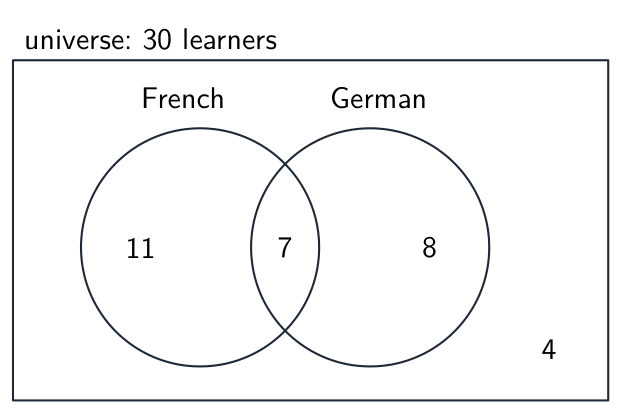
    • A Venn diagram 韦恩图 turns a set problem into a picture, and can show the disjoint regions and their counts. Check that those regions add to the supplied universe total.

    The inclusion-exclusion principle 容斥原理 subtracts the twice-counted overlap once: $|A\cup B|=|A|+|B|-|A\cap B|$.

    Worked example. subtract an overlap only once

    A class universe of 30 is divided into French-only 11, both 7, German-only 8 and neither 4.

    Known: 30 learners, 18 study French, 15 German, and 7 both. The overlap is included in both subject totals.

    $$|F\cup G|=|F|+|G|-|F\cap G|=18+15-7=26$$
    $$N_{neither}=|U|-|F\cup G|=30-26=4$$

    French-only is $18-7=11$ and German-only $15-7=8$. The four disjoint regions sum to 30.

    Practice sheet 4.1 includes progressively harder problems and independently checked solutions.

    Vocabulary · ⁨Từ vựng⁩ Train · ⁨Luyện tập⁩
    English Tiếng Việt
    set/set/ tập hợp
    Union/ˈjuːnɪən/ hợp
    intersection/ˌɪntəˈsekʃn/ giao điểm
    set complement/set ˈkɒmplɪmənt/ bù của tập hợp
    subset/ˈsʌbset/ tập con
    relation/rɪˈleɪʃn/ quan hệ
    function/ˈfʌŋkʃn/ hàm
    Venn diagram/ven ˈdaɪəɡræm/ biểu đồ Venn
    inclusion-exclusion principle/ɪnˈkluːʒn eksˈkluːʒn ˈprɪnsɪpl/ nguyên lý bao hàm - loại trừ
    4.2

    Counting systems

    Syllabus · ⁨Chương trình⁩
    English

    Unit 2 of 5 in GAC024 Discrete Mathematics (Level III). The module is taught over about 40 class hours plus 20 hours of independent study, and is assessed at the teaching centre and moderated by ACT — there is no external exam.

    The module outcomes this unit works towards:

    Learning Objective GAC024.2: Understand the relationships between different counting systems and be able to perform simple binary arithmetic operations.

    Tiếng Việt

    Đơn vị 2 trong 5 đơn vị của GAC024 Toán học Rời rạc (Cấp độ III). Mô-đun được giảng dạy trong khoảng 40 giờ học trên lớp cộng thêm 20 giờ tự học, và được đánh giá tại trung tâm giảng dạy với sự điều tiết bởi ACT — không có kỳ thi bên ngoài.

    Các kết quả học tập mà đơn vị này hướng tới:

    Mục tiêu học tập GAC024.2: Hiểu mối quan hệ giữa các hệ đếm khác nhau và có thể thực hiện các phép toán nhị phân đơn giản.

    Source: Cambridge International syllabus · ⁨Nguồn: Chương trình Cambridge International⁩

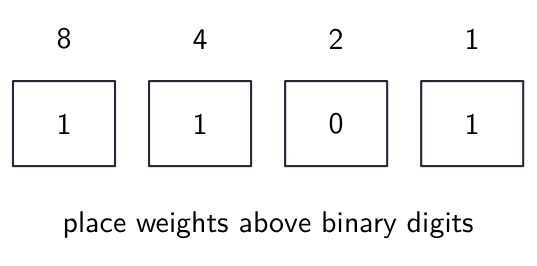
    • A positional number base 进制 b uses digits from zero to b minus one and place weights $b^i$. Decimal 十进制 uses ten, binary 二进制 two, hexadecimal 十六进制 sixteen.
    • Every digit's value is its place value 位值: in binary the places are 1, 2, 4, 8, 16 and so on.
    • Hexadecimal is shorthand for binary: one hex digit is exactly four bits, so conversion can group a stated-width binary pattern into four-bit blocks. Leading zeros preserve width while leaving the unsigned value unchanged.

    For n unsigned bits, values run from zero to $2^n-1$. Distinguish an unrestricted sum from a stored fixed-width result; a wraparound rule, if explicitly given, keeps the low n bits.

    Worked example. place weights determine the decimal value

    The binary digits 1101 are aligned with place weights 8, 4, 2 and 1.

    Known numeral $1101_2$. Use weights from right to left: 1, 2, 4 and 8.

    $$V=\sum d_i2^i$$
    $$V=1(8)+1(4)+0(2)+1(1)=13$$

    The same value is D in hexadecimal. Leading zeros would not change this nonnegative value but can record an intended width.

    Practice sheet 4.2 includes progressively harder problems and independently checked solutions.

    Vocabulary · ⁨Từ vựng⁩ Train · ⁨Luyện tập⁩
    English Tiếng Việt
    number base/ˈnʌmbə beɪs/ cơ sở đếm
    Decimal/ˈdesɪml/ Số thập phân
    binary/ˈbaɪnəri/ nhị phân
    hexadecimal/ˌheksəˈdesɪml/ chữ số thập lục phân
    place value/pleɪs ˈvæljuː/ giá trị vị trí
    4.3

    Binary applications

    Syllabus · ⁨Chương trình⁩
    English

    Unit 3 of 5 in GAC024 Discrete Mathematics (Level III). The module is taught over about 40 class hours plus 20 hours of independent study, and is assessed at the teaching centre and moderated by ACT — there is no external exam.

    The module outcomes this unit works towards:

    Learning Objective GAC024.2: Understand the relationships between different counting systems and be able to perform simple binary arithmetic operations.

    Learning Objective GAC024.5: Use the basic identities of Boolean algebra to analyse logic circuits and understand the basic principles of propositional logic.

    Tiếng Việt

    Đơn vị 3 trong 5 đơn vị của GAC024 Toán học Rời rạc (Cấp độ III). Mô-đun được giảng dạy trong khoảng 40 giờ học trên lớp cộng thêm 20 giờ tự học, và được đánh giá tại trung tâm giảng dạy với sự điều tiết bởi ACT — không có kỳ thi bên ngoài.

    Các kết quả học tập mà đơn vị này hướng tới:

    Mục tiêu học tập GAC024.2: Hiểu mối quan hệ giữa các hệ đếm khác nhau và có thể thực hiện các phép toán nhị phân đơn giản.

    Mục tiêu học tập GAC024.5: Sử dụng các đẳng thức cơ bản của đại số Boolean để phân tích mạch logic và hiểu các nguyên lý cơ bản của logic mệnh đề.

    Source: Cambridge International syllabus · ⁨Nguồn: Chương trình Cambridge International⁩

    • Binary arithmetic 二进制运算 adds like decimal, carrying at 2 instead of at 10.
    • A bit 位 is one binary digit; a byte 字节 is eight.
    • Boolean algebra 布尔代数 works on true and false with AND, OR and NOT.
    • A truth table 真值表 lists every Boolean input combination and output. Matching every row proves equivalence for the same finite Boolean inputs; it does not prove physical circuit timing or real-system security.
    • Logic gates 逻辑门 implement stated operations, and a logic circuit 逻辑电路 connects them. Trace the abstract logic according to its connections and input conventions.

    Use inclusive OR and explicit brackets. De Morgan gives $\neg(A\land B)=(\neg A)\lor(\neg B)$. Bitwise NOT inverts only the stated width, not an unspecified infinite representation.

    Worked example. an OR output is inverted by NOT

    Inputs A and B enter an OR-labelled block, whose output enters a NOT-labelled block to give Y.

    Known: $Y=\neg(A\lor B)$. Inclusive OR is false only when both inputs are false; NOT reverses that result. In row order $(A,B)=(0,0),(0,1),(1,0),(1,1)$, the output column is 1, 0, 0, 0. De Morgan gives equivalent expression $(\neg A)\land(\neg B)$.

    Practice sheet 4.3 includes progressively harder problems and independently checked solutions.

    Vocabulary · ⁨Từ vựng⁩ Train · ⁨Luyện tập⁩
    English Tiếng Việt
    Binary arithmetic/ˈbaɪnəri əˈrɪθmətɪk/ Toán học nhị phân
    bit/bɪt/ bit
    byte/baɪt/ byte
    Boolean algebra/ˈbuːlɪən ˈældʒɪbrə/ Đại số Boole
    truth table/truːθ ˈteɪbl/ bảng chân lý
    Logic gates/ˈlɒdʒɪk ɡeɪts/ Cổng logic
    logic circuit/ˈlɒdʒɪk ˈsɜːkɪt/ mạch logic
    4.4

    Algorithms

    Syllabus · ⁨Chương trình⁩
    English

    Unit 4 of 5 in GAC024 Discrete Mathematics (Level III). The module is taught over about 40 class hours plus 20 hours of independent study, and is assessed at the teaching centre and moderated by ACT — there is no external exam.

    The module outcomes this unit works towards:

    Learning Objective GAC024.3: Construct and analyse algorithms and flowcharts for simple mathematical and general procedures.

    Tiếng Việt

    Đơn vị 4 trong 5 đơn vị của GAC024 Toán học Rời rạc (Cấp độ III). Mô-đun được giảng dạy trong khoảng 40 giờ học trên lớp cộng thêm 20 giờ tự học, và được đánh giá tại trung tâm giảng dạy với sự điều tiết bởi ACT — không có kỳ thi bên ngoài.

    Các kết quả học tập mà đơn vị này hướng tới:

    Mục tiêu học tập GAC024.3: Xây dựng và phân tích các thuật toán và sơ đồ lưu đồ cho các quy trình toán học và chung đơn giản.

    Source: Cambridge International syllabus · ⁨Nguồn: Chương trình Cambridge International⁩

    • An algorithm 算法 describes unambiguous steps for a task. A procedure solving the stated finite task must terminate and give the required result for its allowed inputs.
    • A flowchart 流程图 draws it: a decision is a diamond, a process a rectangle.
    • Pseudocode 伪代码 represents its steps without requiring a particular implementation language. State assignment, loop bounds and index conventions before tracing.
    • Tracing 追踪 an algorithm — a table with one column per variable and one row per step — records its actual updates. A trace checks the chosen input; a claim for all allowed inputs also needs a correctness argument.
    • Efficiency 效率 matters: a linear search can stop early but may inspect all n items. Binary search repeatedly discards half of an ordered search range; its logarithmic comparison count requires the sorted-data and bound conventions.

    Worked example. repeat a remainder step until the second number is zero

    A Euclidean-algorithm flowchart tests b equal to zero, otherwise computes a remainder and updates the pair before returning to the test.

    Known: start with positive integers a equal to 10 and b equal to 6. While b is nonzero, compute r as a MOD b, then set a to b and b to r. Pairs after complete iterations are (6,4), (4,2), (2,0), giving output 2. Temporary r preserves the remainder before a and b change. Each nonzero remainder is smaller than the previous positive b, supporting termination.

    Practice sheet 4.4 includes progressively harder problems and independently checked solutions.

    Vocabulary · ⁨Từ vựng⁩ Train · ⁨Luyện tập⁩
    English Tiếng Việt
    algorithm/ˈælɡərɪθəm/ thuật toán
    flowchart/ˈfləʊtʃɑːt/ sơ đồ khối
    Pseudocode/ˈsuːdəʊkəʊd/ Mã giả
    Tracing/ˈtreɪsɪŋ/ vẽ theo đường viền
    Efficiency/ɪˈfɪʃənsi/ Hiệu quả
    4.5

    Graphs and networks

    Syllabus · ⁨Chương trình⁩
    English

    Unit 5 of 5 in GAC024 Discrete Mathematics (Level III). The module is taught over about 40 class hours plus 20 hours of independent study, and is assessed at the teaching centre and moderated by ACT — there is no external exam.

    The module outcomes this unit works towards:

    Learning Objective GAC024.4: Identify the basic types, properties and applications of graphs and trees.

    Tiếng Việt

    Đơn vị 5 trong 5 đơn vị của GAC024 Toán học Rời rạc (Cấp độ III). Mô-đun được giảng dạy trong khoảng 40 giờ học trên lớp cộng thêm 20 giờ tự học, và được đánh giá tại trung tâm giảng dạy với sự điều tiết bởi ACT — không có kỳ thi bên ngoài.

    Các kết quả học tập mà đơn vị này hướng tới:

    Mục tiêu học tập GAC024.4: Xác định các loại cơ bản, tính chất và ứng dụng của đồ thị và cây.

    Source: Cambridge International syllabus · ⁨Nguồn: Chương trình Cambridge International⁩

    • A graph 图 is a set of vertices 顶点 joined by edges 边. It models anything with connections: roads, friendships, dependencies.
    • For a simple undirected graph with no loops or repeated edges, the degree 度 counts incident edges. Every edge contributes two to the total degree sum.
    • A tree 树 is a connected graph with no cycles, and a finite tree with n vertices has n minus 1 edges. Some hierarchical models use trees, but actual systems can also contain cross-links or cycles.
    • A shortest path 最短路径 problem asks for the cheapest route between two vertices, by total weight under the stated constraints, rather than by the number of edges alone. A minimum spanning tree instead connects every vertex without cycles and minimises total included edge weight.

    Worked example. compare total route weight, not the number of edges

    An undirected network joins A to B with weight 2, B to C with 3, A to C with 8 and C to D with 1.

    Known edge weights are AB = 2, BC = 3, AC = 8 and CD = 1. The path A-C-D has weight 9, while A-B-C-D has weight 6. Therefore the three-edge path is shorter by weight despite having more edges. The minimum spanning tree for this small network uses AB, BC and CD with total 6; the agreement of totals here does not make the tasks identical.

    Practice sheet 4.5 includes progressively harder problems and independently checked solutions.

    Vocabulary · ⁨Từ vựng⁩ Train · ⁨Luyện tập⁩
    English Tiếng Việt
    graph/ɡræf/ đồ thị
    vertices/ˈvɜːtɪsiːz/ đỉnh
    edges/ˈedʒɪz/ cạnh
    degree/dɪˈɡriː/ bậc
    tree/triː/ cây
    shortest path/ˈʃɔːtɪst pæθ/ đường đi ngắn nhất

Log in or create account · ⁨Đăng nhập hoặc tạo tài khoản⁩

IGCSE, A-Level & AP