Classes with private attributes
Trang này cần trình duyệt gần đây (hỗ trợ SharedArrayBuffer). Vui lòng cập nhật Chrome, Edge, Firefox hoặc Safari lên phiên bản mới nhất.
English
Private attributes keep the data safe
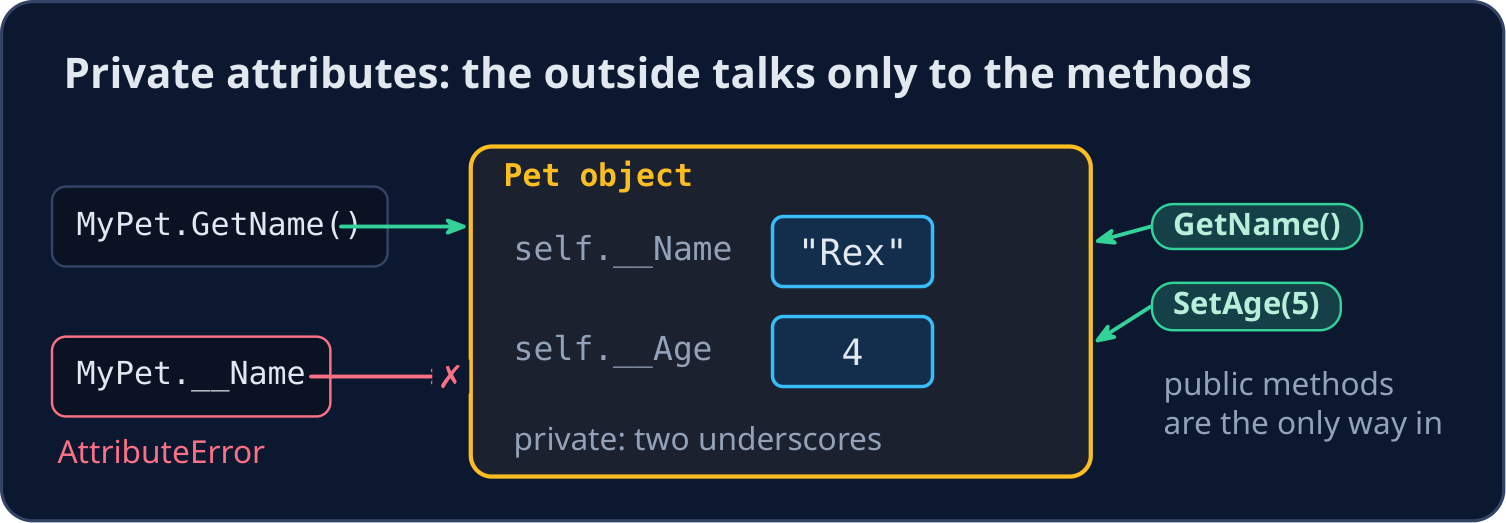
- In Paper 4, every attribute of a class is private. In Python you mark it with two underscores:
self.__Name. - Code outside the class cannot read or change
MyPet.__Name. It must call one of the class's public methods. - Keeping the data inside and the methods outside is called encapsulation. It stops other code from storing a bad value.
English
class Pet:
    def __init__(self, Name, Age):
        self.__Name = Name
        self.__Age = Age

    def GetName(self):
        return self.__Name

    def GetAge(self):
        return self.__Age


MyPet = Pet("Rex", 4)
print(MyPet.GetName(), "is", MyPet.GetAge())
__init__is the constructor. It runs when you writePet("Rex", 4)and stores each parameter in its attribute.- Paper 4 names attributes and methods in this style:
__Name,GetName.
English
Getters and setters
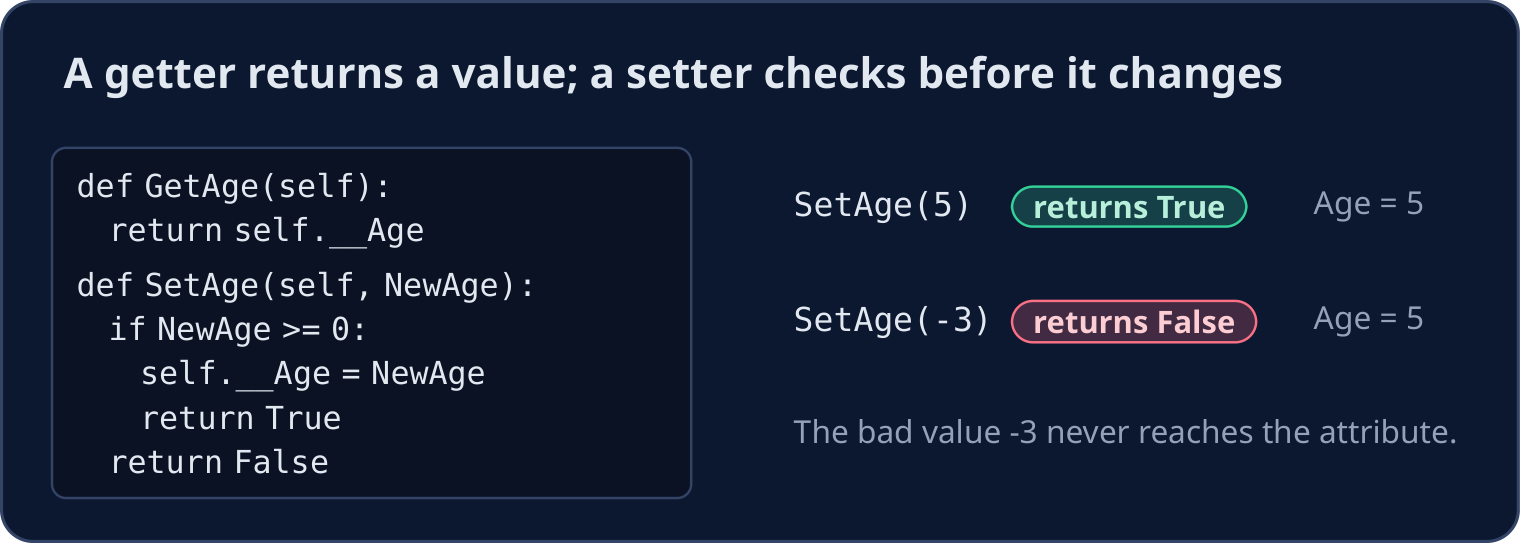
- A getter (
GetAge) returns the value of one attribute. It changes nothing. - A setter (
SetAge) changes one attribute. It can check the new value first and refuse a bad one. - A setter often returns
Truewhen it made the change andFalsewhen it refused.
English
class Pet:
    def __init__(self, Name, Age):
        self.__Name = Name
        self.__Age = Age

    def GetAge(self):
        return self.__Age

    def SetAge(self, NewAge):
        if NewAge >= 0:
            self.__Age = NewAge
            return True
        return False


MyPet = Pet("Rex", 4)
print(MyPet.SetAge(5), MyPet.GetAge())
print(MyPet.SetAge(-3), MyPet.GetAge())
- The output is
True 5, thenFalse 5. The setter kept the bad value out.
English
Private really means outside code cannot reach it
MyPet.__Nameoutside the class raises anAttributeError.- Inside the class's own methods,
self.__Nameworks normally.
class Pet:
    def __init__(self, Name):
        self.__Name = Name

    def GetName(self):
        return self.__Name


MyPet = Pet("Rex")
print(MyPet.GetName())
try:
    print(MyPet.__Name)
except AttributeError:
    print("__Name is private: use GetName()")
English
A list of objects
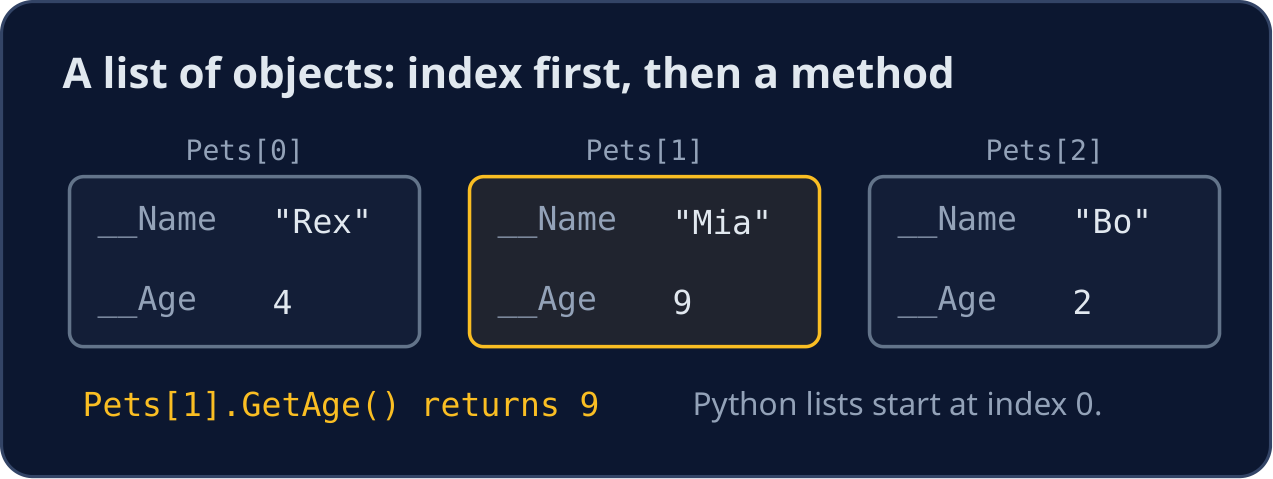
- A program often stores many objects in one list:
Pets = [], thenPets.append(Pet("Rex", 4)). Pets[1]is the second object, because Python lists start at index 0.Pets[1].GetAge()calls that object's method.- To find the oldest pet, loop over the list and compare the ages from the getters.
English
class Pet:
    def __init__(self, Name, Age):
        self.__Name = Name
        self.__Age = Age

    def GetName(self):
        return self.__Name

    def GetAge(self):
        return self.__Age


Pets = [Pet("Rex", 4), Pet("Mia", 9), Pet("Bo", 2)]
Oldest = 0
for Index in range(1, len(Pets)):
    if Pets[Index].GetAge() > Pets[Oldest].GetAge():
        Oldest = Index
print("Oldest:", Pets[Oldest].GetName())
Oldestkeeps the index of the oldest pet so far, so the name and the age always come from the same object.
English
In Cambridge pseudocode
- Pseudocode writes
PRIVATEandPUBLICin front of each attribute and method. The constructor is calledNEW.
CLASS Pet
    PRIVATE Name : STRING
    PRIVATE Age : INTEGER
    PUBLIC PROCEDURE NEW(PName : STRING, PAge : INTEGER)
        Name ← PName
        Age ← PAge
    ENDPROCEDURE
    PUBLIC FUNCTION GetAge() RETURNS INTEGER
        RETURN Age
    ENDFUNCTION
ENDCLASS
MyPet ← NEW Pet("Rex", 4)
English
Common mistakes
| Wrong | Right | Why |
|---|---|---|
self.Name = Name |
self.__Name = Name |
without the two underscores the attribute is public |
def GetName(): |
def GetName(self): |
every method needs self first |
return __Name |
return self.__Name |
the attribute belongs to the object, so use self. |
print(MyPet.__Age) outside the class |
print(MyPet.GetAge()) |
private attributes are reached through methods |
| a setter that stores any value | test the value first | the point of a setter is to keep bad data out |
English
Now you try
- Use two underscores for every attribute and write a method for every value the test needs.
- Press Check answer to test your code.
Độ khó 2/5 · 140 xu + phần thưởng nhỏ khi hoàn thành lần đầu tiên hôm nay
Write a class Book with two private attributes, __Title và __Pages, set by the constructor Book(Title, Pages). Add the getters GetTitle() và GetPages().
Nhấn Chạy để xem kết quả ở đây.
Độ khó 3/5 · 200 xu + phần thưởng nhỏ khi hoàn thành lần đầu tiên hôm nay
Add a setter SetPages(NewPages) đến Book. It stores NewPages and returns True only when NewPages is greater than 0. Otherwise it changes nothing and returns False.
Nhấn Chạy để xem kết quả ở đây.
Độ khó 3/5 · 200 xu + phần thưởng nhỏ khi hoàn thành lần đầu tiên hôm nay
The list Books giữ Book objects. Write a function Longest(Books) that returns the tiêu đề of the book with the most pages. On a tie, return the first one.
Nhấn Chạy để xem kết quả ở đây.