Medical ethics: autonomy, consent and confidentiality
แนะนำใหม่| English | ความหมาย |
|---|---|
| capacity/kəˈpæsɪti/ | The ability to make this decision now. |
| autonomy/ɔːˈtɒnəmi/ | autonomy |
| beneficence | beneficence |
| confidentiality/ˌkɒnfɪˌdenʃiˈæləti/ | The default: what a patient tells a doctor stays private. |
When a patient says no
- A patient needs a blood transfusion to survive, and refuses it because of their beliefs. The team is sure the transfusion is right. Who decides?
- Medical ethics gives a structured answer: four principles, a test of capacity, and the conditions for valid consent. Legal points here follow England and Wales.
Four principles
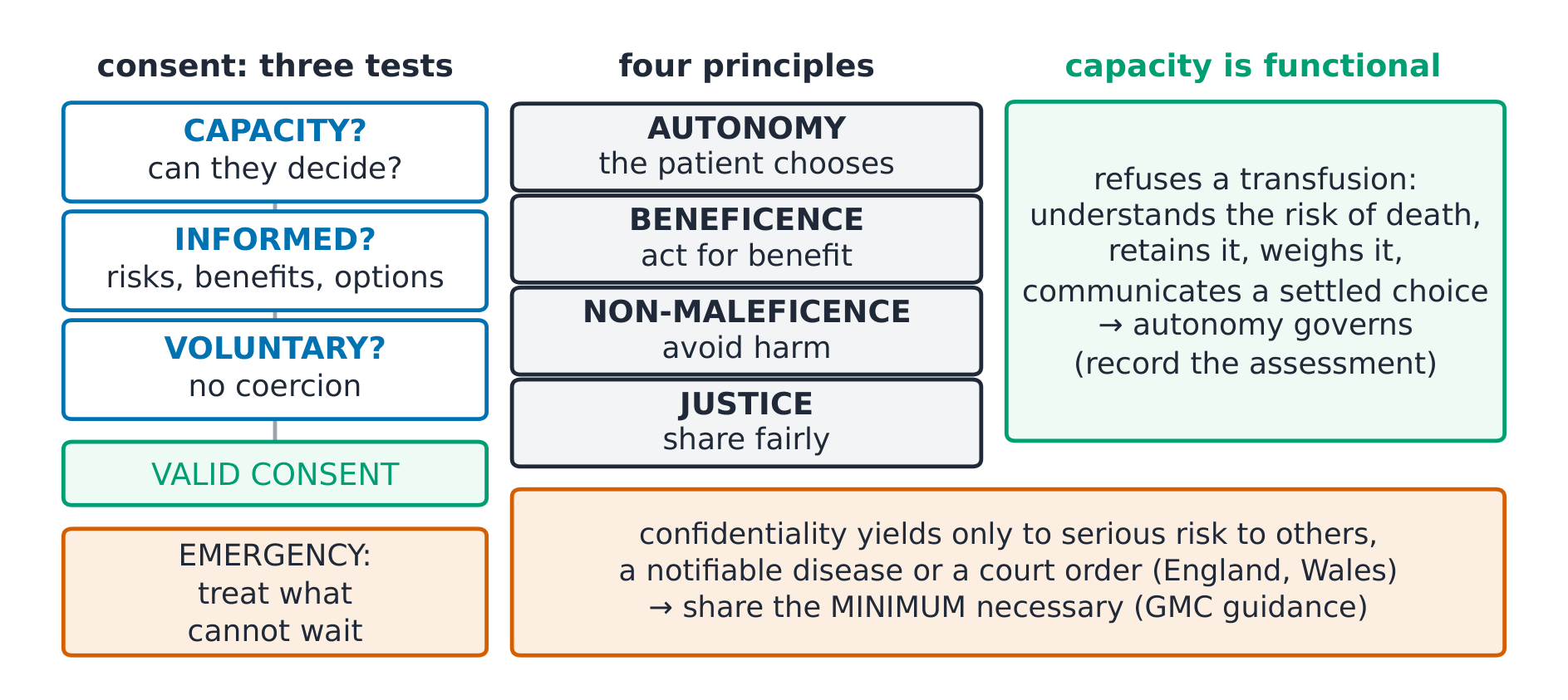
- Autonomy 自主: a competent patient's informed choice governs. Beneficence 行善: act for the patient's benefit.
- Non-maleficence: avoid harm. Justice: distribute care fairly. When they conflict for a competent adult, autonomy usually leads: the patient's values decide what counts as benefit.
Match each principle to its meaning.
ความยาก 2/5 · 140 เหรียญ + บอนัสน้อยๆ เมื่อทำสำเร็จครั้งแรกในวันนี้
When these conflict for a competent adult, autonomy usually leads.
Capacity is tested decision by decision
- Capacity 行为能力 is the ability to make this decision now. The patient must understand the information, retain it long enough, weigh it, and communicate a choice.
- Capacity is specific to the decision and the time. A diagnosis, even dementia or mental illness, does not remove it by itself, and an unwise choice does not prove its absence.
- (Fictional) The patient refusing a transfusion understands that they may die without it, repeats this accurately later, weighs it against their beliefs, and states a settled choice.
- All four parts are met, so they have capacity for this decision. Their refusal stands, and the team documents the assessment.
Which are parts of the test of capacity? Select all that apply.
ความยาก 2/5 · 140 เหรียญ + บอนัสน้อยๆ เมื่อทำสำเร็จครั้งแรกในวันนี้
Capacity is about how the decision is made, not whether the doctor agrees with it.
A patient who makes a choice the team thinks is unwise must lack capacity.
ความยาก 1/5 · 100 เหรียญ + บอนัสน้อยๆ เมื่อทำสำเร็จครั้งแรกในวันนี้
An unwise decision is not proof of incapacity. Capacity is judged by the four-part test.
Valid consent has three parts
- Consent is valid when the patient has capacity, is informed (the nature, risks, benefits and alternatives, including doing nothing), and decides voluntarily, without pressure.
- The signed form only records consent. The conversation is where consent actually happens.
A patient signs a consent form after being told only the benefits of an operation. The consent is —
ความยาก 1/5 · 100 เหรียญ + บอนัสน้อยๆ เมื่อทำสำเร็จครั้งแรกในวันนี้
Valid consent needs capacity, information (including risks and alternatives) and voluntariness. A signature cannot make up for missing information.
Confidentiality and its limits
- Confidentiality 保密 is the default: what a patient tells a doctor stays private. Trust depends on it, and without trust patients hold back information.
- It can yield for a serious risk of harm to others (for example, some notifiable infections) or a legal requirement such as a court order. Disclose the minimum necessary, following GMC guidance.
(England and Wales) Which situation can justify sharing information without consent?
ความยาก 1/5 · 100 เหรียญ + บอนัสน้อยๆ เมื่อทำสำเร็จครั้งแรกในวันนี้
Serious risk to others or a legal requirement can justify disclosure, and only the minimum necessary is shared.
The emergency exception
- If a patient lacks capacity and treatment cannot wait, clinicians may give the treatment that is immediately necessary, in the patient's best interests.
- This does not override a valid advance refusal that the team knows about, and it covers only what cannot wait.
In an emergency, a patient who lacks capacity can be given treatment that is immediately necessary in their best interests.
ความยาก 1/5 · 100 เหรียญ + บอนัสน้อยๆ เมื่อทำสำเร็จครั้งแรกในวันนี้
This covers only what cannot wait, and it does not override a valid advance refusal that the team knows about.
Common slips
- Treating capacity as all-or-nothing. It is tested for each decision.
- Calling the form the consent. The form records; the conversation consents.
- Breaching confidentiality for convenience. The threshold is serious harm or law, and only the minimum is shared.
Recap
- Autonomy, beneficence, non-maleficence, justice; for competent adults autonomy leads.
- Capacity: understand, retain, weigh, communicate, for each decision.
- Valid consent = capacity + information + voluntariness; confidentiality yields only for serious risk to others or law, and only the minimum.