Gastrointestinal physiology
แนะนำใหม่| English | ความหมาย |
|---|---|
| intrinsic factor | intrinsic factor |
| enteric nervous system | enteric nervous system |
A conveyor with chemistry
- The gut is a conveyor with chemistry at every station: movement, secretion, digestion and absorption are staged along its length.
- The staging, not any single step, explains how it works and how it fails.
Who absorbs what
- The stomach mixes and starts protein digestion. The duodenum and jejunum do the bulk of absorption: iron (duodenum), folate, most sugars and peptides.
- The ileum takes up vitamin B12 bound to intrinsic factor 内因子, and recycles bile salts. The colon takes back water and hosts the gut bacteria.
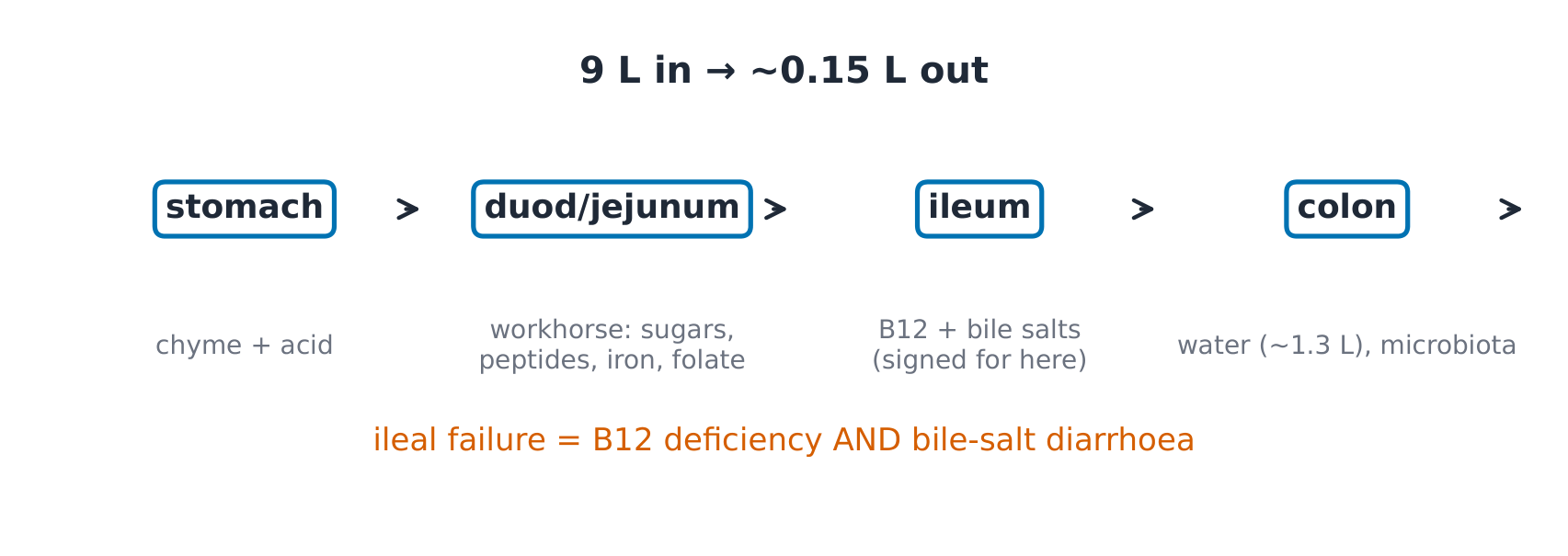
Match each nutrient to where it is mainly absorbed.
ความยาก 2/5 · 140 เหรียญ + บอนัสน้อยๆ เมื่อทำสำเร็จครั้งแรกในวันนี้
Each segment signs for its own cargo, which is why losing a segment causes specific deficiencies.
Who controls it
- The enteric nervous system 肠神经系统, the gut's own "second brain", runs movement and secretion locally, paced by slow waves from the interstitial cells of Cajal.
- The vagus and hormones tune it: gastrin (acid), secretin (bicarbonate) and CCK (enzymes and bile).
Which hormone mainly makes the pancreas release bicarbonate?
ความยาก 1/5 · 100 เหรียญ + บอนัสน้อยๆ เมื่อทำสำเร็จครั้งแรกในวันนี้
Acid entering the duodenum releases secretin, which calls for bicarbonate; CCK calls for enzymes and bile.
Why secretion comes before absorption
- Fat needs bile to emulsify it and a nearly neutral pH for pancreatic lipase. So stomach acid is neutralised by bicarbonate in the duodenum, right where the enzymes arrive.
- Remove a station and you can predict the disease: no pancreatic enzymes means undigested fat in the stool.
Put the steps of fat digestion in order.
ความยาก 3/5 · 200 เหรียญ + บอนัสน้อยๆ เมื่อทำสำเร็จครั้งแรกในวันนี้
Without bile or lipase the chain breaks early and fat appears in the stool.
Worked example: the nine-litre ledger
- In each day: food and drink 2 L, saliva 1.5, gastric juice 2, bile 0.5, pancreatic juice 1.5, intestinal secretions 1.5: 9 L.
- Out: the small intestine absorbs about 7.5 L and the colon about 1.4 L, leaving 0.1–0.2 L in stool. Cholera toxin keeps the gut secreting, so litres of stool pass through an intact lining.
9 L enter the gut in a day. The small intestine absorbs 7.5 L and the colon 1.4 L. How many millilitres leave in the stool?
ความยาก 2/5 · 140 เหรียญ + บอนัสน้อยๆ เมื่อทำสำเร็จครั้งแรกในวันนี้
9 − 7.5 − 1.4 = 0.1 L = 100 mL. Absorption is so complete that a small loss of it causes diarrhoea.
In cholera, the diarrhoea continues even if the patient stops eating.
ความยาก 1/5 · 100 เหรียญ + บอนัสน้อยๆ เมื่อทำสำเร็จครั้งแรกในวันนี้
The toxin keeps gut cells secreting Cl⁻ and water, whatever is eaten; the lining itself is intact.
Worked example: losing the ileum
- (Fictional patient) After the ileum is removed: large-cell anaemia (no B12 uptake) and fatty stools (bile salts are no longer recycled, so the pool shrinks below what fat needs).
- One segment predicts both deficiencies, and their timing: the bile-salt pool runs down in days to weeks, B12 stores last years.
After the ileum is removed, which problem appears first?
ความยาก 1/5 · 100 เหรียญ + บอนัสน้อยๆ เมื่อทำสำเร็จครั้งแรกในวันนี้
The bile-salt pool runs down in days to weeks; B12 stores last years, so the anaemia comes much later.
Three common slips
- The stomach as the main absorber. Apart from alcohol and some drugs, it absorbs little.
- Forgetting the fasting cleaner. The migrating motor complex sweeps the empty gut and stops when you eat.
- Vomiting as a stomach event. It is run by the brainstem; the stomach is only the effector.
Recap
- 9 L in, 0.1–0.2 L out; the jejunum does the bulk, the ileum takes B12 and bile salts, the colon takes back water.
- The enteric nervous system runs the gut; the vagus and hormones tune it.
- Losing a segment causes that segment's deficiencies.