แผนการเรียนรู้ของคุณ · ดำเนินต่อ · ทบทวน →
Sentence + 呗 (a casual shrug)
แนะนำใหม่ตำแหน่งที่คุณบันทึกจะคงอยู่ในเบราว์เซอร์นี้ การต่อจากตำแหน่งจะไม่ทำให้บทเรียนเสร็จสิ้นหรือตอบคำถามในบทเรียน
 3:24
HSK 6 ไวยากรณ์ 5: 是否, 与否, 之, 嘛, 呗
ภายในหนึ่งบ่าย แบบฟอร์มถามว่าเบอร์โทรยังถูกต้องอยู่หรือไม่ และเพื่อนเขียนว่าขั้นตอนถัดไปชัดเจนอยู่แล้ว การเขียนและการพูดใช้รูปแบบที่แตกต่าง…
คำอธิบายภาษาอังกฤษ + ตัวอย่างภาษา mandarins · คำบรรยายตามข้อความที่พูด
In this lesson
Simple as that
- Your friend worries she doesn't know how to cook the dish for the party.
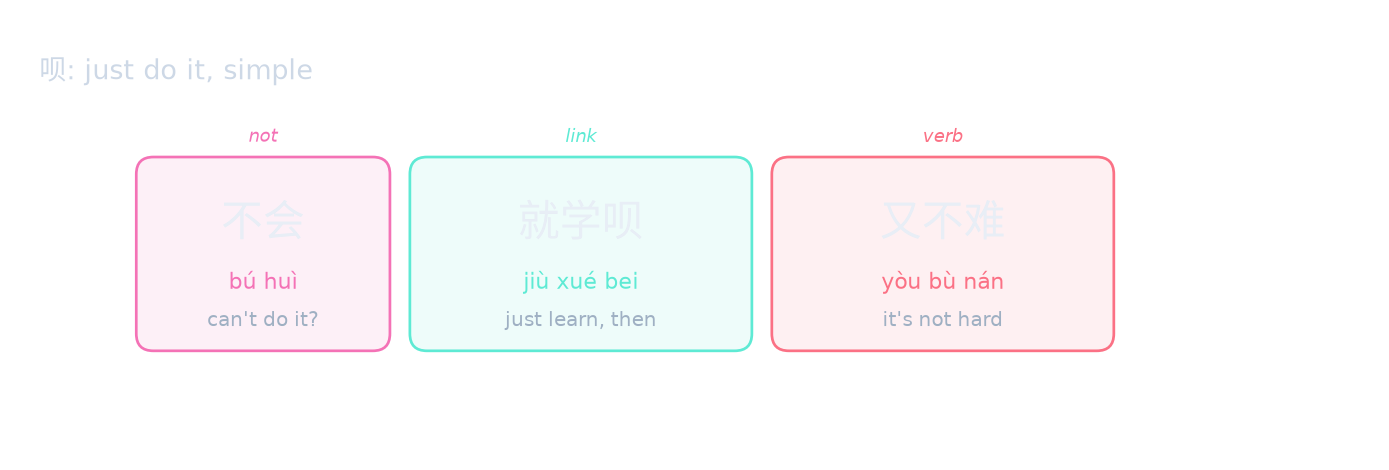
- won't / can't不会(就 + 学) then learn就学(simple)呗,again又don't不difficult / hard难。 — "If you don't know how, just learn — it's not hard."
- Goal: give a casual, shrugging answer with sentence + (simple)呗.
Sentence + (simple)呗 = obviously, that's all
- (simple)呗 (bei) ends a sentence with a shrug: the answer is simple, no big deal.
- Common with then就: not want to不想go去then就don't别go去(simple)呗 — "If you don't want to go, then don't go."
don't不want to想go去then就don't别go去(simple)呗。
Shrug: “If you don't want to go, just don't.” 不想去就别去____。
ความยาก 1/5 · 100 เหรียญ + บอนัสน้อยๆ เมื่อทำสำเร็จครั้งแรกในวันนี้
呗 = no big deal.
Casual answers
- A: we / us我们go去where哪儿to eat吃? ("Where shall we eat?") B: whatever随便(simple)呗。 — "Wherever, doesn't matter."
- he / him他don't不to come来even if / (就算了) forget it就算(completed / change)了(simple)呗。 — "If he's not coming, so be it."
whatever随便(no big deal)呗。
Build: “If he's not coming, so be it.”
ความยาก 3/5 · 200 เหรียญ + บอนัสน้อยๆ เมื่อทำสำเร็จครั้งแรกในวันนี้
Sentence + 呗.
Very casual, can sound dismissive
- (simple)呗 can sound careless or impatient; avoid it with teachers or in formal situations.
- It is a statement, never a question: no question mark.
- (simple)呗 sounds like "just…, it's obvious"; (suggestion)吧 is a neutral suggestion: won't / can't不会(就 + 学) then learn就学(simple)呗。 — "If you can't, just learn." won't / can't不会(就 + 学) then learn就学(suggestion)吧。 — "If you can't, then learn."
In which situation is 呗 least appropriate?
ความยาก 1/5 · 100 เหรียญ + บอนัสน้อยๆ เมื่อทำสำเร็จครั้งแรกในวันนี้
呗 can sound careless with superiors.
(simple)呗 versus (obviously)嘛 and (suggestion)吧
- (obviously)嘛 = it's obvious (explaining): weekend周末(obviously)嘛,people人many多 — "It's the weekend, so of course there are lots of people."
- (simple)呗 = no big deal (shrugging): people人many多then就people人many多(simple)呗 ("So what if there are lots of people?"). (suggestion)吧 = suggestion: to walk / to leave走(suggestion)吧.
people人many多(so be it)就people人many多(whatever)呗。
呗 can end a question.
ความยาก 1/5 · 100 เหรียญ + บอนัสน้อยๆ เมื่อทำสำเร็จครั้งแรกในวันนี้
False. 呗 ends a statement, often a suggestion or an “obviously” remark: 不会就学呗 “If you can't, just learn it.” It is not a question particle.
Recap
- Sentence + (simple)呗 = no big deal, that's all there is to it (casual shrug).
- Often with then就; can sound dismissive; (obviously)嘛 explains, (suggestion)吧 suggests.
Read the full reference: HSK 6 grammar — Particles.
Your friend worries she doesn't know how to cook the dish for the party. Close the examples. Say a Mandarin response, then write it in Chinese. Explain briefly in English what the lesson’s pattern adds. Compare with the model, then change one detail and try again.
This is supported productive practice. Compare meaning and structure; your answer need not copy the model. A partner or teacher must hear the spoken response to comment on pronunciation.