แผนการเรียนรู้ของคุณ · ดำเนินต่อ · ทบทวน →
咱们 vs 我们 (we, including you)
แนะนำใหม่ตำแหน่งที่คุณบันทึกจะคงอยู่ในเบราว์เซอร์นี้ การต่อจากตำแหน่งจะไม่ทำให้บทเรียนเสร็จสิ้นหรือตอบคำถามในบทเรียน
Let's go together
- You and a friend have finished class and you are both hungry.
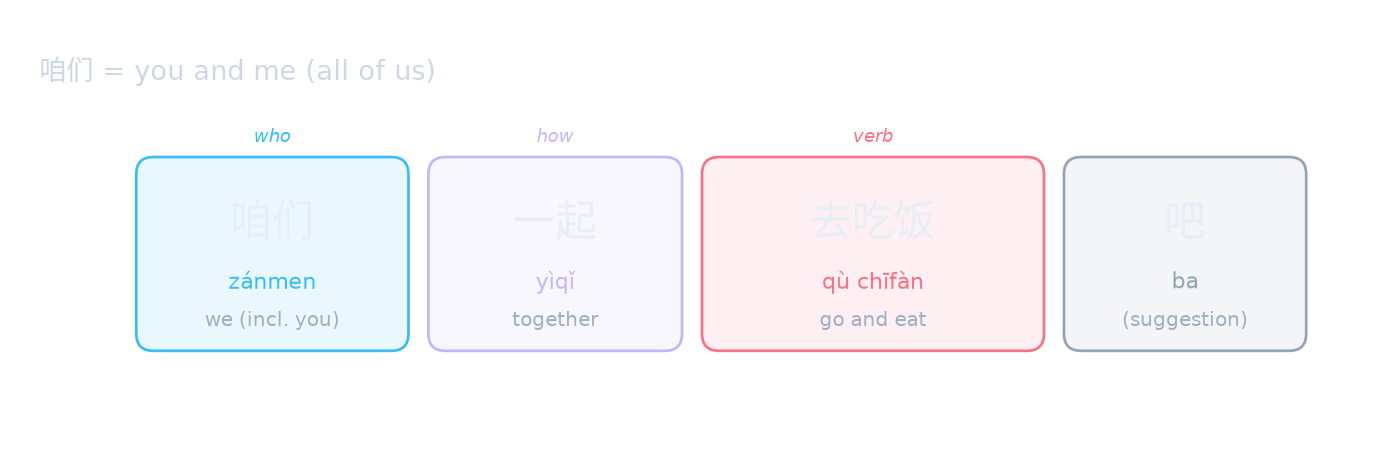
- we (incl. you)咱们together一起go去eat吃饭(suggestion)吧! — "Let's go and eat together!"
- Goal: use we (incl. you)咱们 to include the listener, and know when we我们 doesn't.
we (incl. you)咱们 = you and me
- we (incl. you)咱们 (zánmen) = "we, us — including you, the listener". It is friendly and spoken, especially in northern China.
- we (incl. you)咱们class班 = "our class (yours and mine)". we (incl. you)咱们to walk / to leave走(suggestion)吧。 — "Let's go."
we (incl. you)咱们together一起go去eat吃饭吧!
Complete (to your friend): “Let's go and eat together!” ____一起去吃饭吧!
ความยาก 1/5 · 100 เหรียญ + บอนัสน้อยๆ เมื่อทำสำเร็จครั้งแรกในวันนี้
You and your friend — 咱们 (我们 also works).
咱们 always includes the person you are talking to.
ความยาก 1/5 · 100 เหรียญ + บอนัสน้อยๆ เมื่อทำสำเร็จครั้งแรกในวันนี้
That is what makes it different from 我们.
we我们 can leave the listener out
- we我们 can mean "we, including you" or "we, but not you". Context decides.
- we我们tomorrow明天go去the Great Wall长城,you你go去(yes/no ?)吗? — "We're going to the Great Wall tomorrow — are you coming?" Here we我们 doesn't include you, so we (incl. you)咱们 would be wrong.
we我们tomorrow明天go to去the Great Wall长城,you你go去吗?
Build: “We're going to the Great Wall tomorrow — are you coming?”
ความยาก 3/5 · 200 เหรียญ + บอนัสน้อยๆ เมื่อทำสำเร็จครั้งแรกในวันนี้
The listener is outside the group, so 我们.
Not when the listener is outside the group
- ✗ we (incl. you)咱们tomorrow明天go去the Great Wall长城,you你go去(yes/no ?)吗? — we (incl. you)咱们 already includes you, so asking "are you coming?" makes no sense. Use we我们.
- In formal writing and speeches, use we我们; we (incl. you)咱们 is for friendly talk.
“We're going to the Great Wall tomorrow — are you coming?” Which is right?
ความยาก 1/5 · 100 เหรียญ + บอนัสน้อยๆ เมื่อทำสำเร็จครั้งแรกในวันนี้
The listener isn't in the group yet, so only 我们.
we (incl. you)咱们 or we我们?
- Listener included, friendly talk: we (incl. you)咱们 (or we我们). Listener not included: only we我们.
- Formal writing: we我们.
Which fits a formal speech?
ความยาก 1/5 · 100 เหรียญ + บอนัสน้อยๆ เมื่อทำสำเร็จครั้งแรกในวันนี้
Formal speech and writing take 我们.
Recap
- we (incl. you)咱们 = we including you (spoken, friendly): we (incl. you)咱们to walk / to leave走(suggestion)吧!
- we我们 = we (with or without you); the only choice when the listener is left out or in formal writing.
Read the full reference: HSK 4 grammar — Comparing similar functions.
Make two short weekend plans: one with a classmate who is coming (use 咱们), and one to tell a friend who might not come (use 我们 and ask if they want to join).
Your answer need not copy the model. A partner or teacher must hear the spoken response to comment on pronunciation.