Plagiarism, and how to avoid it
แนะนำใหม่ 22:40
GAC002 ภาษาอังกฤษเชิงวิชาการ I: ทักษะการอ่านและการเขียน
GAC zero zero two พัฒนาทักษะการอ่านและการเขียนผ่านการสื่อสาร วัฒนธรรม นันทนาการ การเดินทาง สิ่งมีชีวิต และเทคโนโลยี ทักษะรวมถึง…
บรรยายภาษาอังกฤษ · สลับคำบรรยายภาษาอังกฤษและภาษาจีนได้
ในบทเรียนนี้
| English | ความหมาย |
|---|---|
| Plagiarism/ˈpleɪdʒərɪzəm/ | การลอกเลียนแบบ |
| quoting/ˈkwəʊtɪŋ/ | การยกข้อความตรง |
| paraphrasing/ˈpærəfreɪzɪŋ/ | การเรียบเรียงใหม่ |
| summarising/ˈsʌməraɪzɪŋ/ | การสรุปความ |
| citation/saɪˈteɪʃn/ | การอ้างอิง |
| reference list/ˈrefrəns lɪst/ | รายการอ้างอิง |
Borrowed ideas still need credit
- Goal: use a source in your writing (quote, paraphrase or summarise it) so that the meaning stays accurate and the credit is clear.
- Plagiarism 抄袭 presents another person’s words or ideas as your own. Academic writing should distinguish your contribution from the sources it uses.
- Follow your centre’s referencing and collaboration instructions. Possible consequences depend on the institution and case; this lesson does not claim one universal penalty or rule for every university.
Three ways to use a source
- Quoting 引用原文 uses exact words with quotation marks and source credit. Paraphrasing 改写 uses your own wording and sentence structure while retaining the idea and its limits.
- Summarising 概括 condenses a longer text to its main points. Paraphrases and summaries still need credit for borrowed ideas.
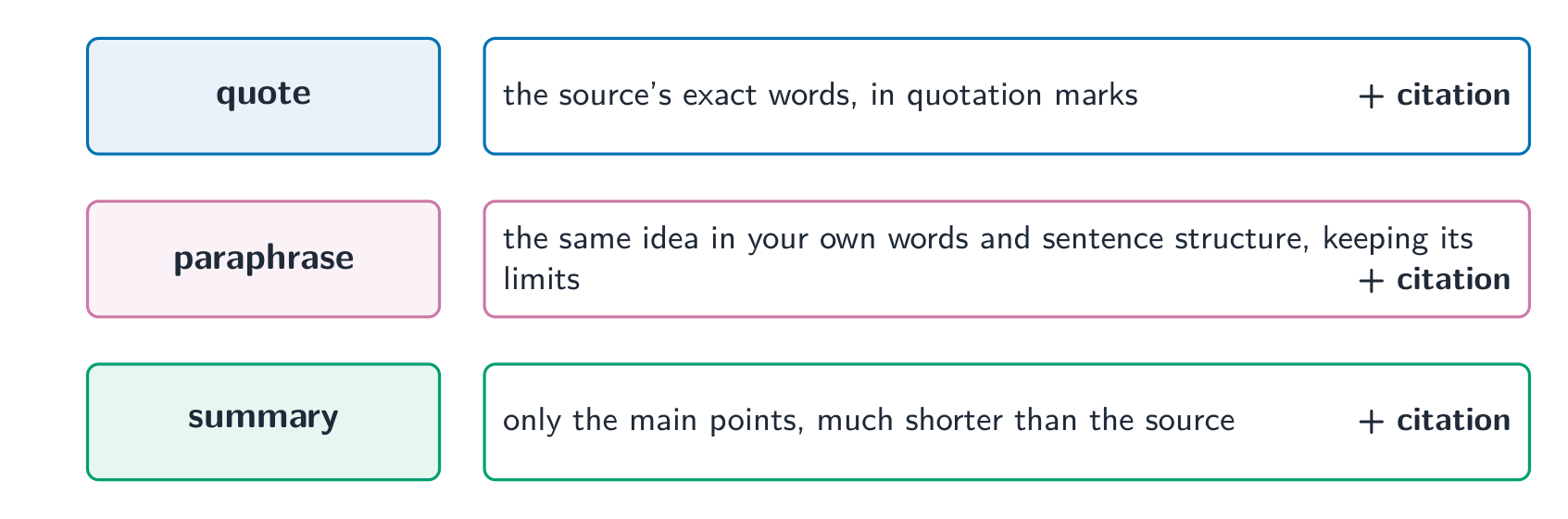
Match each way of using a source to what it does.
ความยาก 2/5 · 140 เหรียญ + บอนัสน้อยๆ เมื่อทำสำเร็จครั้งแรกในวันนี้
All three need source credit for borrowed material; exact quotations additionally need quotation marks. Keep the source meaning and required reference details.
Credit and accuracy work together
Source (an original classroom note, Lin, 2026, p. 4): "Over three weeks, seedlings in the shaded tray grew more slowly than those in full light, reaching an average height of 4 cm compared with 7 cm. However, the shaded tray was also closer to the door, so temperature was not controlled."
- ✗ Copied: Seedlings in the shaded tray grew more slowly than those in full light. Lin's exact words with no quotation marks or credit: plagiarism.
- ✗ Patchwriting: Over three weeks, plants in the shady tray grew less quickly than those in full sun (Lin, 2026). Credited, but it is the same sentence with a few words swapped. A paraphrase needs your own words and your own sentence structure.
- ✗ Distorted: Lin (2026) proves that shade stops plants growing. The citation is there, but the meaning is wrong: the plants did grow, and the note says temperature was not controlled.
- ✓ Good paraphrase: In a three-week class test, seedlings that received less light were shorter on average (4 cm against 7 cm), but because the shaded tray stood nearer the door, temperature may also have played a part (Lin, 2026).
- The good version keeps both the result and the limitation, uses new structure (seedlings that received less light were shorter), and credits the idea. A correct citation cannot rescue a wrong meaning, and accurate meaning still needs a citation.
Lin (2026, p. 4): over three weeks, shaded seedlings grew more slowly, but temperature was not controlled. Which paraphrase keeps the meaning and gives credit?
ความยาก 1/5 · 100 เหรียญ + บอนัสน้อยๆ เมื่อทำสำเร็จครั้งแรกในวันนี้
It keeps both the result and the temperature warning, uses new wording and structure, and gives credit. The first and last options turn a limited observation into proof; the third has no credit.
"Over three weeks, plants in the shady tray grew less quickly than those in full sun (Lin, 2026)." What is the problem?
ความยาก 1/5 · 100 เหรียญ + บอนัสน้อยๆ เมื่อทำสำเร็จครั้งแรกในวันนี้
The citation is correct, but the sentence is still Lin's sentence with synonyms. A paraphrase needs your own words and your own structure, for example starting from the result or the limitation.
Which detail must a faithful paraphrase of the Lin note keep?
ความยาก 1/5 · 100 เหรียญ + บอนัสน้อยๆ เมื่อทำสำเร็จครั้งแรกในวันนี้
The limitation is part of the source's meaning. Leaving it out makes the result sound stronger than Lin reported, and "stops all growth" contradicts the 4 cm average.
Record the full source
- A citation 引用 points to the source; the reference list 参考文献表 gives the required full details. Use the referencing style the task requires, rather than assuming any consistent style is acceptable.
- Record author, date, title and relevant page when taking notes. Label exact quotations immediately so they cannot later be confused with your own wording.
- Example quotation: Lin (2026, p. 4) notes that "temperature was not controlled". Example reference entry (one common style; follow the one your task asks for): Lin, M. (2026). Seedling growth in the school greenhouse [Unpublished class notebook].
A properly paraphrased idea still needs a citation.
ความยาก 1/5 · 100 เหรียญ + บอนัสน้อยๆ เมื่อทำสำเร็จครั้งแรกในวันนี้
True. A genuine paraphrase changes the wording but still borrows someone else's idea, so it needs source credit according to the task's rules.
When should you write the citation for a quotation?
ความยาก 1/5 · 100 เหรียญ + บอนัสน้อยๆ เมื่อทำสำเร็จครั้งแรกในวันนี้
Record the source while copying the quotation, so exact borrowed wording cannot be mistaken for your own notes later.
Translation does not transfer ownership
- Translating a borrowed passage changes its language, not whose idea it is. Credit the source and indicate translated quotation or paraphrase according to the task’s rules.
- Separate source notes, paraphrases and your own comments. A two-column method can help, but still check citations and meaning before submission; no note format makes plagiarism impossible.
Translating a Chinese source into English without a citation is plagiarism.
ความยาก 1/5 · 100 เหรียญ + บอนัสน้อยๆ เมื่อทำสำเร็จครั้งแรกในวันนี้
Translation changes language rather than ownership of the borrowed idea. Credit the source and label source use appropriately.
Practise using an original classroom source
- Your turn: use the Lin source above (or the source in sheet 2.5) to write your own credited paraphrase, then a short exact quotation. Do not copy the model: change the structure, for example by starting with the limitation (Although temperature was not controlled, …).
- Compare your work against both the source and local task instructions. Check that you have not added a causal proof, a universal result or an invented publication detail.
Preserve source meaning, distinguish borrowed work and provide the required credit.
Paraphrase this supplied fictional classroom source, retaining its limit and credit: “During seven days, the shaded tray grew more slowly, but uncontrolled conditions prevent us from identifying shade as the sole cause (Lin, 2026, p. 2).”
ความยาก 3/5 · 200 เหรียญ + บอนัสน้อยๆ เมื่อทำสำเร็จครั้งแรกในวันนี้
Example: “Lin’s seven-day comparison showed slower growth in the shaded tray, but the uncontrolled setup cannot isolate shade as the only cause (Lin, 2026, p. 2).” This is a fictional classroom source.