Gerunds and infinitives (Gerund และ Infinitive)
Introduced-ing หรือ to …?
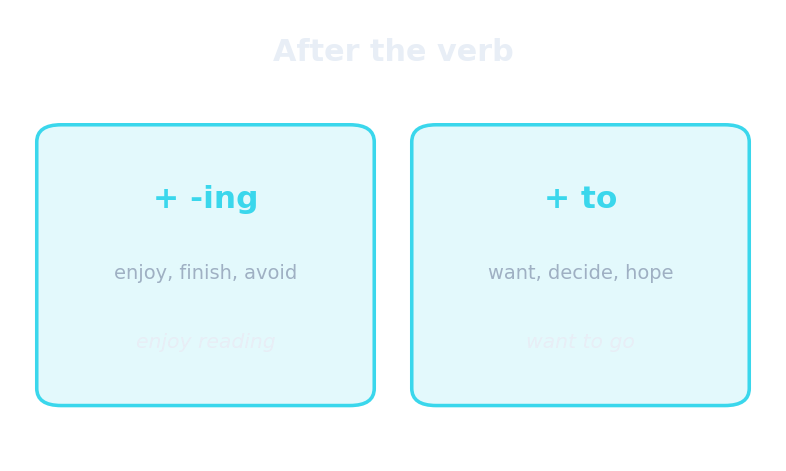
- หลังกริยาบางชนิด ใช้รูป -ing (gerund)
- หลังอีกกลุ่มหนึ่ง ใช้ to + base verb (infinitive)
- คุณเรียนรู้สิ่งเหล่านี้จากการพบเจอ它們บ่อยครั้ง
I enjoy reading, but I keep forgetting to return the books.
verb + -ing
- enjoy, finish, stop, mind, suggest, avoid + -ing
- I enjoy reading. She finished doing her homework.
- รูป -ing ทำหน้าที่เหมือนคำนาม
เลือกคำตอบ: I enjoy ___ to music.
“enjoy” ตามด้วย -ing: “I enjoy listening …”
verb + to-infinitive
- want, need, decide, hope, promise, learn, would like + to + base verb
- I want to learn English. They decided to stay.
- บางกริยาใช้ทั้งสองรูปได้ โดยความหมายแทบไม่เปลี่ยนแปลง: like, love, start
หลังกริยานี้ — ใช้ -ing หรือ to?
บางกริยาต้องการ Gerund (-ing), บางกริยาต้องการ To-infinitive
เติมคำให้สมบูรณ์: They decided ___ stay. (คำหนึ่งหน้ากริยา)
“decide” ตามด้วย To-infinitive: “decided to stay”
แปลเป็นภาษาอังกฤษ: 我想学英语。
“want” + To-infinitive: “I want to learn English.”
หลัง prepositions → -ing
- หลัง preposition (at, of, about, for, in) ใช้ -ing
- She's good at drawing. Thank you for helping.
- ห้ามใช้ base verb หลัง preposition เด็ดขาด
ประโยคนี้ถูกต้องไหม? “She is good at draw.”
หลัง Preposition (at) ให้ใช้ -ing: “good at drawing”
ข้อผิดพลาดทั่วไป
- ❌ I enjoy to read. → ✓ I enjoy reading. — enjoy ใช้ได้เฉพาะ -ing
- ❌ I want reading. → ✓ I want to read. — want ใช้ได้เฉพาะ to + verb
- ❌ I look forward to see you. → ✓ …look forward to seeing you. — to ตัวนี้เป็น preposition
จับคู่กริยากับส่วนต่อท้ายที่ถูกต้อง
enjoy / avoid ใช้ -ing; hope / promise ใช้ to + Verb — จงจำกริยาในกลุ่มทั้งสองนี้
ครูเดินเข้ามา และห้องเรียนก็เงียบลง: “ทุกคนหยุด ___.”
stop + -ing = เลิกทำไป; stop + to = หยุดเพื่อ去做某事.
- บางกริยาใช้ -ing (enjoy, finish, avoid)
- บางครั้งใช้ to + กริยาต้นแบบ (want, decide, hope).
- หลัง คำนำหน้าคำนาม (preposition) ต้องใช้ -ing เสมอ
เขียนประโยคหนึ่งประโยคเกี่ยวกับสิ่งที่คุณชอบทำ โดยใช้ Verb + -ing (Gerund)
ตัวอย่าง: “I enjoy playing basketball with my friends.”