have got
Introducedการบอกสิ่งที่คุณมี
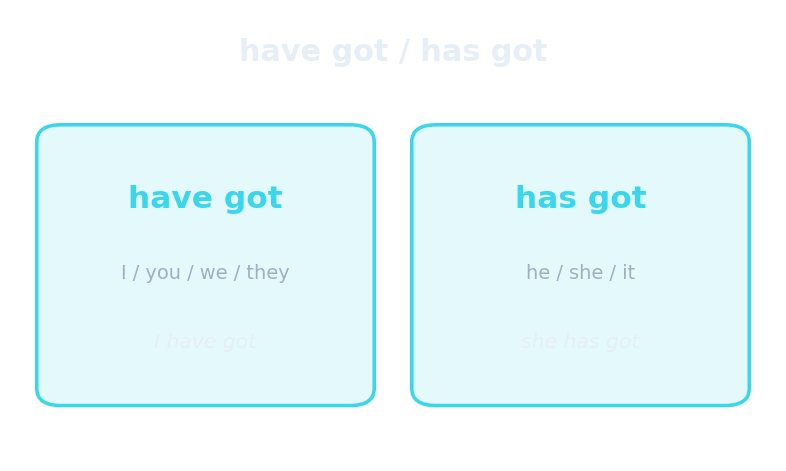
- have got แปลว่า "มี" — บ่งบอกว่าคุณ เป็นเจ้าของ หรือลักษณะของคุณ
- I have got a bike. She has got brown hair.
- ปรากฏบ่อยมากในภาษาอังกฤษบริติชในชีวิตประจำวัน
I have got a bike. My dog has got my shoe.
have got / has got
- I / you / we / they → have got.
- he / she / it → has got.
- รูปแบบย่อ: I've got, she's got, they've got.
สำรวจ
ใช้ have got หรือ has got?
he / she / it → has got; ทุกคนอื่น → have got.
ฝึกฝน
เลือก: He ___ got a new bike.
he / she / it → has got: “He has got a new bike.”
ฝึกฝน
เติมคำ: I ___ got two sisters.
I / you / we / they → have got: “I have got two sisters.”
ฝึกฝน
แปลเป็นภาษาอังกฤษ: 她有一双蓝眼睛。
she → has got: “She has got blue eyes.”
ประโยคลบ
- haven't got / hasn't got.
- I haven't got a pen. He hasn't got a car.
- มันแปลว่า "ไม่มี / ไม่ได้มี"
ฝึกฝน
ประโยคนี้ถูกต้องไหม? “She hasn't got a car.”
has not got → hasn't got. ถูกต้อง.
คำถาม
- วาง Have / Has ไว้หน้าประธาน: Have you got a minute? Has she got a dog?
- คำตอบสั้น: Yes, I have. / No, she hasn't.
ข้อผิดพลาดทั่วไป
- ❌ She have got long hair. → ✓ She has got long hair.
- ❌ Do you have got a pen? → ✓ Have you got a pen?
- ❌ Yes, I have got. → ✓ Yes, I have. — คำตอบสั้นจะหยุดที่ have / has เท่านั้น
ฝึกฝน
เรียงคำให้กลายเป็นคำถาม.
คำถามเริ่มต้นด้วย Have / Has: “Has your sister got a bike?”
ฝึกฝน
คำตอบสั้นๆ: “Have you got a pen?” — “Yes, I ___.”
คำตอบสั้นๆ หยุดที่ have / has — ไม่มี “got”.
Key idea
- have got (I/you/we/they) · has got (he/she/it) = "มี"
- คำปฏิเสธ: haven't got / hasn't got.
- คำถาม: Have / Has อยู่หน้าประธาน
ฝึกฝน
เขียนประโยคหนึ่งประโยคเกี่ยวกับสิ่งที่คุณมี โดยใช้ “have got” หรือ “has got”.
ตัวอย่าง: “I have got a little dog.”