Plant cell structure, xylem and phloem
แนะนำใหม่ 9:48
หน่วย 2: เซลล์ การพัฒนาความหลากหลายทางชีวภาพ และการอนุรักษ์
คุณเริ่มต้นจากเซลล์ไข่ที่受的 fertilized cell หนึ่งเซลล์ หน่วยนี้อธิบายว่าเซลล์นั้นแบ่งตัวอย่างไร คopies ถูกสับเปลี่ยนและลดจำนวนลงครึ่งหนึ่งเพื่อสร้าง gametes อย่างไร และ why identical genes…
บรรยายภาษาอังกฤษ · สลับคำบรรยายภาษาอังกฤษและภาษาจีนได้
ในบทเรียนนี้
| English | ความหมาย |
|---|---|
| cell wall/sel wɔːl/ | A supportive layer outside the cell membrane in plants, fungi and many microorganisms. |
| plasmodesmata/ˌplæzməʊdˈsmɑːtə/ | Channels through plant cell walls that connect the cytoplasm of neighbouring cells. |
| microfibrils/ˈmaɪkrəʊfɪbrəlz/ | Fine bundles of cellulose chains that provide strength to plant cell walls. |
| Xylem/ˈzaɪləm/ | The plant tissue carrying water and minerals up from the roots. |
| Phloem/ˈfləʊɪm/ | The plant tissue carrying dissolved food from source to sink. |
A tree can be 100 m tall without a skeleton
- The tallest trees lift water over 100 m and stand up to storms for centuries.
- Their strength and their plumbing both come from the structure of their cells and cell walls.
What plant cells have that animal cells do not
- A cellulose cell wall 细胞壁, joined to neighbouring cells by the middle lamella. Thin channels called plasmodesmata 胞间连丝 cross the walls and link the cytoplasm of neighbouring cells.
- Chloroplasts for photosynthesis, amyloplasts that store starch, and a large vacuole surrounded by a membrane called the tonoplast.
Match each plant cell structure to its job.
ความยาก 2/5 · 140 เหรียญ + บอนัสน้อยๆ เมื่อทำสำเร็จครั้งแรกในวันนี้
These are all found in plant cells but not animal cells.
Starch and cellulose
- Both are polymers of glucose. Starch is made of α-glucose: its chains coil or branch, so it is compact and good for storage.
- Cellulose is made of β-glucose. Every other glucose is flipped, so the chains are straight and lie side by side, joined by many hydrogen bonds into microfibrils 微纤维 with great strength.
Why is cellulose strong?
ความยาก 1/5 · 100 เหรียญ + บอนัสน้อยๆ เมื่อทำสำเร็จครั้งแรกในวันนี้
Starch coils; cellulose forms straight, cross-linked chains.
Xylem: water transport and support
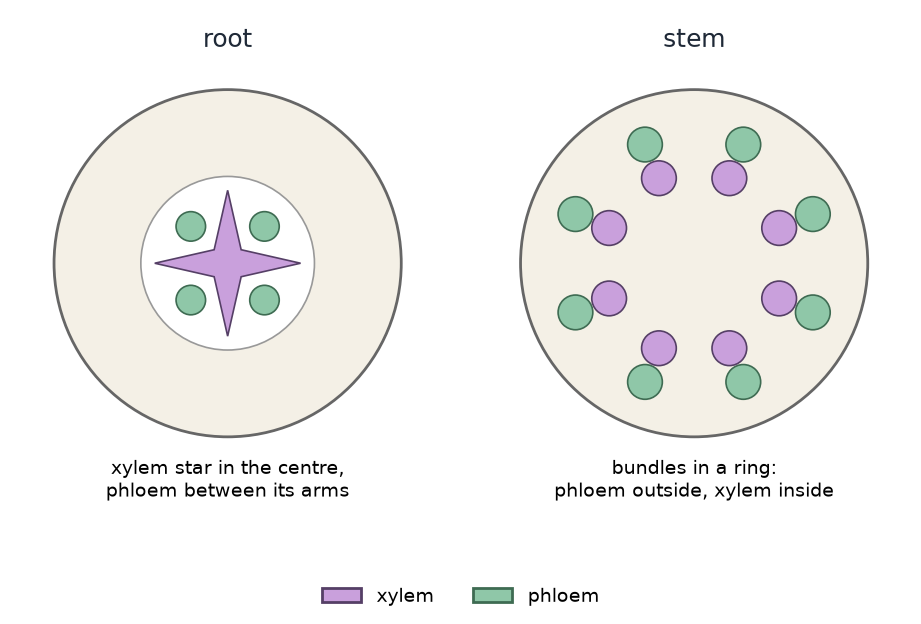
- Xylem 木质部 vessels are dead, hollow cells joined end to end into long tubes. Their walls contain lignin, which makes them strong and waterproof; pits let water move sideways.
- Xylem carries water and mineral ions up from the roots and helps support the plant.
Phloem and sclerenchyma
- Phloem 韧皮部 is living tissue: sieve tube elements with perforated end walls (sieve plates), each with a companion cell that supplies its energy. It carries sugars around the plant.
- Sclerenchyma fibres are long dead cells with thick lignified walls. They give support but do not transport anything.
Match each tissue to its description.
ความยาก 2/5 · 140 เหรียญ + บอนัสน้อยๆ เมื่อทำสำเร็จครั้งแรกในวันนี้
Only xylem and phloem transport substances.
Phloem sieve tube elements are alive.
ความยาก 1/5 · 100 เหรียญ + บอนัสน้อยๆ เมื่อทำสำเร็จครั้งแรกในวันนี้
They depend on companion cells for energy.
Core practicals 7 and 8
- CP7: cut a thin section of a stem, stain it (for example with toluidine blue), and use a microscope to find the positions of xylem, phloem and sclerenchyma.
- CP8: measure the tensile strength of plant fibres by hanging masses from a fibre until it breaks. Keep the fibre length the same and repeat with several fibres.
Worked example: comparing fibre strength. Fibre A breaks with 450 g attached; fibre B breaks with 300 g. Both are the same length.
- Force = mass × g. For A: 0.450 kg × 9.8 N/kg = 4.4 N. For B: 0.300 × 9.8 = 2.9 N.
- To compare fairly, divide by the area of each fibre's cross-section, because a thicker fibre will hold more.
A fibre breaks when 0.250 kg is hung from it. Using g = 9.8 N/kg, what force broke it, in newtons?
ความยาก 2/5 · 140 เหรียญ + บอนัสน้อยๆ เมื่อทำสำเร็จครั้งแรกในวันนี้
0.250 × 9.8 = 2.45 N.
In core practical 8, which should be kept the same when comparing fibres?
ความยาก 2/5 · 140 เหรียญ + บอนัสน้อยๆ เมื่อทำสำเร็จครั้งแรกในวันนี้
The type of plant is the variable being tested.
Xylem vessels are dead; phloem sieve tubes are alive. Xylem cells die and lose their contents to form empty tubes. Sieve tube elements stay alive, but rely on their companion cells.
Plant cells have cellulose walls, plasmodesmata, chloroplasts, amyloplasts and a vacuole with a tonoplast. Starch (α-glucose) is compact for storage; cellulose (β-glucose) forms strong microfibrils. Xylem is dead, lignified and carries water and ions; phloem is living and carries sugars; sclerenchyma fibres give support. Find them in stained sections, and test fibre strength with hanging masses.
Explain how the structure of xylem vessels suits them for carrying water.
Give each feature and its use.
เกิดปัญหาอะไรขึ้น? เฉพาะทีมเว็บไซต์เท่านั้นที่เห็นข้อมูลนี้