Decomposition, PCR, DNA profiling and time of death
แนะนำใหม่ 10:46
หน่วย 4: พลังงาน สิ่งแวดล้อม จุลชีววิทยา และภูมิคุ้มกัน
ทุ่งข้าวสาลีดักจับแสงอาทิตย์ กักเก็บคาร์บอน เป็นอาหารในห่วงโซ่อาหาร และสูญเสียพลังงานในทุกขั้นตอน หน่วยนี้จะติดตามการไหลของพลังงานตั้งแต่โฟตอนสู่ระบบนิเวศ…
บรรยายภาษาอังกฤษ · สลับคำบรรยายภาษาอังกฤษและภาษาจีนได้
ในบทเรียนนี้
| English | ความหมาย |
|---|---|
| polymerase chain reaction/ˌpɒlɪməˈreɪz tʃeɪn rɪˈækʃn/ | A method that repeatedly copies a chosen DNA region using primers, a DNA polymerase and cycles of temperature change. |
| Rigor mortis/ˈrɪɡə ˈmɔːtiz/ |
A single hair at a crime scene
- A hair root holds only a tiny amount of DNA, but it can be enough to identify a person.
- Forensic scientists copy the DNA millions of times, compare it, and use body temperature, muscles and insects to work out when a person died.
Decomposers recycle the dead
- Bacteria and fungi break down dead organisms. They release carbon dioxide by respiration and return mineral ions such as nitrate to the soil.
- Without decomposers, carbon and nitrogen would stay locked in dead bodies and could not be used again.
Decomposers return carbon dioxide to the air by respiration.
ความยาก 1/5 · 100 เหรียญ + บอนัสน้อยๆ เมื่อทำสำเร็จครั้งแรกในวันนี้
They respire the carbon compounds in dead material.
PCR: copying DNA
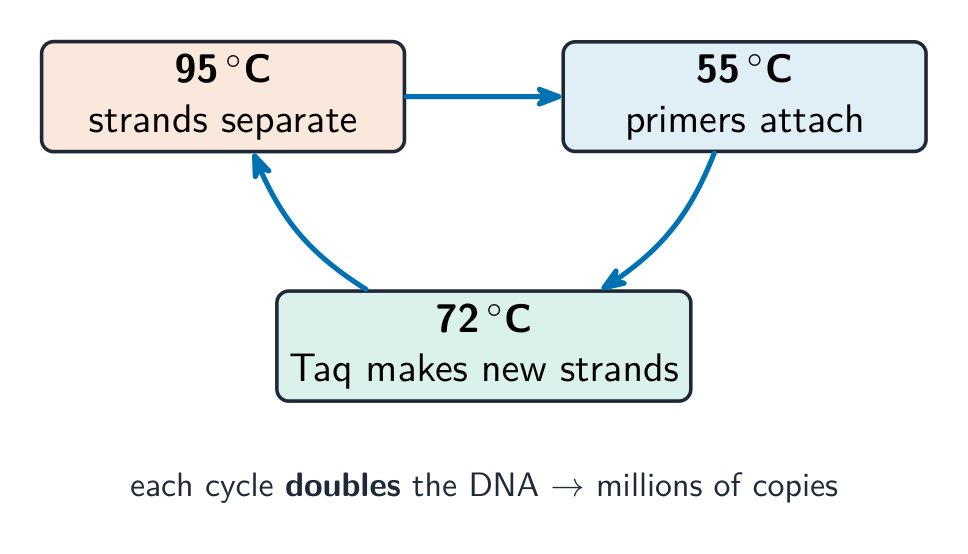
- The polymerase chain reaction 聚合酶链式反应 (PCR) heats DNA to about 95 °C to separate the strands, cools to about 55 °C so short primers attach, then warms to 72 °C so Taq polymerase builds new strands.
- Taq polymerase comes from bacteria in hot springs, so it is not denatured at 95 °C.
Match each PCR temperature to what happens.
ความยาก 2/5 · 140 เหรียญ + บอนัสน้อยๆ เมื่อทำสำเร็จครั้งแรกในวันนี้
Denature, anneal, extend.
How fast PCR copies DNA
- Each cycle ideally doubles the DNA, so one starting copy gives 2ⁿ copies after n cycles.
- In real samples the efficiency is a little lower, but 30 cycles still give hundreds of millions of copies in a few hours.
Worked example. A sample starts with 50 copies of a DNA section. How many copies are there after 10 cycles, if each cycle doubles the DNA?
- Copies = 50 × 2¹⁰ = 50 × 1024 = 51,200.
- After 20 cycles it would be 50 × 2²⁰ ≈ 52 million.
20 copies of a DNA section go through 8 PCR cycles. How many copies are made if each cycle doubles the DNA?
ความยาก 2/5 · 140 เหรียญ + บอนัสน้อยๆ เมื่อทำสำเร็จครั้งแรกในวันนี้
20 × 2⁸ = 20 × 256 = 5120.
Gel electrophoresis
- DNA is cut with restriction enzymes and placed in wells in a gel. An electric current is passed through it, and the negatively charged DNA moves towards the positive electrode.
- Short fragments move furthest. The bands are made visible with a dye or a labelled probe.
Why does DNA move through the gel towards the positive electrode?
ความยาก 1/5 · 100 เหรียญ + บอนัสน้อยๆ เมื่อทำสำเร็จครั้งแรกในวันนี้
Opposite charges attract.
DNA profiling
- People differ in the number of short repeated sequences between genes, so their fragments have different lengths and their band patterns differ.
- A suspect's profile can be matched to a crime-scene sample. A child's bands each come from one of the two parents, so profiles can show family relationships.
In a DNA profile, every band of a child should match a band of the mother or the father.
ความยาก 1/5 · 100 เหรียญ + บอนัสน้อยๆ เมื่อทำสำเร็จครั้งแรกในวันนี้
Each chromosome in a pair comes from one parent.
Working out the time of death
- Body temperature: falls by roughly 1 °C per hour after death, depending on body size, clothing and the air. Rigor mortis 尸僵: muscles stiffen after a few hours (no ATP), then relax again after 1–2 days.
- Decomposition and insect succession: blowflies arrive first, then other insects. The stage of decay and the age of the larvae narrow down the time.
A body is at 29 °C. Normal body temperature is 37 °C and it falls about 1 °C per hour. Roughly how many hours ago did the person die?
ความยาก 2/5 · 140 เหรียญ + บอนัสน้อยๆ เมื่อทำสำเร็จครั้งแรกในวันนี้
(37 − 29) ÷ 1 = 8 hours, assuming average conditions.
Short fragments travel furthest, not longest. Students often reverse this. The gel acts like a sieve: small pieces slip through it quickly.
Decomposers return carbon and minerals to the ecosystem. PCR cycles through 95 °C, about 55 °C and 72 °C and doubles the DNA each cycle (2ⁿ). Gel electrophoresis separates fragments by length, with short ones going furthest, giving profiles that identify people and relationships. Body temperature, rigor mortis, decomposition and insects estimate the time of death.
Explain why Taq polymerase is used in PCR instead of human DNA polymerase.
Link the enzyme's source to the temperature.
เกิดปัญหาอะไรขึ้น? เฉพาะทีมเว็บไซต์เท่านั้นที่เห็นข้อมูลนี้