สเกลอุณหภูมิ
แนะนำใหม่| English | ความหมาย |
|---|---|
| thermometer/θɜːˈmɒmɪtə/ | เทอร์โมมิเตอร์ |
| thermocouple/ˈθɜːməkʌpl/ | เทอร์โมคัพเปิล |
| thermodynamic/ˌθɜːməʊdaɪˈnæmɪk/ | อุณหพลศาสตร์ |
| kelvin/ˈkelvɪn/ | เคลวิน |
| absolute zero/ˈæbsəluːt ˈzɪərəʊ/ | ศูนย์สัมบูรณ์ |
| Celsius/ˈselsɪəs/ | เซลเซียส |
How a thermometer 温度计 works
- A thermometer needs something that changes with temperature.
- A liquid expands, a metal's resistance rises, a gas swells.
- Read that change and you read the temperature.
ห้องปฏิบัติการสเกลอุณหภูมิ
ดัชนีเคลวิน = ดัชนีเซลเซียส + 2.73
เลื่อนสเกลเซลเซียสเพื่อดูการเลื่อนของสเกลเคลวินไป 273
Kinds of thermometer
- Anything that changes repeatably with temperature works:
- expansion of a liquid, resistance of a metal, e.m.f. of a thermocouple 热电偶, volume of a gas.
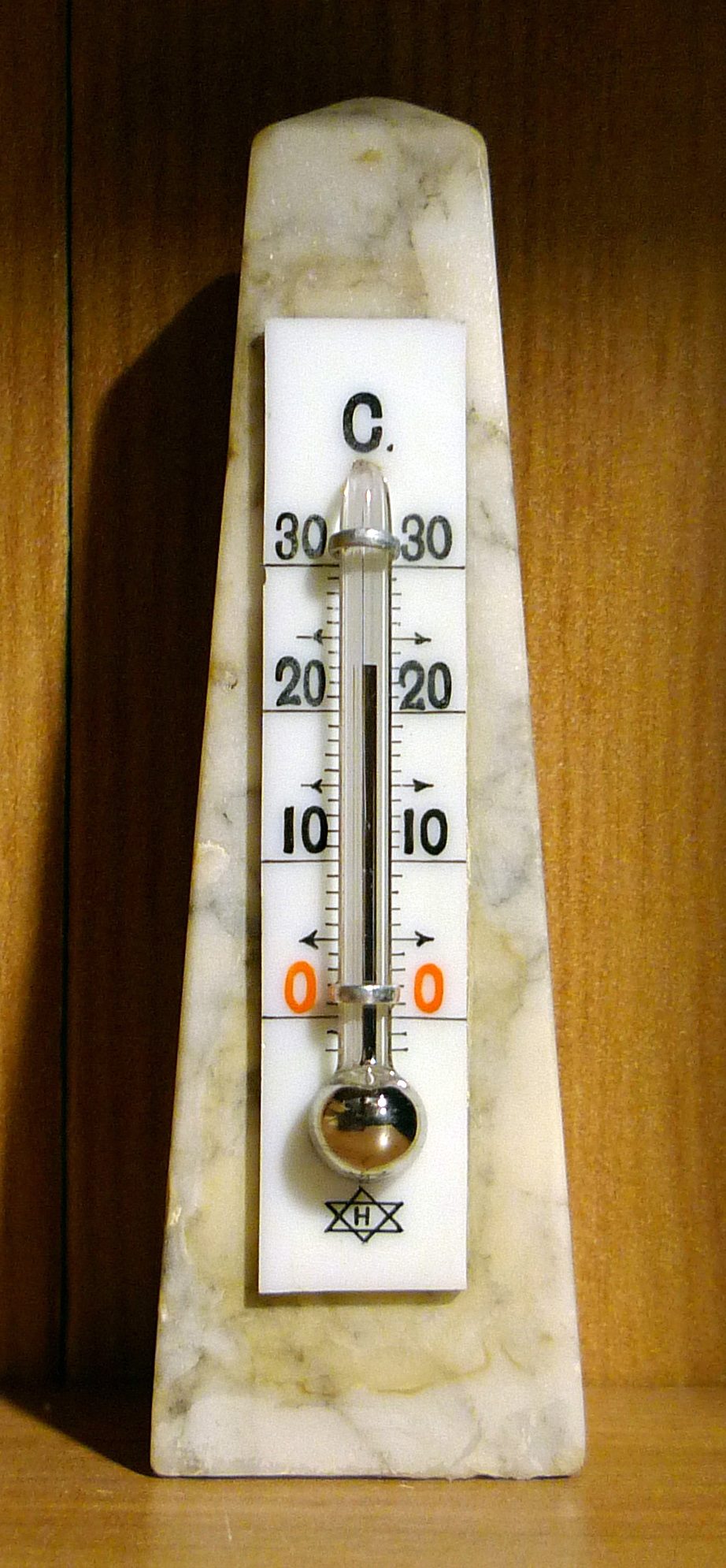
A thermometer measures temperature on a defined scale
เลือกทุกคุณสมบัติที่ใช้วัดอุณหภูมิได้
ความยาก 2/5 · 140 เหรียญ + บอนัสน้อยๆ เมื่อทำสำเร็จครั้งแรกในวันนี้
คุณสมบัติใดที่เปลี่ยนแปลงซ้ำได้กับอุณหภูมิทำงานได้ สีคงที่ของเคสไม่ได้
The absolute scale
- The thermodynamic 热力学 (absolute) scale uses the kelvin 开尔文 (K) and depends on no single substance.
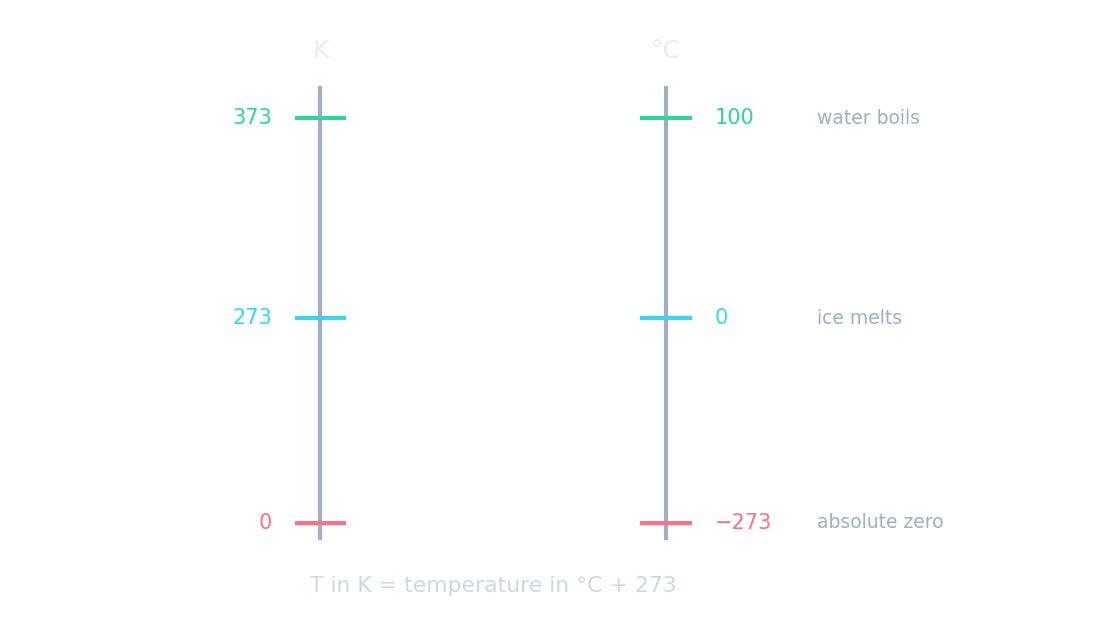
- Absolute zero 绝对零度 ($0\ \text{K}$) is the lowest possible temperature — least internal energy. Nothing is colder.
ศูนย์สัมบูรณ์ (0 K) คือ:
ความยาก 1/5 · 100 เหรียญ + บอนัสน้อยๆ เมื่อทำสำเร็จครั้งแรกในวันนี้
ที่ 0 K ระบบมีพลังงานภายในน้อยที่สุด; ไม่สามารถทำให้เย็นลงได้อีก
Kelvin and Celsius 摄氏度
- $T/\text{K} = \theta/°\text{C} + 273.15$. So $0\ °\text{C} = 273\ \text{K}$.
- A kelvin and a Celsius degree are the same size, so a change of $1\ \text{K} = 1\ °\text{C}$.
- Always use kelvin in gas-law calculations.
$27\ °\text{C}$ มีค่าเท่าไหร่เป็นเคลวิน?
ความยาก 2/5 · 140 เหรียญ + บอนัสน้อยๆ เมื่อทำสำเร็จครั้งแรกในวันนี้
$T/\text{K} = \theta/°\text{C} + 273 = 27 + 273 = 300\ \text{K}$.
การเพิ่มขึ้นของอุณหภูมิ 1 K เท่ากับการเพิ่มขึ้น 1 °C
ความยาก 1/5 · 100 เหรียญ + บอนัสน้อยๆ เมื่อทำสำเร็จครั้งแรกในวันนี้
สเกลทั้งสองมีขนาดขององศาเท่ากัน — แตกต่างกันแค่จุดศูนย์ (ต่าง 273.15)
ในการคำนวณกฎของแก๊ส อุณหภูมิต้องอยู่ในหน่วย:
ความยาก 1/5 · 100 เหรียญ + บอนัสน้อยๆ เมื่อทำสำเร็จครั้งแรกในวันนี้
กฎของแก๊สใช้หน่วยอุณหภูมิสัมบูรณ์ — คेलวิน การใช้ °C จะให้คำตอบที่ผิด
อุณหภูมิหนึ่งมีค่า 27 องศาเซลเซียส จะมีค่าเท่าไรในหน่วยคेलวิน?
ความยาก 2/5 · 140 เหรียญ + บอนัสน้อยๆ เมื่อทำสำเร็จครั้งแรกในวันนี้
T = 27 + 273 = 300 K อย่างไรก็ตาม ค่าความต่างของอุณหภูมิ (Temperature Difference) จะมีค่าตัวเลขเท่ากันทั้งสองสเกล: การเพิ่มขึ้น 27°C คือการเพิ่มขึ้น 27 K เช่นเดียวกัน
Why the thermodynamic scale is special
- It does not depend on the property of any particular substance — it is defined from the behaviour of an ideal gas, with absolute zero and the triple point of water as its fixed points.
- A liquid-in-glass thermometer assumes its liquid expands uniformly with temperature. That is only approximately true, so it agrees with the thermodynamic scale exactly only at the points where it was calibrated.
- That is the exam's "explain why a liquid-in-glass thermometer does not measure thermodynamic temperature".
อะไรทำให้สเกลเทอร์โมไดนามิกมีความพิเศษ? เลือก ทั้งหมด ที่ถูกต้อง
ความยาก 2/5 · 140 เหรียญ + บอนัสน้อยๆ เมื่อทำสำเร็จครั้งแรกในวันนี้
หน่วยเป็นผลตามมา ไม่ใช่คุณลักษณะที่กำหนด สเกลของเทอร์โมมิเตอร์ปรอทขึ้นอยู่กับวิธีการที่ปรอทขยายตัว ซึ่งสเกลนี้ไม่ขึ้นอยู่กับสิ่งนั้นเลย
Choosing a thermometer
- Platinum resistance: resistance varies linearly and repeatably with temperature over a wide range — very accurate. But it has a large thermal capacity, so it is slow and cannot follow a rapidly changing temperature.
- Thermocouple: two metal junctions give an e.m.f.; tiny, fast, wide range, measures at a point — ideal for a changing temperature.
- Liquid in glass: cheap and simple; limited range, slow, and reads only where the bulb is.
จับคู่เทอร์โมมิเตอร์แต่ละชนิดกับคุณลักษณะสำคัญ
ความยาก 2/5 · 140 เหรียญ + บอนัสน้อยๆ เมื่อทำสำเร็จครั้งแรกในวันนี้
ความจุความร้อนสูงทำให้เทอร์โมมิเตอร์ความต้านทานแม่นยำแต่ช้า; จุดต่อของเทอร์โมคัปเปิลที่มีขนาดเล็ก responds รวดเร็ว; สเกลสัมบูรณ์ถูกกำหนดจากพฤติกรรมของแก๊สอุดมคติ ไม่ใช่จากวัสดุใดๆ
จับคู่เทอร์โมมิเตอร์แต่ละชนิดกับคุณสมบัติที่ใช้
ความยาก 2/5 · 140 เหรียญ + บอนัสน้อยๆ เมื่อทำสำเร็จครั้งแรกในวันนี้
เทอร์โมคัปเปิลมีความจุความร้อนน้อยและตอบสนองเร็ว จึงถูกเลือกสำหรับอุณหภูมิที่เปลี่ยนไปอย่างรวดเร็ว
Worked example: finding absolute zero, then converting
A fixed volume of gas has pressure $100\ \text{kPa}$ at $0\ °\text{C}$ and $136.6\ \text{kPa}$ at $100\ °\text{C}$. Then: a gas is heated from $27\ °\text{C}$ to $742\ °\text{C}$.
- Gradient: $\dfrac{136.6 - 100}{100} = 0.366\ \dfrac{\text{kPa}}{°\text{C}}$; pressure is a straight line in temperature.
- Extrapolate to zero pressure: $\theta = -\dfrac{100}{0.366} = -273\ °\text{C}$ — absolute zero.
- Convert: $27\ °\text{C} = 300\ \text{K}$; $742\ °\text{C} = 1015\ \text{K}$.
- Temperature change: $742 - 27 = 715\ °\text{C} = 715\ \text{K}$ — a difference is the same number on both scales.
- Check: absolute zero is where the pressure of an ideal gas would fall to zero; the gas would liquefy long before, which is why the point is found by extrapolation, not by cooling.

Extrapolating the pressure-temperature line back to zero pressure gives absolute zero, about -273 degC
แก๊สถูกให้ความร้อนจาก $20\ °\text{C}$ ไปยัง $95\ °\text{C}$. การเปลี่ยนแปลงอุณหภูมิมีค่าเท่าไรในหน่วย K?
ความยาก 2/5 · 140 เหรียญ + บอนัสน้อยๆ เมื่อทำสำเร็จครั้งแรกในวันนี้
การเปลี่ยนแปลงจะมีค่าตัวเลขเท่ากันบนทั้งสองสเกล: $95 - 20 = 75\ °\text{C} = 75\ \text{K}$. การบวก 273 ในกรณีนี้จะผิด
Add $273$ to convert a Celsius temperature to kelvin, but a temperature difference is the same number on both scales — do not add $273$ to a $\Delta T$. A kelvin temperature can never be negative. And absolute zero is the temperature of minimum internal energy, not zero energy — "the molecules stop moving" is not an accepted answer.
จุดศูนย์สัมบูรณ์คืออุณหภูมิที่สารมีพลังงานภายใน ____
ความยาก 1/5 · 100 เหรียญ + บอนัสน้อยๆ เมื่อทำสำเร็จครั้งแรกในวันนี้
ไม่ใช่พลังงานศูนย์ — แต่เป็นค่าต่ำสุดที่เป็นไปได้ ดังนั้นข้อความว่า "โมเลกุลหยุดเคลื่อนที่" จึงไม่ถูกต้อง
You've got it
- a thermometer uses any property that changes repeatably with temperature; the thermodynamic scale depends on no substance
- absolute zero $= 0\ \text{K} = -273.15\ °\text{C}$, the lowest possible temperature (minimum internal energy)
- $T/\text{K} = \theta/°\text{C} + 273$; a difference is the same in K and °C; use kelvin in gas laws