Refine designs and choose test data
Refine before writing statements
For a largest-gap report, start with read data → calculate gaps → find greatest gap → output. Refine calculate gaps to compare indices I and I - 1 for I from 2 to NumberOfReadings. This avoids reading before the lower bound.
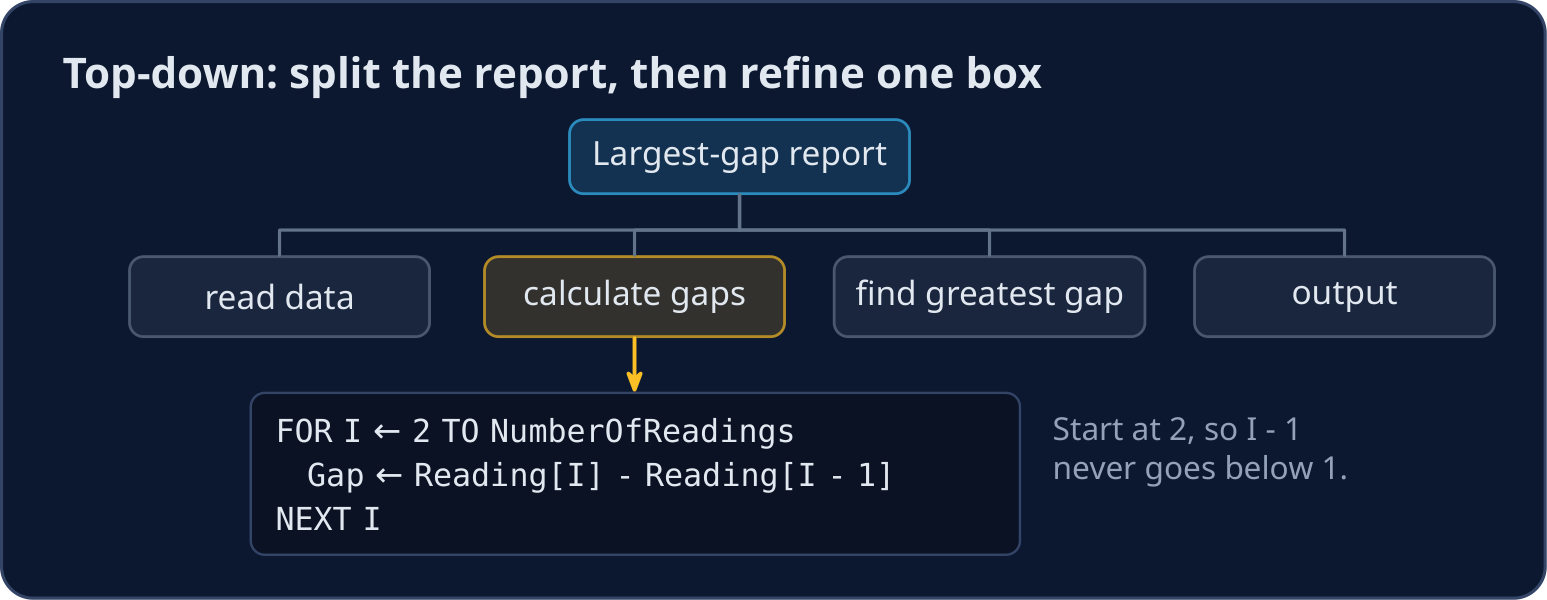
Translate a flow into control structures
A decision that returns to an earlier input step is repetition, not a single IF. Write the continuation condition carefully. Make an identifier table with each name, type and purpose before coding.
Common mistakes
- Starting the gap loop at 1.
Data[I - 1]then readsData[0], which is outside[1:6]: a runtime error. - Turning a back edge into an
IF. The input is checked only once, so a second bad value gets through. - A test plan with an input but no expected result. Without a prediction, the output cannot be judged.
- Refining every box into statements at once. Refine one step, check it, then refine the next.
Test with expected outcomes
A test plan must state input, reason and expected result. For largest adjacent gap, [2, 2] should produce 0; [-3, 5] should produce 8. Include the smallest permitted list and a maximum gap at the last pair. Compare the observed output with the prediction; merely running a program is not evidence of correctness.
On paper, draw a flowchart for the validation task and explain how its back edge becomes a loop. The structured checks below assess the algorithm and chosen values; your diagram and explanation need self-review or teacher review.
ความยาก 4/5 · 280 เหรียญ + บอนัสน้อยๆ เมื่อทำสำเร็จครั้งแรกในวันนี้
Translate this flow into pseudocode: 1 read Value; 2 if Value < 1 OR Value > 6, return to step 1; 3 output Value * 5; 4 stop.
คลิก Run เพื่อดูผลลัพธ์ที่นี่
ความยาก 4/5 · 280 เหรียญ + บอนัสน้อยๆ เมื่อทำสำเร็จครั้งแรกในวันนี้
Valid integers are 1 to 6. Choose one normal, one boundary and one invalid value, in that order, from: 3, 6, 7.
ความยาก 4/5 · 280 เหรียญ + บอนัสน้อยๆ เมื่อทำสำเร็จครั้งแรกในวันนี้
Read NumberOfReadings (2 to 6), then NumberOfReadings non-decreasing integer readings. Store them in an array. Output the largest gap between adjacent readings.
คลิก Run เพื่อดูผลลัพธ์ที่นี่
Explain your choice of data structure and loop. Identify one boundary case and predict its result. For a subroutine, explain what is returned or changed in the caller.
บันทึกสำหรับรอบนี้บนเบราว์เซอร์นี้ ทบทวนด้วยตนเองหรือร่วมกับครู; คำอธิบายเหล่านี้ไม่ถูกให้คะแนนอัตโนมัติ
ทบทวนคำอธิบายของคุณตามเกณฑ์เหล่านี้
- My types and data structure match the data and the question.
- I justified the loop and checked its first and last iterations.
- Initial values and rejected operations preserve the intended state.
- My test includes input, purpose and expected result.
- I distinguished returning a value from printing and changing caller state.