Hypersensitivity
Введено| English | Значение |
|---|---|
| type I hypersensitivity | type I hypersensitivity |
| anaphylaxis | anaphylaxis |
| immune complexes | immune complexes |
| delayed-type hypersensitivity | delayed-type hypersensitivity |
Two allergies, two clocks
- One student wheezes within minutes of eating peanut. Another gets an itchy rash under a new watch strap two days after first wearing it.
- Both are called allergy, but the machinery is different. Hypersensitivity comes in four types, and the time to the reaction names the type.
Type I: IgE and mast cells
- In type I hypersensitivity I型超敏反应, IgE made at an earlier exposure sits on mast cells. The allergen cross-links it, and histamine is released within minutes.
- Hay fever, allergic asthma and anaphylaxis 过敏性休克 (sudden, body-wide, life-threatening) are type I.
Why can a first-ever bee sting not cause type I anaphylaxis?
Сложность 1/5 · 100 монет + небольшой бонус за первое завершение сегодня
The first exposure sensitises by making IgE; a later exposure cross-links it.
Type II: antibody against a cell
- In type II, IgG or IgM binds a cell or tissue directly, and complement or phagocytes destroy it, within minutes to hours.
- Examples: a mismatched blood transfusion, haemolytic disease of the newborn, and drug-induced cytopenias, where a drug coats blood cells and antibody clears them.
Maternal IgG crosses the placenta and destroys the baby's red cells. Which type is this?
Сложность 1/5 · 100 монет + небольшой бонус за первое завершение сегодня
Antibody binding directly to a cell is type II.
Type III: immune complexes
- In type III, antibody and soluble antigen form immune complexes 免疫复合物 that lodge in vessel walls, kidneys and joints and trigger inflammation there.
- Examples: serum sickness, appearing about 1–2 weeks after a foreign protein, and the kidney disease of lupus.
A week after receiving a foreign protein, a patient has fever, rash, joint pain and protein in the urine. Which type is most likely?
Сложность 1/5 · 100 монет + небольшой бонус за первое завершение сегодня
Serum sickness is the classic immune-complex disease.
Type IV: delayed and T-cell driven
- Delayed-type hypersensitivity 迟发型超敏反应 (type IV) involves no antibody: T cells recruit and activate macrophages, which takes 48–72 hours.
- Examples: contact dermatitis from nickel and the tuberculin skin test.
Match each type to an example.
Сложность 2/5 · 140 монет + небольшой бонус за первое завершение сегодня
Mast cells, cell-bound antibody, complexes and T cells.
The clock names the mechanism
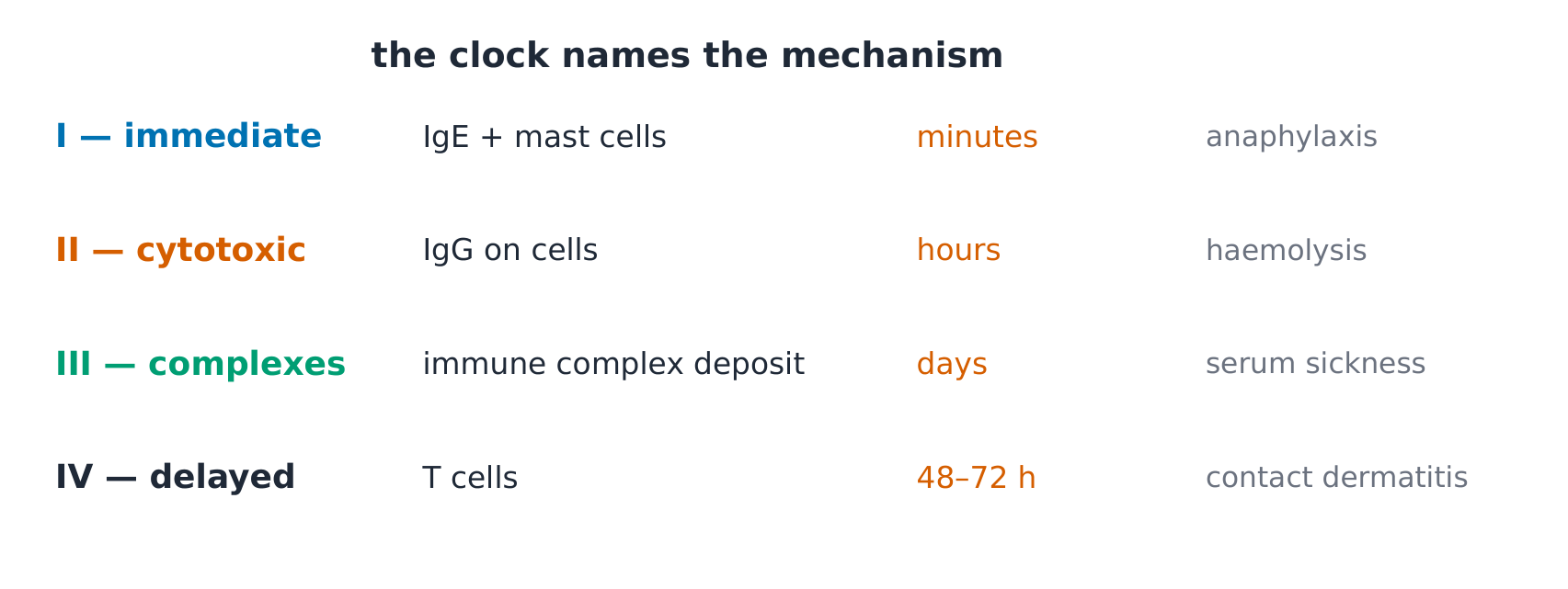
- Type I needs only antibody already sitting on mast cells: minutes. Type II needs antibody to reach the cell and recruit killers. Type III needs complexes to form and deposit. Type IV needs T cells to be recruited: 2–3 days.
- Each later type adds a step, and each step adds time.
Put the types in order from fastest to slowest typical onset.
Сложность 3/5 · 200 монет + небольшой бонус за первое завершение сегодня
Each later type adds a step between exposure and damage.
Worked example: the bee sting
- (Fictional) Eight minutes after a bee sting, a man has hives, wheeze and low blood pressure. He had a milder reaction to a sting last summer.
- That earlier sting made IgE; this sting cross-links it on mast cells. It is type I anaphylaxis, and intramuscular adrenaline is the first treatment. A first sting cannot cause it this way, because there is no IgE yet.
Worked example: the watch strap
- (Fictional) An itchy, eczema-like patch appears 2 days after wearing a cheap watch, exactly where the metal touched. Nickel binds skin proteins, and T cells respond: type IV.
- Patch tests are read at 48 and 72 hours or later because the mechanism needs that long. Antihistamines do little; steroid creams, which quiet T cells, help.
Antihistamines are the best treatment for nickel contact dermatitis.
Сложность 1/5 · 100 монет + небольшой бонус за первое завершение сегодня
It is type IV, with no histamine-first step; steroid creams quiet the T cells.
Which test investigates a suspected nickel allergy?
Сложность 1/5 · 100 монет + небольшой бонус за первое завершение сегодня
Type IV takes days; prick tests and IgE detect type I.
Three common slips
- "All allergy is type I." Contact dermatitis is type IV, so antihistamines are the wrong tool.
- Using a skin-prick test for a type IV reaction. Prick tests detect IgE (type I); patch tests detect type IV.
- Forgetting type II drug reactions. A drug on a blood cell can make the cell a target.
Recap
- I: IgE on mast cells, minutes. II: antibody against a cell, minutes to hours.
- III: immune complexes deposit, hours to weeks. IV: T cells and macrophages, 48–72 hours.
- The clock names the mechanism, and the mechanism names the test and the treatment.