Motion — speed, acceleration and graphs
Введено| English | Значение |
|---|---|
| speed/spiːd/ | скорость (модуль) |
| velocity/vəˈlɒsɪti/ | скорость |
| acceleration/əkˌseləˈreɪʃn/ | ускорение |
| deceleration/dɪˌseləˈreɪʃn/ | замедление |
| gradient/ˈɡreɪdɪənt/ | наклон |
| free fall/friː fɔːl/ | свободное падение |
| air resistance/eə rɪˈzɪstəns/ | сопротивление воздуха |
| terminal velocity/ˈtɜːmɪnl vəˈlɒsɪti/ | предельная скорость |
How fast, and speeding 速率 up?
- A cheetah sprints at about $30\ \text{m/s}$; a passenger jet cruises near $250\ \text{m/s}$.
- Motion is about two ideas: how fast something goes, and how its speed changes.
- We describe both with simple formulas — and read them straight off graphs.
Speed and velocity 速度
- Speed is the distance travelled each second:
- Average speed uses the whole journey: $\dfrac{\text{total distance}}{\text{total time}}$.
- Velocity is speed in a stated direction — so velocity is a vector, speed is a scalar.
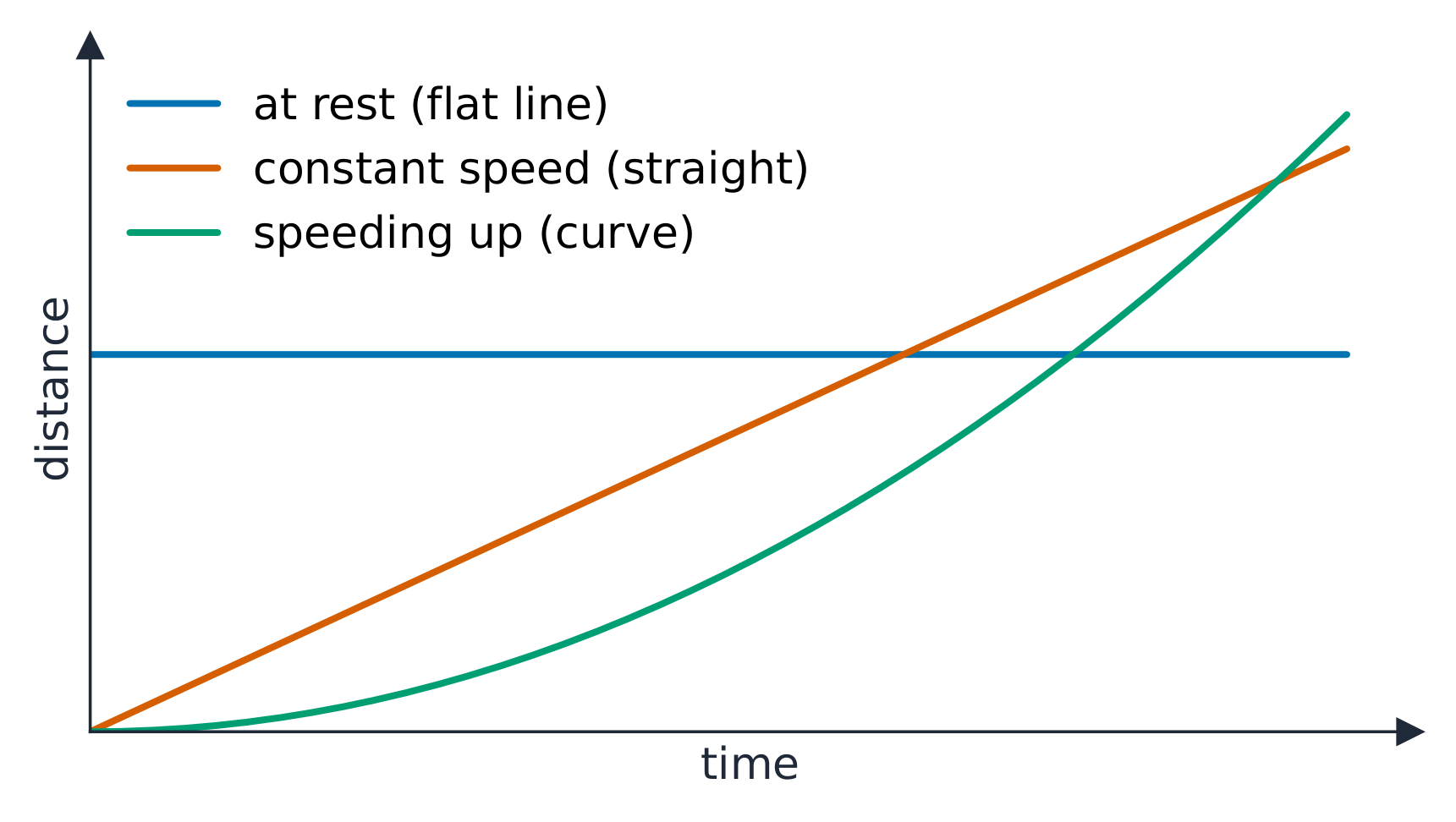
The shape of a distance-time line: flat = at rest, straight = constant speed, curve = speeding up
Speed, acceleration & graphs
v = u + at
On a speed–time graph the gradient is the acceleration and the площадь underneath is the distance travelled.
A runner covers $100\ \text{m}$ in $8.0\ \text{s}$. What is the average speed, in m/s?
Сложность 2/5 · 140 монет + небольшой бонус за первое выполнение сегодня
$v = \dfrac{s}{t} = \dfrac{100}{8.0} = 12.5\ \text{m/s}$.
Acceleration 加速度
- Acceleration is how much the velocity changes each second:
- $\Delta v$ means "the change in velocity".
- Slowing down is a deceleration 减速 — a negative acceleration.
A car speeds up from rest to $20\ \text{m/s}$ in $4.0\ \text{s}$. What is its acceleration, in m/s²?
Сложность 2/5 · 140 монет + небольшой бонус за первое выполнение сегодня
$a = \dfrac{\Delta v}{\Delta t} = \dfrac{20 - 0}{4.0} = 5.0\ \text{m/s}^2$.
Distance–time graphs
- A distance–time graph shows how far an object has gone.
- Flat line → the object is at rest.
- Straight slope → steady speed. The steeper the line, the faster it goes (the gradient 斜率 is the speed).
- Curve getting steeper → it is speeding up.
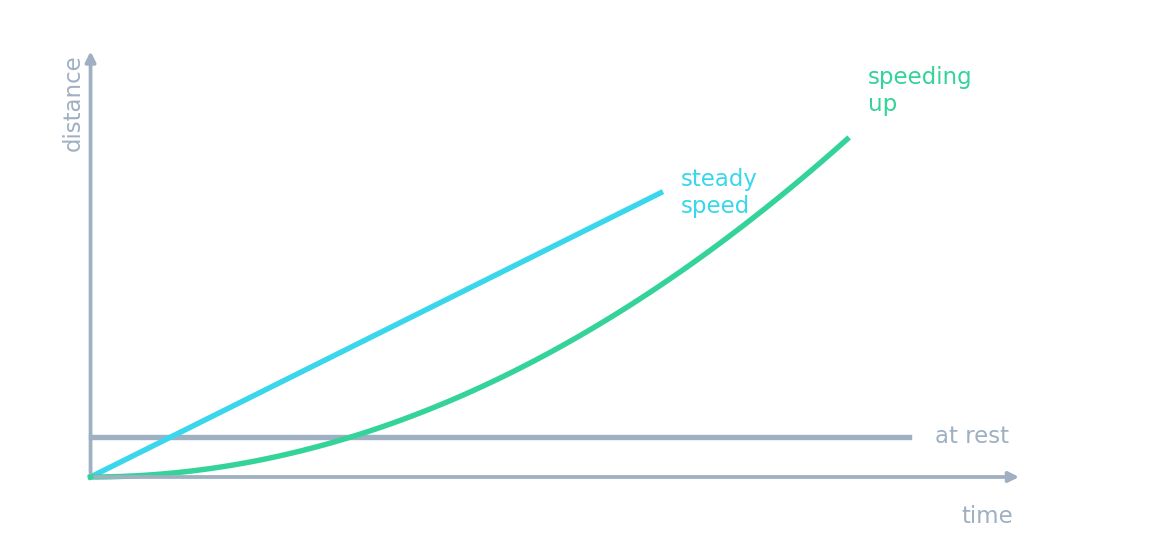
On a distance–time graph, a flat (horizontal) line means the object is:
Сложность 1/5 · 100 монет + небольшой бонус за первое выполнение сегодня
A flat distance–time line means the distance is not changing — the object is at rest.
Speed–time graphs
- A speed–time graph shows how fast an object is going.
- Flat line → constant speed.
- Straight slope → constant acceleration (the gradient is the acceleration).
- Area under the line → the distance travelled.
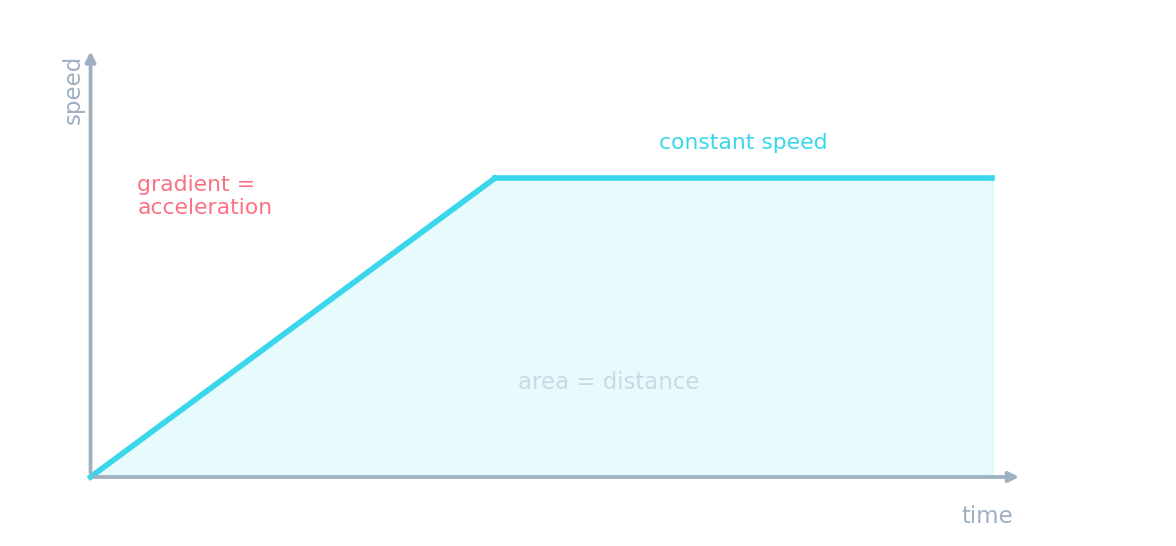
On a speed–time graph, the area under the line is the distance travelled.
Сложность 1/5 · 100 монет + небольшой бонус за первое выполнение сегодня
Speed × time = distance, and that is exactly the area under a speed–time line.
A car travels at a constant $10\ \text{m/s}$ for $6.0\ \text{s}$. From the speed–time graph (area), how far does it go, in m?
Сложность 2/5 · 140 монет + небольшой бонус за первое выполнение сегодня
The area is a rectangle: $10 \times 6.0 = 60\ \text{m}$.
Falling objects
- Near the Earth, all objects speed up as they fall at the same rate: the acceleration of free fall 自由落体, $g \approx 9.8\ \text{m/s}^2$.
- Falling through air, air resistance 空气阻力 pushes up and grows as the object speeds up.
- When air resistance equals the weight, the resultant force is zero — the object stops speeding up and falls at a steady terminal velocity 收尾速度.
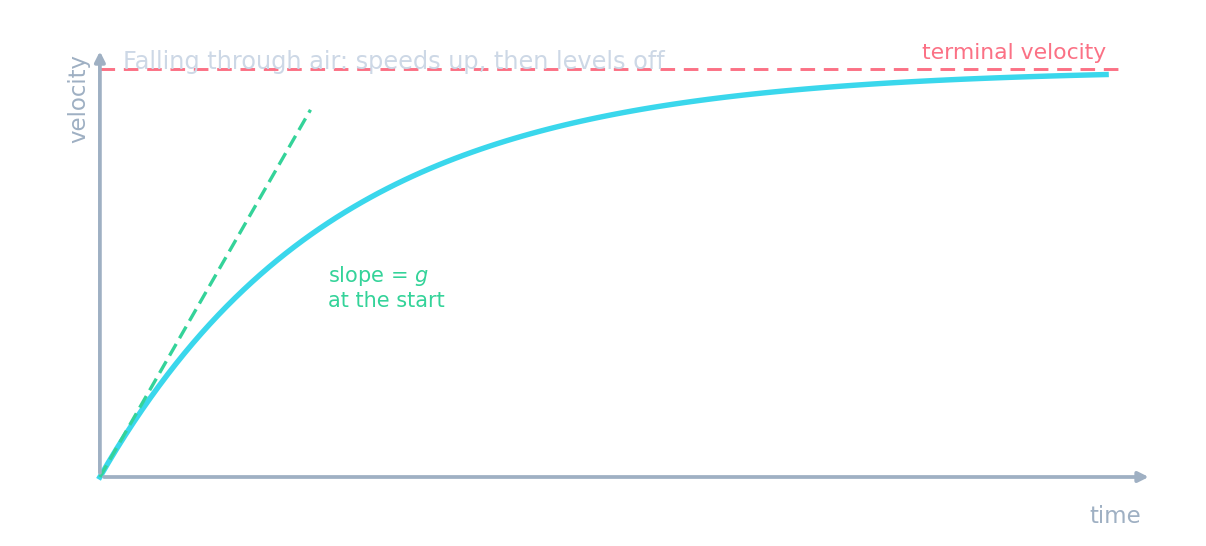
A skydiver reaches terminal velocity. This happens because:
Сложность 1/5 · 100 монет + небольшой бонус за первое выполнение сегодня
As speed rises, air resistance grows until it balances the weight. The resultant force is then zero, so the speed stays steady.
Worked examples
1. A car speeds up from $5.0\ \text{m/s}$ to $25\ \text{m/s}$ in $4.0\ \text{s}$. Find its acceleration. $a = \dfrac{\Delta v}{\Delta t} = \dfrac{25 - 5.0}{4.0} = 5.0\ \text{m/s}^2$.
2. How far does it travel in those $4.0\ \text{s}$? The area under the speed–time graph is a trapezium: $\dfrac{5.0 + 25}{2} \times 4.0 = 60\ \text{m}$.
Velocity changes from 4 to 16 metres per second in 8 s at constant acceleration. What are the acceleration and the displacement?
The change in velocity is 12 metres per second. Average velocity 10 times 8 s is 80 metres.
What is the acceleration?
Сложность 1/5 · 100 монет + небольшой бонус за первое выполнение сегодня
12 divided by 8 is 1.5 metres per second squared.
You've got it
- speed $v = \dfrac{s}{t}$; velocity is speed with a direction
- acceleration $a = \dfrac{\Delta v}{\Delta t}$; slowing down is negative
- distance–time: gradient = speed · speed–time: gradient = acceleration, area = distance
- free fall: $g \approx 9.8\ \text{m/s}^2$; terminal velocity when air resistance = weight
Write from an acceleration of 1.5 metres per second squared
- Velocity changes from 4 to 16 metres per second in 8 s, with constant acceleration.
- Find the acceleration and the displacement.