Ваш учебный план · Продолжить · Обзор →
所 + Verb + 的 (that which is V-ed)
ВведеноВаше сохранённое положение остаётся в этом браузере. Возобновление не завершает урок и не отвечает на его вопросы.
What you said
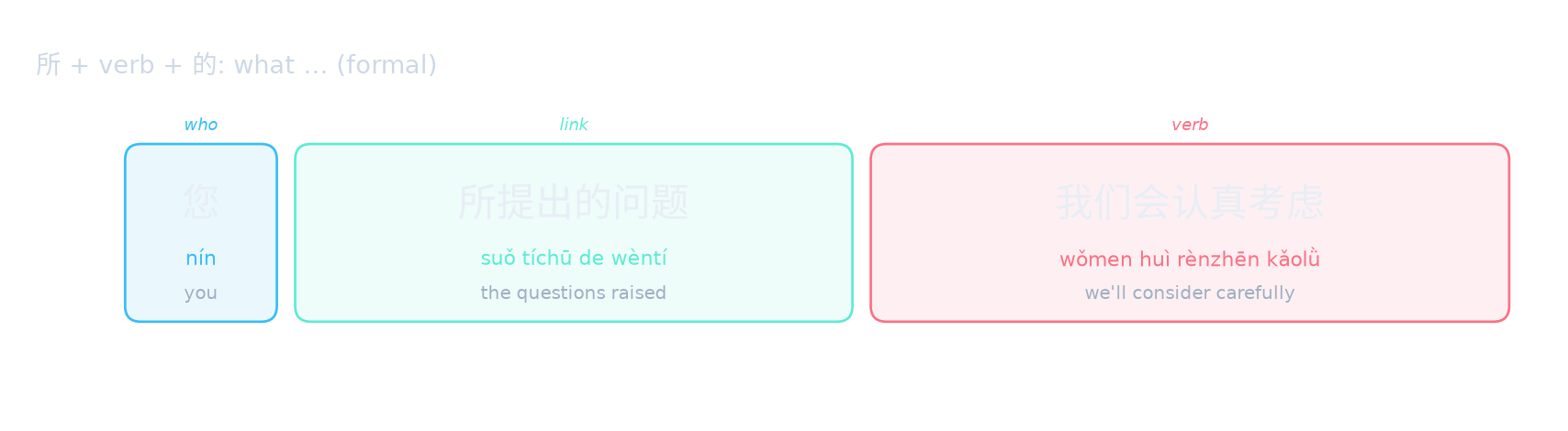
- In a formal letter you respond to a complaint point by point.
- you (polite)您(that which)所to raise (an issue)提出(modifier / structural particle)的question / problem问题,we / us我们can / will会conscientious认真to think over考虑。 — "We will carefully consider the issues you have raised."
- Goal: turn a verb into "what is done" with (subject +) (that which)所 + verb + (modifier / structural particle)的.
(Subject +) (that which)所 + verb + (modifier / structural particle)的 (+ noun) = that which … V
- (that which)所 + verb + (modifier / structural particle)的 marks the object of the verb: I我(that which)所know知道(modifier / structural particle)的 (what I know), he / him他(that which)所to speak说(的) + words; or "if"的话 (the words he said).
- (that which)所 is formal; the meaning is the same without it: he / him他to speak说(的) + words; or "if"的话.
this这is exactly就是I我(that which)所know知道的。
Complete (formal): “the words he said” 他____说的话
Сложность 1/5 · 100 монет + небольшой бонус за первое завершение сегодня
Subject + 所 + verb + 的.
Formal writing
- we / us我们(that which)所to do; to make做(modifier / structural particle)的everything一切all / both都is是in order to为了child孩子。 — "Everything we do is for the children."
- just as正如everyone大家(that which)所has seen看到(modifier / structural particle)的,the situation情况already已经has improved好转。 — "As everyone can see, the situation has improved."
just as正如everyone大家(that which)所has seen看到的,the situation情况has improved好转了。
Build: “Everything we do is for the children.”
Сложность 3/5 · 200 монет + небольшой бонус за первое завершение сегодня
所 + verb + 的 + noun.
(that which)所 goes right before the verb
- Order: subject + (that which)所 + verb + (modifier / structural particle)的: he / him他(that which)所to speak说(modifier / structural particle)的, not (that which)所he / him他to speak说(modifier / structural particle)的.
- It needs a transitive verb (one with an object): (that which)所to speak说, (that which)所to do; to make做, (that which)所has seen看到; not (that which)所to go去 / (that which)所to come来.
- Build it step by step: he / him他to raise (an issue)提出question / problem问题 → he / him他(that which)所to raise (an issue)提出(modifier / structural particle)的question / problem问题 — "the question he raised".
Which order is correct?
Сложность 1/5 · 100 монет + небольшой бонус за первое завершение сегодня
所 stands before the verb in the pattern subject + 所 + verb + 的: 我所知道的 “what I know”. It never comes before the subject or after the verb.
(that which)所 versus plain (modifier / structural particle)的
- he / him他to speak说(的) + words; or "if"的话 (everyday) = he / him他(that which)所to speak说(的) + words; or "if"的话 (formal).
- (that which)所 adds weight and precision; it is common in speeches, reports and set phrases (as everyone knows众所周知).
as everyone knows众所周知,the Earth地球is是round圆的。
众所周知 means “as everyone knows”.
Сложность 1/5 · 100 монет + небольшой бонус за первое завершение сегодня
True. 众所周知 is a set phrase with 所 meaning “as is well known to all”.
Recap
- Subject + (that which)所 + verb + (modifier / structural particle)的 (+ noun) = that which … (formal; (that which)所 marks the object).
- Subject before (that which)所; transitive verbs; as everyone knows众所周知 = as everyone knows.
Read the full reference: HSK 6 grammar — Sentence patterns.
In a formal letter you respond to a complaint point by point. Close the examples. Say a Mandarin response, then write it in Chinese. Explain briefly in English what the lesson’s pattern adds. Compare with the model, then change one detail and try again.
This is supported productive practice. Compare meaning and structure; your answer need not copy the model. A partner or teacher must hear the spoken response to comment on pronunciation.