Ваш учебный план · Продолжить · Обзор →
谅 (I bet / I'll wager …)
ВведеноВаше сохранённое положение остаётся в этом браузере. Возобновление не завершает урок и не отвечает на его вопросы.
 2:44
HSK 6 Грамматика 8: 谅 + Subject + Verb Phrase
谅 followed by Subject followed by Verb Phrase. Разговорное 谅 вводит лёгкое, уверенное предположение или вызов. В обычном английском эквивалентно «я ставлю на это», «я уверен, что ты не стал бы», или «я…
Английские объяснения + примеры на мандаринском · субтитры следуют за звучащим текстом
In this lesson
I bet he won't dare
- Your friend boasts he'll jump into the freezing lake. You doubt it.
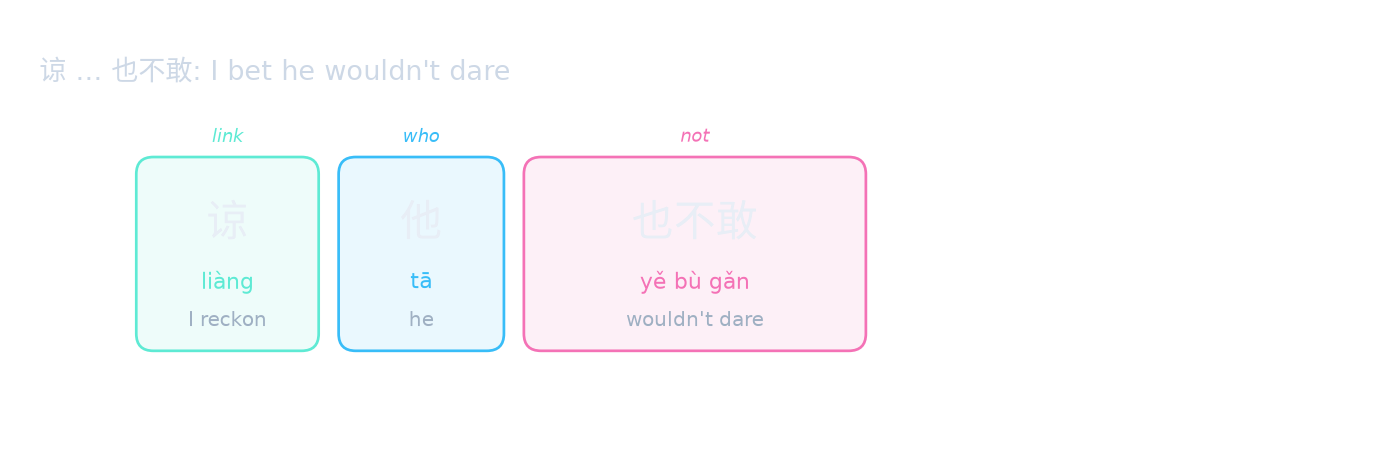
- I bet谅he他(even)也不敢。 — "I bet he wouldn't dare."
- Goal: make a confident guess about what someone won't dare do with I bet谅 + subject + (even)也不敢.
I bet谅 + person + (even)也 / not不 … = I'm sure, I bet
- I bet谅 (liàng) expresses a confident, often dismissive guess about what someone can or will do, usually negative: I bet谅he他不敢, I bet谅you你(even)也to do; to make做not reach / less than不到 — "I bet you can't do it either."
- It is literary and old-fashioned but still heard in set phrases.
I bet谅you你(even)也can't do it做不到。
Complete: “I bet he wouldn't dare.” ____他也不敢。
Сложность 1/5 · 100 монет + небольшой бонус за первое завершение сегодня
谅 + person + 不 / 也….
Confident predictions
- it天so这么late晚(completed / change)了,I bet谅he他won't不会come来(completed / change)了。 — "It's this late; I'm sure he won't come now."
- I bet谅he他一个person人(even)也to move搬not move不动。 — "I'll wager he can't move it on his own."
it天so这么late晚了,I'm sure谅he他won't不会come来了。
Build: “It's so late; I'm sure he won't come.”
Сложность 3/5 · 200 монет + небольшой бонус за первое завершение сегодня
Situation, then 谅 + person + negative.
Mostly negative, literary
- I bet谅 usually predicts what someone can't or won't do; positive uses are rare.
- In modern speech, me我to look / to think看 / me我to guess猜 / definitely; to be sure肯定 are more natural: me我to look / to think看he他不敢 — "I don't think he dares."
Which is the modern spoken equivalent of 谅他不敢?
Сложность 1/5 · 100 монет + небольшой бонус за первое завершение сегодня
我看… is the everyday guess.
I bet谅 the verb: forgive
- I bet谅 also appears in forgive原谅 (forgive) and understanding; to forgive谅解 (understand, make allowance): please请forgive原谅me我.
- Do not confuse the guess I bet谅 with these verbs.
please请forgive原谅me我。
In 请原谅我, 谅 means “I bet”.
Сложность 1/5 · 100 монет + небольшой бонус за первое завершение сегодня
False. In 原谅 谅 is part of the verb “forgive”. The sense “I expect, surely” appears only in written patterns like 谅他不敢.
Recap
- I bet谅 + person + (even)也 / not不 … = I bet / I'm sure (a confident, often dismissive negative guess).
- Literary; modern me我to look / to think看…; forgive原谅 = forgive.
Read the full reference: HSK 6 grammar — Verbs.
Your friend boasts he'll jump into the freezing lake. You doubt it. Close the examples. Say a Mandarin response, then write it in Chinese. Explain briefly in English what the lesson’s pattern adds. Compare with the model, then change one detail and try again.
This is supported productive practice. Compare meaning and structure; your answer need not copy the model. A partner or teacher must hear the spoken response to comment on pronunciation.