Ваш учебный план · Продолжить · Обзор →
给 (colloquial passive)
ВведеноВаше сохранённое положение остаётся в этом браузере. Возобновление не завершает урок и не отвечает на его вопросы.
 5:48
HSK 5 Грамматика 8: Предлоги
(自)从, 为, 对 而言, 包括 在内, 凭 , 1 или 2. (自)从; С какого-то момента; 自从毕业以来,我一直在北京。 : С момента окончания учебы я живу в Пекине. 为 + лицо; Ради кого-то…
Английские объяснения + примеры на мандаринском · субтитры следуют за звучащим текстом
В этом уроке
Who broke the cup?
- You come into the kitchen and see pieces on the floor: the cup杯子(passive)给break打破(completed / change)了! — "The cup's been broken!"
- Goal: use (passive)给 in spoken passive sentences (thing + (passive)给 + (person) + verb + result), and compare it with (passive: by)被 and (把: marks the object)把.
Thing + (passive)给 + (person) + verb + result
- Affected thing + (passive)给 + (doer) + verb + result / (completed / change)了: like (passive: by)被, but more casual and spoken.
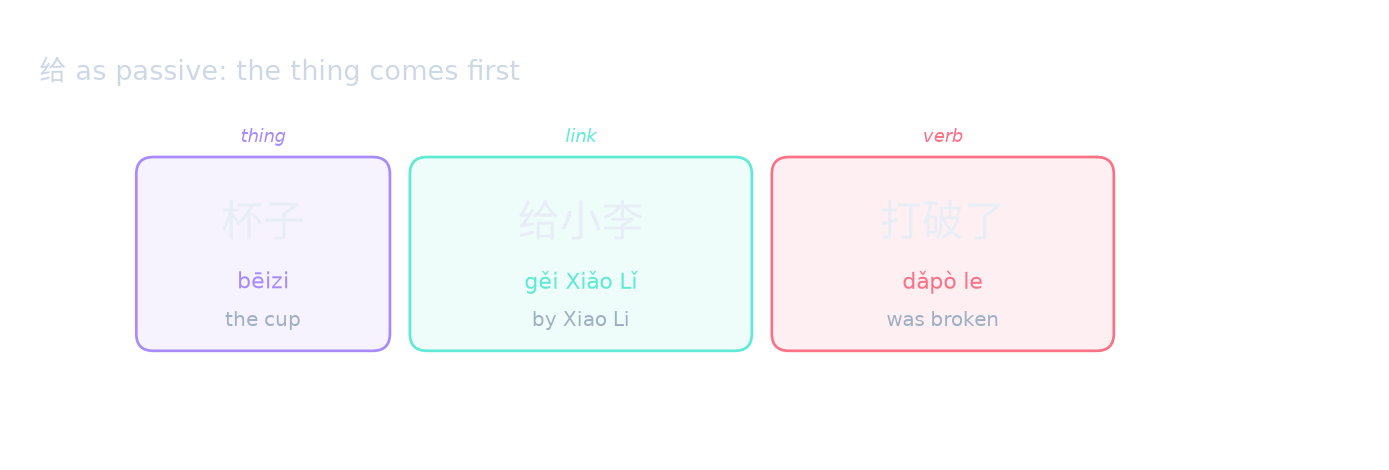
- With the doer: the cup杯子(passive)给small / Xiao (before a name)小Li (surname) / plum李break打破(completed / change)了。 — "The cup was broken by Xiao Li." Without: I / me我(modifier / structural particle)的bicycle自行车(passive)给to steal偷(completed / change)了。 — "My bike got stolen."
the cup杯子(passive)给Xiao Li小李break打破了。
Spoken: “My phone got taken by my little brother.” 我的手机____弟弟拿走了。
Сложность 1/5 · 100 монет + небольшой бонус за первое завершение сегодня
Thing + 给 / 被 + doer + verb + result.
Build: “The cup was broken by Xiao Li.”
Сложность 3/5 · 200 монет + небольшой бонус за первое завершение сегодня
Thing + 给 + doer + verb + 了.
Three ways to say it
- Active: Xiao Li小李break打破(completed / change)了the cup杯子。 — "Xiao Li broke the cup."
- (把: marks the object)把: small / Xiao (before a name)小Li (surname) / plum李(把: marks the object)把the cup杯子break打破(completed / change)了。 (what Xiao Li did to the cup) · (passive: by)被 / (passive)给: the cup杯子(passive: by)被 / (passive)给small / Xiao (before a name)小Li (surname) / plum李break打破(completed / change)了。 (what happened to the cup).
Match each sentence to what it starts with.
Сложность 2/5 · 140 монет + небольшой бонус за первое завершение сегодня
把 starts with the doer; passive 给 with the thing affected.
(passive: by)被 … (passive)给 + verb
- In speech, (passive)给 is often added before the verb in a (passive: by)被 sentence for emphasis: purse钱包(passive: by)被thief小偷(passive)给偷走(completed / change)了。 — "My wallet was stolen by a thief."
Don't confuse it with (passive)给 = "to / for"
- I / me我(passive)给he / him他to make a telephone call打电话。 — "I'm calling him." (person + (passive)给 + receiver: "for, to").
- the cup杯子(passive)给break打破(completed / change)了。 (thing + (passive)给 + verb: passive). The verb needs a result or (completed / change)了: ✗ the cup杯子(passive)给to hit / play / make (a call)打.
In which sentence is 给 passive?
Сложность 1/5 · 100 монет + небольшой бонус за первое завершение сегодня
The homework (the thing) comes first and is affected by the dog.
Which sentence is complete?
Сложность 1/5 · 100 монет + небольшой бонус за первое завершение сегодня
The verb needs a result or 了.
Recap
- Thing + (passive)给 + (doer) + verb + result = spoken passive (= (passive: by)被, more casual).
- (把: marks the object)把 starts with the doer; (passive: by)被 / (passive)给 start with the thing affected.
Read the full reference: HSK 5 grammar — Prepositions.
Tell a friend about two small accidents at home this week, using passive 给.
Your answer need not copy the model. A partner or teacher must hear the spoken response to comment on pronunciation.