Ваш учебный план · Продолжить · Обзор →
Вопросительные слова как «какой-то / какой-либо»
ВведеноВаше сохранённое положение остаётся в этом браузере. Возобновление не завершает урок и не отвечает на его вопросы.
 4:00
HSK 3 Грамматика 6: Синтаксические конструкции (把 & 被)
Эта тема начинается с двух известных конструкций. 把 обозначает действие с конкретным объектом; 被 сообщает, что с ним произошло. Обе конструкции требуют большего, чем один глагол. Затем мы…
Английские объяснения + примеры на мандаринском · субтитры следуют за звучащим текстом
В этом уроке
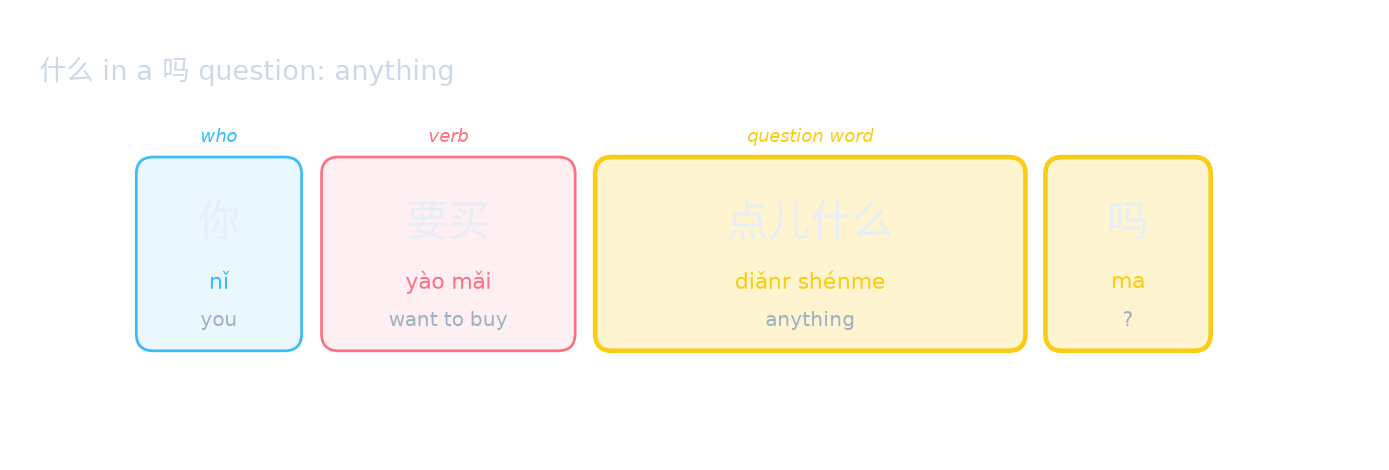
Do you want anything?
- Your friend is going to the shop and offers to bring something back for you.
- you你want / will / need要买点儿anything什么(yes/no ?)吗? Nǐ yào mǎi diǎnr shénme ma? — "Do you want to buy anything?" Here anything什么 means "anything", not "what".
- Goal: read and use anything什么, who谁 and where哪儿 as "something / anything / anyone / anywhere", and tell this apart from a real question.
Question word + (yes/no ?)吗 = something / anything
- In a (yes/no ?)吗 question, a question word becomes indefinite: anything什么 = anything, who谁 = anyone, where哪儿 = anywhere.
- you你to go去where哪儿(completed / change)了(yes/no ?)吗? — "Did you go anywhere?" (compare you你to go去where哪儿(completed / change)了? — "Where did you go?")
you你want想eat吃anything什么吗?
What does 你周末去哪儿了吗? mean?
Сложность 1/5 · 100 монет + небольшой бонус за первое завершение сегодня
With 吗, 哪儿 becomes “anywhere”.
Build: “Do you want to eat anything?”
Сложность 3/5 · 200 монет + небольшой бонус за первое завершение сегодня
QW + 吗 = anything?
In negatives and guesses
- I我not want to不想eat吃anything什么。 — "I don't really want to eat anything."
- With seems好像 or maybe / possible可能: he他seems好像have有anything什么matter事。 — "He seems to have something on his mind."
he他seems好像have有something什么matter事。
Complete: “Did anyone call me?” 有____给我打电话吗?
Сложность 1/5 · 100 монет + небольшой бонус за первое завершение сегодня
In a 吗 question, 谁 = anyone (有人 also works).
(yes/no ?)吗 changes the meaning
- you你to buy买anything什么? asks "What are you buying?"; you你to buy买anything什么(yes/no ?)吗? asks "Are you buying anything?"
- not不 + Verb + anything什么 is a mild "not much / nothing in particular", weaker than anything什么(at all)都not不.
Versus QW + (at all)都
- I我anything什么(at all)都not want to不想eat吃 = "I don't want to eat anything at all" (total).
- I我not want to不想eat吃anything什么 = "I don't feel like eating anything in particular" (softer).
I我anything什么(at all)都not不want想eat吃。
我不想吃什么 is stronger than 我什么都不想吃.
Сложность 1/5 · 100 монет + небольшой бонус за первое завершение сегодня
什么都不 is the total negative; 不…什么 is softer.
One anything什么, four meanings
| Sentence | Meaning |
|---|---|
| you你want想eat吃anything什么? | What do you want to eat? (a real question) |
| you你want想eat吃anything什么(yes/no ?)吗? | Do you want to eat anything? (yes / no) |
| I我anything什么(at all)都want想eat吃。 | I want to eat everything. |
| I我not want to不想eat吃anything什么。 | I don't really want to eat anything. (soft) |
- Look at the end and the middle: (yes/no ?)吗 turns it into a yes / no question; (at all)都 turns it into every- / no-.
Match each sentence to its meaning.
Сложность 2/5 · 140 монет + небольшой бонус за первое завершение сегодня
吗 makes a yes / no question; 都 makes every- or (with 不) no-.
Recap
- In (yes/no ?)吗 questions, negatives and guesses, a QW = some-/any-: anything什么 = anything, who谁 = anyone.
- not不 + V + anything什么 is soft; anything什么(at all)都not不 is total.
Read the full reference: HSK 3 grammar — Basic sentence patterns.
Your friend is going to the shop and offers to bring something back for you. Close the examples. Say a Mandarin response, then write it in Chinese. Explain briefly in English what the lesson’s pattern adds. Compare with the model, then change one detail and try again.
This is supported productive practice. Compare meaning and structure; your answer need not copy the model. A partner or teacher must hear the spoken response to comment on pronunciation.
Что пошло не так? Это увидит только команда сайта.