Ваш учебный план · Продолжить · Обзор →
Задайте вопрос, требующий ответа «да» или «нет»
ВведеноВаше сохранённое положение остаётся в этом браузере. Возобновление не завершает урок и не отвечает на его вопросы.
You want to check
-
you你to be / is是student学生。 — You are a student. is a statement. you你to be / is是student学生(yes/no ?)吗? — Are you a student? checks it.
-
Add (yes/no ?)吗 ma at the end. The words before it keep their order.
-
Before you start: Recall to be / is是 and is not / no不是 from identity statements, and the information question from asking a name.
A card says 我不是老师。What identity does the speaker deny?
Сложность 1/5 · 100 монет + небольшой бонус за первое завершение сегодня
不是老师 denies being a teacher. It does not give a name or necessarily establish that the speaker is a student. Revisit the identity lesson if the negative is unclear.
Keep (yes/no ?)吗 light
- (yes/no ?)吗 has a neutral tone: short and unstressed. It does not have one fixed flat pitch; the surrounding speech affects its pitch.
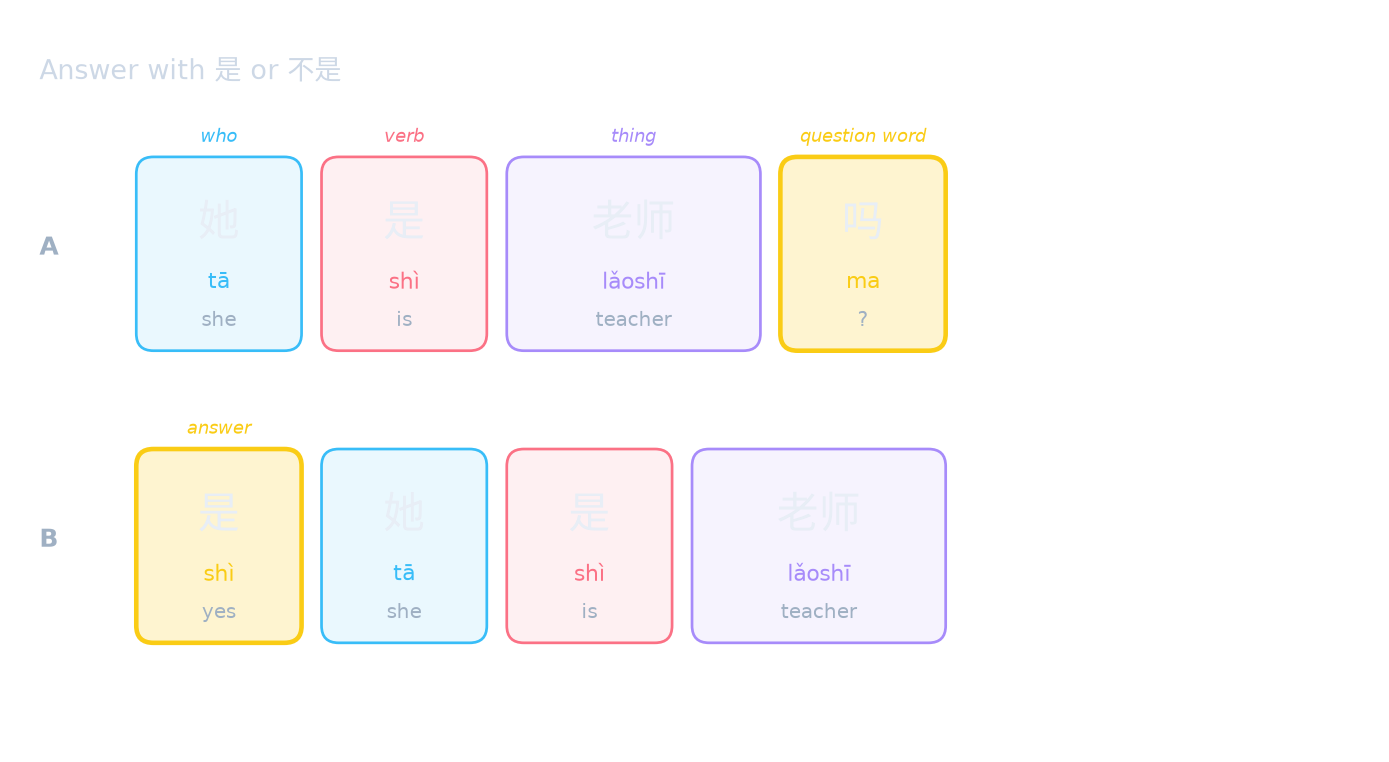
- Try another identity: she / her她to be / is是teacher老师(yes/no ?)吗? Tā shì lǎoshī ma? — Is she a teacher?
Complete “Are you a student?”: 你是学生____?
Сложность 1/5 · 100 монет + небольшой бонус за первое завершение сегодня
The final 吗 turns this statement into a question.
Answer the identity question
- For you你to be / is是student学生(yes/no ?)吗?, confirm with to be / is是,I / me我to be / is是student学生。 or deny with is not / no不是,I / me我to be / is是teacher老师。
- These replies use to be / is是 because the question uses to be / is是. Other verbs have other natural replies; to be / is是 is not a universal Chinese “yes”.
A: she / her她to be / is是teacher老师(yes/no ?)吗? B: to be / is是,she / her她to be / is是teacher老师。 — Is she a teacher? Yes, she is.
Work through a decision: Start with you你to be / is是student学生。To check that same identity, keep the word order and add (yes/no ?)吗:you你to be / is是student学生(yes/no ?)吗?A fictional teacher denies the proposed identity with is not / no不是 and can correct it with I / me我to be / is是teacher老师。Question formation and truthful reply are separate decisions.
Compare a near miss: you你to call / be called / (animals) cry, bark叫what什么name名字? already asks for missing information. Adding (yes/no ?)吗 would change the ordinary name-question pattern being practised. Also, to be / is是,I / me我to be / is是student学生 cannot fit a teacher role merely because it repeats the words in the question.
A teacher is asked 你是学生吗? Choose the truthful reply.
Сложность 1/5 · 100 монет + небольшой бонус за первое завершение сегодня
不是 denies being a student; 我是老师 states the teacher’s identity.
Match each question.
Сложность 2/5 · 140 монет + небольшой бонус за первое завершение сегодня
Identity questions check a claim; the name question requests information.
A fictional teacher hears 你是学生吗? Choose the reply that fits the role card.
Сложность 1/5 · 100 монет + небольшой бонус за первое завершение сегодня
The proposed identity 学生 is false for this role, so 不是 denies it; 我是老师 supplies the correction. The third reply denies the actual role instead. Match both parts to the card.
Recognise asking and telling
- Play and listen for the final ma.
- You can ask simple identity questions by adding (yes/no ?)吗. For the name question you你to call / be called / (animals) cry, bark叫what什么name名字?, do not add (yes/no ?)吗: you are asking for information.
This is the ordinary beginner distinction between an information question and a yes/no question. Later you may meet question words used in other ways; avoid treating this shortcut as a rule about every Chinese sentence.
What is the speaker doing?
Сложность 1/5 · 100 монет + небольшой бонус за первое завершение сегодня
The final 吗 asks a yes/no question about his identity.
The ordinary way to ask a name is 你叫什么名字吗?
Сложность 1/5 · 100 монет + небольшой бонус за первое завершение сегодня
Ask 你叫什么名字? without 吗 when you want the name.
A:你是老师吗? B:不是,我是学生。Which account fits the new exchange?
Сложность 1/5 · 100 монет + небольшой бонус за первое завершение сегодня
The final 吗 makes A’s line a check of an identity. B’s 不是 denies that proposed identity, and 我是学生 corrects it. This is neither a statement of fact nor a request for a name.
Ask and answer
- Ask a partner you你to be / is是student学生(yes/no ?)吗? Then answer their question truthfully, or use fictional roles. Alone, listen to the question and reply before reading a model.
- Revisit the name question too: one asks for a name, the other checks an identity.
Statement + (yes/no ?)吗 makes a simple yes/no question. For identity questions, to be / is是 confirms and is not / no不是 denies.
Later recall: Tomorrow, turn two identity statements into questions and answer from new fictional role cards. A few days later, mix a name request with an identity check and explain why only the latter uses final (yes/no ?)吗 here. Revisit “Recognise asking and telling” if the question types get mixed.
Next: decline an invitation.
Build “Are you a student?”
Сложность 3/5 · 200 монет + небольшой бонус за первое завершение сегодня
The question is 你是学生吗?; the order before 吗 stays unchanged.
Write a new Mandarin identity statement about a fictional person, turn it into a 吗 question and give a fitting answer. Then change the person’s role so that the first answer would be false, and revise the reply. Say the question and both replies aloud.
Compare and revise your own wording. Written self-review does not assess pronunciation or conversation quality.